
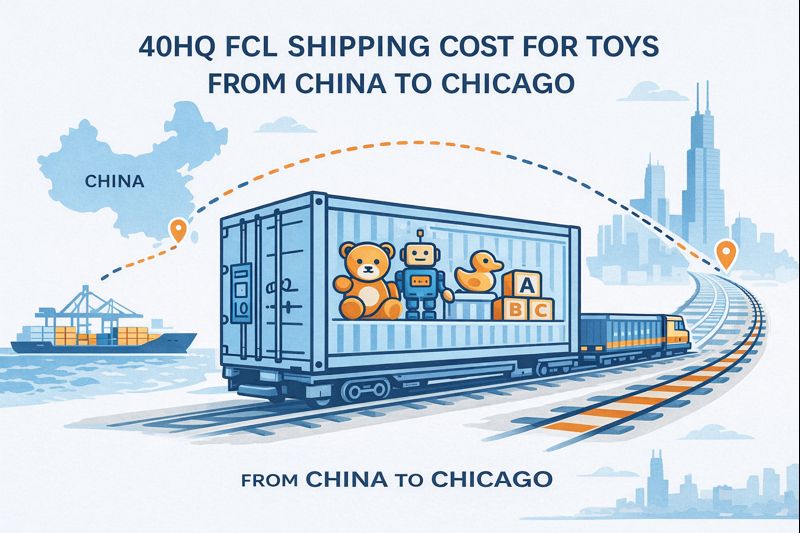
As U.S. toy demand continues to grow, the 40HQ FCL shipping cost for toys from China to Chicago has become a critical planning factor for importers balancing margin pressure and delivery schedules. However, because Chicago is an inland hub rather than a coastal port, total cost often extends beyond ocean freight alone. Therefore, this guide explains how pricing is structured, what drives cost changes, and how importers can plan shipments more predictably with support from partners such as Top China Freight.
Why is 40HQ FCL commonly used for toy shipments?
Toys are typically lightweight but voluminous, which makes container utilization a key cost driver. A 40HQ container provides extra cubic capacity compared with a standard 40GP, allowing importers to maximize carton loading without exceeding weight limits.
Moreover, toys often ship in seasonal waves tied to retail calendars. As a result, FCL shipments reduce handling risk and protect packaging quality better than consolidation. Consequently, while 40HQ FCL costs more per container, it usually delivers lower unit cost per toy.

What factors shape the 40HQ FCL shipping cost?
The shipping cost from China to Chicago is built from several interconnected components rather than a single flat rate. Therefore, understanding each element helps importers assess quotations accurately.
Ocean freight rates from China
Base ocean freight depends on origin port, carrier selection, and market conditions. Ports such as Shenzhen, Ningbo, and Shanghai often show different pricing due to vessel availability and routing patterns.
Inland rail or truck delivery to Chicago
Because Chicago is inland, containers typically move by rail from West Coast or Gulf ports. This inland leg represents a significant share of total cost and fluctuates with rail capacity and fuel prices.
Seasonal demand and equipment availability
During peak toy seasons, especially ahead of Q4 retail demand, container shortages and higher freight rates are common. Therefore, timing plays a decisive role in cost control.
Can shipping costs be optimized without changing volume?
Even when shipment size remains constant, cost optimization remains possible. Importers often reduce total spend through better routing and scheduling.
Effective strategies include:
- Choosing less congested ports when feasible
- Aligning production timelines with off-peak shipping windows
- Working with experienced sea freight services to secure stable carrier allocations
Because freight rates remain volatile, proactive planning consistently outperforms last-minute booking.
How do customs and compliance influence shipping cost?
Although customs duties do not alter ocean freight rates directly, clearance delays can increase demurrage and storage charges. Toys entering the U.S. must comply with CPSIA regulations, labeling rules, and safety documentation.
Therefore, accurate HS codes and compliant paperwork help avoid inspections that slow container release. Many importers integrate clearance planning with professional customs brokerage services to reduce downstream cost risks.
Case Studies
Plastic Toy Shipment to Chicago
Origin: Yiwu, China
Destination: Chicago, USA
Cargo: Plastic educational toys, 40HQ FCL
Cargo Value: USD 180,000
Transit Time: 31 days
Total Freight Cost: USD 7,200
Although a West Coast port showed higher base ocean freight, faster rail transfer reduced overall inland costs. As a result, total landed cost was lower than alternative East Coast routing.
Mixed Toy Shipment for Midwest Retailer
Origin: Ningbo, China
Destination: Chicago, USA
Cargo: Mixed plastic and plush toys, 40HQ FCL
Cargo Value: USD 240,000
Transit Time: 34 days
Total Freight Cost: USD 8,100
By shifting from an East Coast route to a West Coast–rail solution, the importer reduced inland delays and avoided peak-season surcharges. Consequently, the final landed cost decreased despite slightly higher base ocean freight.
40HQ FCL vs alternative shipping methods
Although 40HQ FCL remains the dominant option for toy imports, alternatives occasionally support specific scenarios.
| Shipping Method | Cost Level | Transit Time | Best Use Case |
|---|---|---|---|
| 40HQ FCL Sea Freight | Medium | 28–38 days | High-volume toy imports |
| LCL Consolidation | Low–Medium | 35–45 days | Small or test shipments |
| Air Freight | High | 5–7 days | Urgent or promotional items |
While air freight ensures speed, its cost structure limits use to exceptional cases. As a result, most toy importers rely on FCL as the backbone of their supply chain.

How do inland rail and last-mile delivery shape total cost?
Because Chicago sits far from U.S. coastal gateways, inland transport becomes a decisive factor in the 40HQ FCL shipping cost for toys from China to Chicago. While ocean freight often draws the most attention, rail and final delivery frequently represent 25–40% of total logistics spend.
In practice, containers arriving at West Coast ports usually move by intermodal rail to Chicago ramps, followed by short-haul trucking. Therefore, rail congestion, chassis availability, and terminal dwell time can all influence final cost. When these variables remain unmanaged, even a competitively priced ocean rate may lose its advantage.
Should importers route via West Coast or East Coast ports?
Choosing between West Coast and East Coast gateways requires a balance between time and cost. Although West Coast routes generally offer shorter sailing times, they sometimes face heavier congestion during peak seasons.
Key considerations include:
- West Coast routes often deliver faster rail connections to Chicago
- East Coast routes may offer lower ocean rates during certain market cycles
- Canal delays or weather disruptions can shift cost efficiency
Consequently, importers benefit from evaluating both options rather than locking into a single routing strategy year-round.
Conclusion
The 40HQ FCL shipping cost for toys from China to Chicago depends on far more than ocean freight alone. By understanding inland rail dynamics, seasonal risks, and product-specific factors, importers gain clearer cost visibility and stronger control. Ultimately, a structured logistics strategy transforms shipping from a reactive expense into a predictable component of supply chain planning.
Request A Free Quote
Start shipping smarter with TopChinaForwarder today! 🚢✨ Request a Free Quote 📝 and get a tailored logistics plan built around your cargo and timeline.
FAQ:
What does the 40HQ FCL shipping cost usually include?
The cost typically covers ocean freight and inland rail, but excludes customs duties, insurance, and local delivery fees.
Why is Chicago shipping more expensive than coastal cities?
Chicago requires inland transport by rail or truck, which adds an extra cost layer beyond port-to-port freight.
When is the cheapest time to ship toys from China?
Off-peak periods outside major retail seasons usually offer more stable rates and better equipment availability.
How can importers avoid unexpected inland fees?
Early booking, accurate documentation, and clear delivery planning help minimize additional rail or terminal charges.
Is insurance included in the shipping cost?
No, insurance is usually separate and should be arranged based on cargo value and risk tolerance.