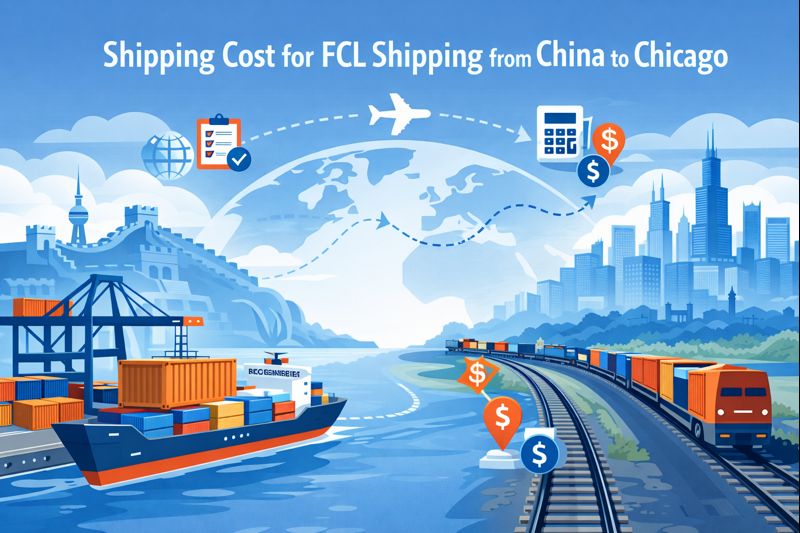
When U.S. importers plan inland delivery to the Midwest, the shipping cost for FCL shipping from China to Chicago becomes more complex than a simple ocean rate. Because containers must move from coastal ports to Chicago by rail or truck, total cost depends heavily on routing and inland strategy. Therefore, many buyers work with partners such as Top China Freight to evaluate routes and control landed cost from the start.
What Does the Shipping Cost for FCL Shipping from China to Chicago Include?
Unlike port-to-port shipments, Chicago-bound FCL shipments combine ocean transport with inland movement. As a result, the total cost includes multiple layers.
Core cost components
Ocean freight from China to U.S. port
Origin charges in China (THC, documentation)
U.S. destination port fees
Inland rail or truck transport to Chicago
Customs clearance and compliance costs
Because each layer fluctuates independently, importers benefit from understanding the full cost structure rather than focusing only on base freight rates.
How Do Container Size and Type Affect Costs?
Container size directly influences pricing. While both 20ft and 40ft containers ship to Chicago, cost efficiency differs.
Container Type
Typical Use Case
Cost Efficiency
20GP
Heavy, compact cargo
Lower inland rail cost
40GP
Mixed cartons
Better unit economics
40HQ
High-volume textiles
Highest CBM efficiency
Therefore, selecting the correct container type often reduces per-unit shipping cost without changing the route.
What Role Does Customs Clearance Play in Total Cost?
Although customs clearance represents a smaller portion of the total cost, delays quickly generate extra charges.
Common customs-related costs include:
Broker service fees
ISF filing
Exams and inspections
When aligned early with professional customs brokerage services, these costs remain predictable and manageable.
Which China–Chicago Routes Influence FCL Shipping Costs Most?
Route choice plays a decisive role in cost control. Generally, shipments move through either the U.S. West Coast or East Coast before inland transfer.
Route Option
Typical Entry Port
Cost Impact
Transit Stability
West Coast + Rail
Los Angeles / Long Beach
Lower ocean, higher rail
High
East Coast + Rail
New York / Savannah
Higher ocean, lower rail
Medium
Gulf Coast + Rail
Houston
Balanced
Medium
Consequently, West Coast routing often offers the lowest shipping cost for FCL shipping from China to Chicago, especially for time-sensitive cargo.
Case Studies
Textile Cartons from Shanghai to Chicago
Origin: Shanghai Entry Port: Los Angeles Inland Mode: Rail to Chicago Container: 40HQ Transit Time: 32 days Cost Outcome: Lower total cost compared with East Coast routing
By choosing West Coast entry and early rail booking, the importer reduced overall shipping cost despite longer inland distance.
Machinery Parts from Ningbo to Chicago
Origin: Ningbo Entry Port: New York Inland Mode: Rail Container: 20GP Transit Time: 38 days Cost Outcome: Stable cost with less rail congestion
Because cargo weight was high, the 20GP container lowered rail charges and improved cost control.
How Can Importers Reduce the Shipping Cost for FCL to Chicago?
Although base rates matter, cost reduction usually comes from operational decisions rather than negotiation alone. Therefore, importers should focus on controllable variables.
Practical cost-optimization actions
Area
Optimization Method
Cost Impact
Route planning
Choose West Coast when rail is stable
Medium–High
Container choice
Match weight to 20GP or 40HQ
Medium
Booking timing
Avoid peak-week departures
Medium
Inland coordination
Pre-book rail capacity
High
As a result, consistent planning often delivers better savings than chasing short-term rate dips.
Should Importers Choose Door-to-Door Pricing?
For many Midwest importers, door-to-door pricing simplifies budgeting. Instead of managing multiple vendors, importers receive one consolidated cost.
When door delivery integrates ocean freight, rail, and final trucking, door-to-door solutions reduce hidden inland charges and improve schedule accountability. Consequently, finance teams gain clearer landed-cost visibility.
How Do Risks Affect Total Shipping Cost?
Unexpected risks often inflate costs more than rate changes. Delays, exams, and demurrage quickly erode savings.
High-impact cost risks
Port congestion leading to rail delays
Customs exams triggered by document errors
Chassis shortages at inland terminals
Because of these risks, proactive documentation and routing decisions protect budgets more effectively than last-minute rate negotiations.
Conclusion
The shipping cost for FCL shipping from China to Chicago depends on far more than ocean freight alone. Route selection, inland rail strategy, container choice, and seasonal timing all shape the final landed cost. By approaching cost as a system rather than a single rate, importers gain predictability, resilience, and long-term savings.
Request A Free Quote
Start shipping smarter with TopChinaForwarder today! 🚢✨ Request a Free Quote 📝 and get a tailored logistics plan built around your cargo and timeline.