
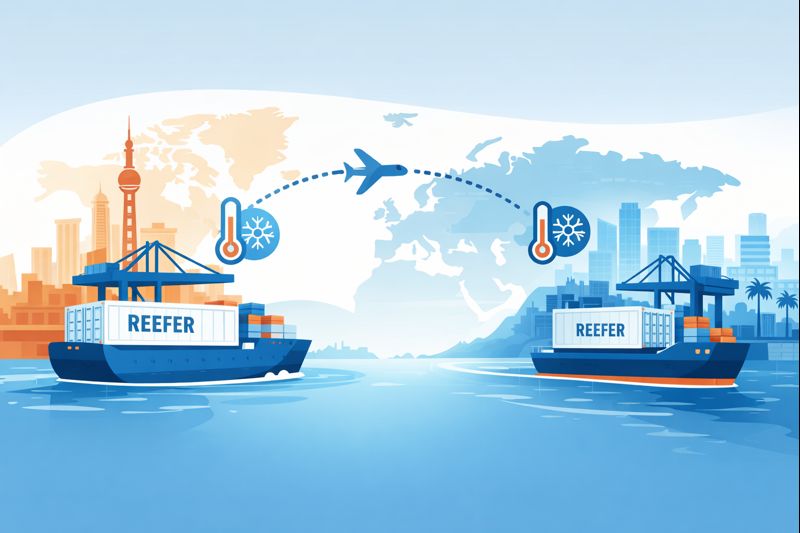
When cargo quality and temperature stability matter, Reefer FCL shipping from China to USA becomes a strategic choice rather than a niche solution. However, many importers still face challenges around freight rates, equipment availability, and customs coordination. Therefore, this guide explains how reefer full container load shipments operate in practice, from Chinese export ports to US gateways, with proven solutions supported by Top China Freight.
What Is Reefer FCL Shipping and Why Is It Used?
Reefer FCL shipping refers to full container load transport using refrigerated containers that maintain controlled temperature and humidity throughout the voyage.
Why temperature-controlled FCL matters
First, reefer containers protect goods from heat, cold, and moisture fluctuations during long ocean crossings. Consequently, products such as food, pharmaceuticals, chemicals, and sensitive industrial materials arrive in stable condition.
Reefer FCL versus standard dry containers
Although dry containers cost less initially, reefer FCL reduces hidden risks. Because temperature excursions often cause product loss or rejection, many US importers prefer reefer FCL for higher-value or compliance-sensitive cargo.
How Does Reefer FCL Shipping from China to USA Work?
Understanding the end-to-end workflow helps importers plan more accurately.
Container allocation and pre-trip inspection
Initially, the carrier assigns a reefer container and performs a pre-trip inspection to confirm cooling performance. Meanwhile, shippers set temperature parameters based on cargo requirements.
Inland transport and port handling in China
After loading, the sealed reefer container moves to the export port under power supply. As a result, temperature control remains uninterrupted before vessel loading.
Ocean transit and monitoring
During ocean transit, the reefer unit stays connected to onboard power. Because monitoring systems record temperature data, deviations can be identified and addressed quickly.
How Are Reefer FCL Freight Rates Structured?
Instead of focusing only on base ocean rates, importers should consider the full pricing structure.
Main cost components
Reefer FCL shipping costs usually include:
- Ocean freight
- Reefer surcharge (electricity usage)
- Port handling charges
- Inland trucking (if applicable)
Because these elements fluctuate, comparing quotes without detail often leads to budget gaps.
Indicative cost ranges
| Route | Estimated Cost Range (USD) |
|---|---|
| China → US West Coast | 4,500 – 6,800 |
| China → US East Coast | 6,200 – 8,900 |
Rates change with fuel prices, equipment balance, and seasonal demand. Therefore, coordination with a provider experienced in sea freight solutions improves cost predictability.
What Are the Typical Transit Times to the USA?
Transit time varies by destination port and vessel service.
| US Destination | Ocean Transit Time |
|---|---|
| Los Angeles / Long Beach | 13–18 days |
| Oakland | 15–20 days |
| Seattle / Tacoma | 16–22 days |
| New York / Savannah | 28–35 days |
When inland transport and port handling are included, total China-to-USA transit time typically ranges from 20 to 40 days.
Case Studies
Reefer FCL to the US West Coast
Shipment overview
Origin: Shanghai
Destination: Los Angeles
Cargo: Temperature-sensitive food ingredients
Container: 40HQ Reefer FCL
Execution
The shipment moved on a direct service with continuous temperature monitoring from origin to arrival.
Result
Total transit time reached 21 days, while product quality met all import compliance standards.
Reefer FCL Shipment to the US East Coast
Shipment overview
Origin: Ningbo
Destination: Savannah
Cargo: Pharmaceutical raw materials
Container: 40GP Reefer FCL
Execution
The shipment followed a trans-Pacific and Panama Canal route with continuous temperature logging. Customs documentation was prepared in advance to match FDA-related requirements.
Cost and timeline
Total transit time: 34 days
Estimated logistics cost: USD 8,100
Outcome
The importer achieved on-time delivery with full compliance, supporting uninterrupted downstream production.
How Can Importers Manage Risks in Reefer FCL Shipping?
Even with advanced equipment, reefer FCL shipments still involve operational and commercial risks. Fortunately, several proven strategies help reduce exposure.
Temperature setting and monitoring discipline
First, temperature settings must match cargo requirements exactly. For example, frozen, chilled, and controlled-ambient goods all require different parameters. Therefore, confirming set points before departure avoids costly disputes later.
Power continuity and contingency planning
Additionally, ensuring uninterrupted power supply during inland moves and port handling is critical. Because reefer units rely on electricity, contingency plans for plug shortages or delays significantly reduce spoilage risk.

Should You Choose Door-to-Port or Door-to-Door Reefer FCL?
Service scope directly influences control, cost, and workload.
Door-to-port for experienced logistics teams
Door-to-port works well when importers already manage US customs clearance and inland trucking. However, coordination increases after vessel arrival, especially during peak seasons.
Door-to-door for streamlined operations
In contrast, door-to-door reefer FCL solutions integrate inland pickup, ocean freight, customs clearance, and final delivery. Consequently, many growing businesses prefer full workflows supported by professional door-to-door transport services to reduce internal complexity.
When Might Reefer FCL Not Be the Best Choice?
Although reefer FCL offers strong protection, it may not suit every shipment.
Non-sensitive, low-value goods
If cargo tolerates temperature variation and carries low unit value, standard dry FCL may be more economical.
Unstable shipment volumes
Additionally, irregular volumes may benefit from LCL or flexible booking options rather than fixed reefer equipment.
Conclusion
Choosing Reefer FCL shipping from China to USA enables importers to protect cargo quality, improve delivery reliability, and strengthen supply chain resilience. By aligning route selection, temperature control, and customs planning, reefer FCL becomes a scalable solution for US-bound trade. When supported by experienced logistics partners, it delivers both operational and commercial confidence.
Request A Free Quote
Start shipping smarter with TopChinaForwarder today! 🚢✨ Request a Free Quote 📝 and get a tailored logistics plan built around your cargo and timeline.
FAQ:
What factors most affect reefer FCL freight rates?
Rates depend on ocean capacity, reefer surcharges, fuel prices, and seasonal equipment balance.
How accurate is temperature control during ocean transit?
Modern reefer containers maintain stable ranges when correctly set and continuously powered.
Do reefer shipments face longer customs inspections?
Not always. With accurate documents and records, clearance timing is often similar to dry containers.
Can reefer FCL be combined with inland rail in the USA?
Yes. Reefer containers can move by rail if power supply requirements are met.
How early should reefer FCL bookings be made?
Bookings are best confirmed 2–3 weeks in advance, especially before peak seasons.