
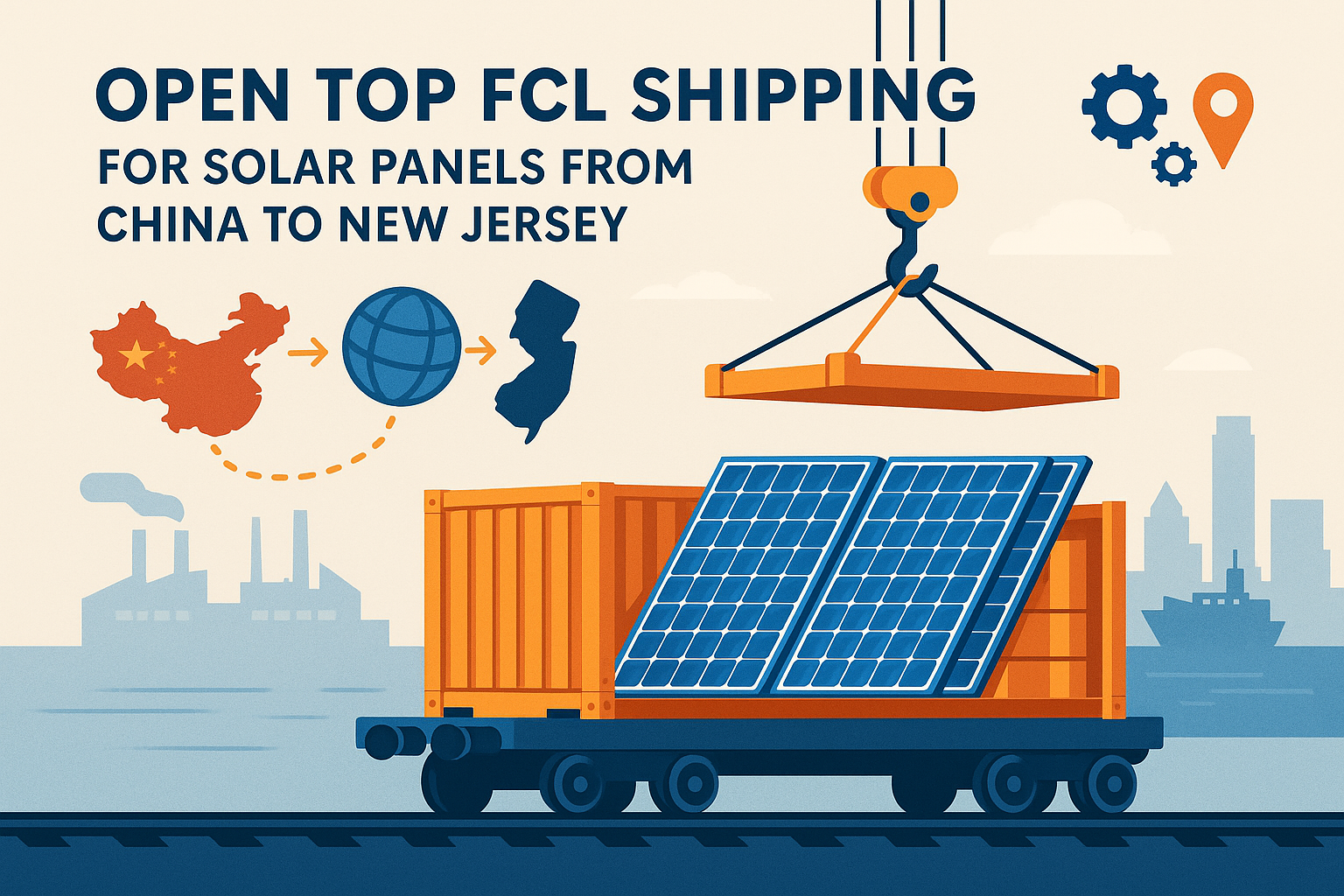
Because Open Top FCL shipping cost for solar panels from China to New Jersey fluctuates with dimensional variance, handling requirements, and terminal conditions, many exporters find budgeting unexpectedly complex; however, a structured method can create predictable cost visibility. Moreover, companies who rely on stable solar supply chains can streamline cost planning by aligning shipment design, packing reinforcement, and routing choices with insights from partners such as the Top China Freight homepage. Therefore, this guide explains how OT container costs are calculated, how loading methods affect pricing, and how to avoid unnecessary accessorial charges across China–US corridors.
What Determines the Open Top FCL Shipping Cost for Solar Panels?
Although OT containers follow the same freight rate base as standard FCL, oversized cargo conditions and special handling raise the total cost. Moreover, solar panels require careful lifting procedures, additional packing materials, and dimensional analysis, which influence terminal charges and inland delivery fees. Therefore, cost must be assessed from both sea and landside perspectives.
Primary Cost Components
- Base ocean freight for OT containers
- Oversized freight charges for solar modules
- Port handling fees for lifting equipment
- Reinforced packing and bracing costs
- Inland trucking to New Jersey warehouses
- Marine insurance for fragile PV panels
Additionally, the weight-to-volume ratio of solar modules affects route availability and vessel slot allocation.
How Solar Panel Dimensions Influence OT Container Pricing
Because Open Top containers are selected for height or width constraints, solar panel crates must be evaluated for clearance, lifting space, and center-of-gravity stability. Moreover, dimension discrepancies cause reloading or remeasurement fees, which raise the overall cost. Therefore, exporters must calculate dimensions early.
Dimensional Factors That Affect OT Costs
- Crate height exceeding 2.5m
- Bundles exceeding forklift reach limits
- Over-width cargo requiring side loading
- Extra lifting gear required at China ports
- Clearance restrictions at New Jersey terminals
Additionally, precise drawings reduce handling time and allow forwarders to arrange suitable loading equipment.

How Reinforced Packing Reduces Risk and Avoids Extra Charges
Although solar panels are structurally rigid, they remain extremely sensitive to shock, flex, and compression. Moreover, panel damage claims often originate from improper crating rather than transit. Therefore, reinforced packaging lowers financial risk and reduces insurance premiums.
Packing Enhancements for Solar Modules
- ISPM-15 certified wooden crates
- Metal edge guards for frame protection
- Vibration-absorbing foam layers
- Waterproof wrap to protect wiring and cells
- Vertical crate orientation for balanced weight distribution
Furthermore, consistent crate dimensions support better container loading geometry, reducing wasted space.
What Routes Are Most Common from China to New Jersey for Solar Panels?
Because New Jersey importers typically use NY/NJ container terminals, routing depends on origin port, carrier availability, and expected peak-season congestion. Moreover, exporters using OT containers must choose routes with stable lifting equipment and fewer weather disruptions.
Popular OT Routes to New Jersey
- Shanghai → New York/Newark
- Ningbo → New York/Newark
- Qingdao → New York/Newark
Additionally, selecting vessels with wider deck-space allocation improves the reliability of OT container acceptance.
Case Studies
OT Shipment of 180 kW Solar Modules
Origin: Ningbo
Cargo: Height-exceeding PV crates
Challenge: Lifting constraints at terminal
Outcome: After crate redesign and bracing improvements, the shipment loaded smoothly. Moreover, early lifting-gear reservation avoided rehandling fees.
Large Solar Frames to New Jersey Warehouse
Origin: Shanghai
Cargo: Oversized mounting frames + PV panels
Challenge: High drayage quotes due to size
Outcome: By using a specialized heavy-haul carrier, total New Jersey inland cost dropped by 18%. Additionally, consistent crate dimensions reduced unloading time.
Indicative Open Top FCL Cost Range
| Cost Component | Estimated Range (USD) | Notes |
|---|---|---|
| Ocean Freight (OT) | $5,800–$9,200 | Depends on season & carrier |
| Oversized Cargo Charges | $300–$900 | For height/width exceptions |
| Port Handling Fees | $180–$450 | Higher for lifting equipment |
| Reinforced Packing | $200–$600 | Varies by crate design |
| New Jersey Drayage | $350–$780 | Based on warehouse distance |
Should Importers Consider Alternative Transport Modes beyond OT Containers?
Although Open Top FCL remains the most practical solution for oversized solar cargo, alternative modes can reduce cost or time under specific scenarios. Moreover, weather volatility along the East Coast sometimes causes vessel delays, so importers diversify routes to balance supply chain risks. Therefore, decision-making should incorporate cargo fragility, deadlines, and inland delivery conditions.
When Alternatives Make Sense
- Flat Rack containers when cargo width exceeds OT limits
- Breakbulk service when solar frames exceed crane capacity
- Air freight for emergency replacement modules
- Rail-to-truck multimodal routing for inland distribution
Additionally, diversifying modes helps solar developers maintain continuity during utility-scale project deadlines.
What Seasonal Factors Influence OT Solar Panel Costs?
Although solar demand stays relatively steady, shipping costs fluctuate strongly during peak construction cycles, Chinese manufacturing peaks, and US hurricane season. Moreover, carriers adjust OT availability depending on vessel slot constraints and safety margins. Therefore, solar shipments should be scheduled with seasonal risk in mind.
Key Seasonal Cost Drivers
- Q2–Q3 construction peak increases OT demand
- Pre–Golden Week vessel space tightening
- Winter port congestion at NY/NJ terminals
- Hurricane-related deviations or delays
Additionally, early booking provides cost stability when OT equipment becomes scarce.
Conclusion
As shown throughout this guide, Open Top FCL shipping cost for solar panels from China to New Jersey depends on dimensional control, handling requirements, terminal rules, inland delivery, and documentation accuracy. Therefore, exporters must plan holistically—because every step from crating to drayage affects total landed cost. When supported by expert logistics engineering and predictable carrier schedules, solar panel shipments reach New Jersey safely, efficiently, and at optimized cost levels.
Request A Free Quote
Start shipping smarter with TopChinaForwarder today! 🚢✨ Request a Free Quote 📝 and get a tailored logistics plan built around your cargo and timeline.
FAQ:
What affects the total OT shipping cost for solar panels?
Multiple factors influence cost, including oversized charges, reinforced packing, lifting equipment, and New Jersey drayage distance.
Can weather impact OT cargo delivery time?
Certainly, winter storms, hurricanes, and East Coast congestion can shift delivery windows, so importers should build buffer time.
How do I prevent rehandling fees at New Jersey terminals?
Proper crate balance, correct OT labeling, and early crane scheduling prevent rehandling and equipment penalties.
What inland delivery method works best for OT cargo?
Side-loader or crane-assisted drayage works reliably, especially when handling tall or heavy solar crates.
How do I reduce detention at NY/NJ terminals?
Quick document submission, pre-booked drayage, and accurate crate information significantly shorten storage duration.