
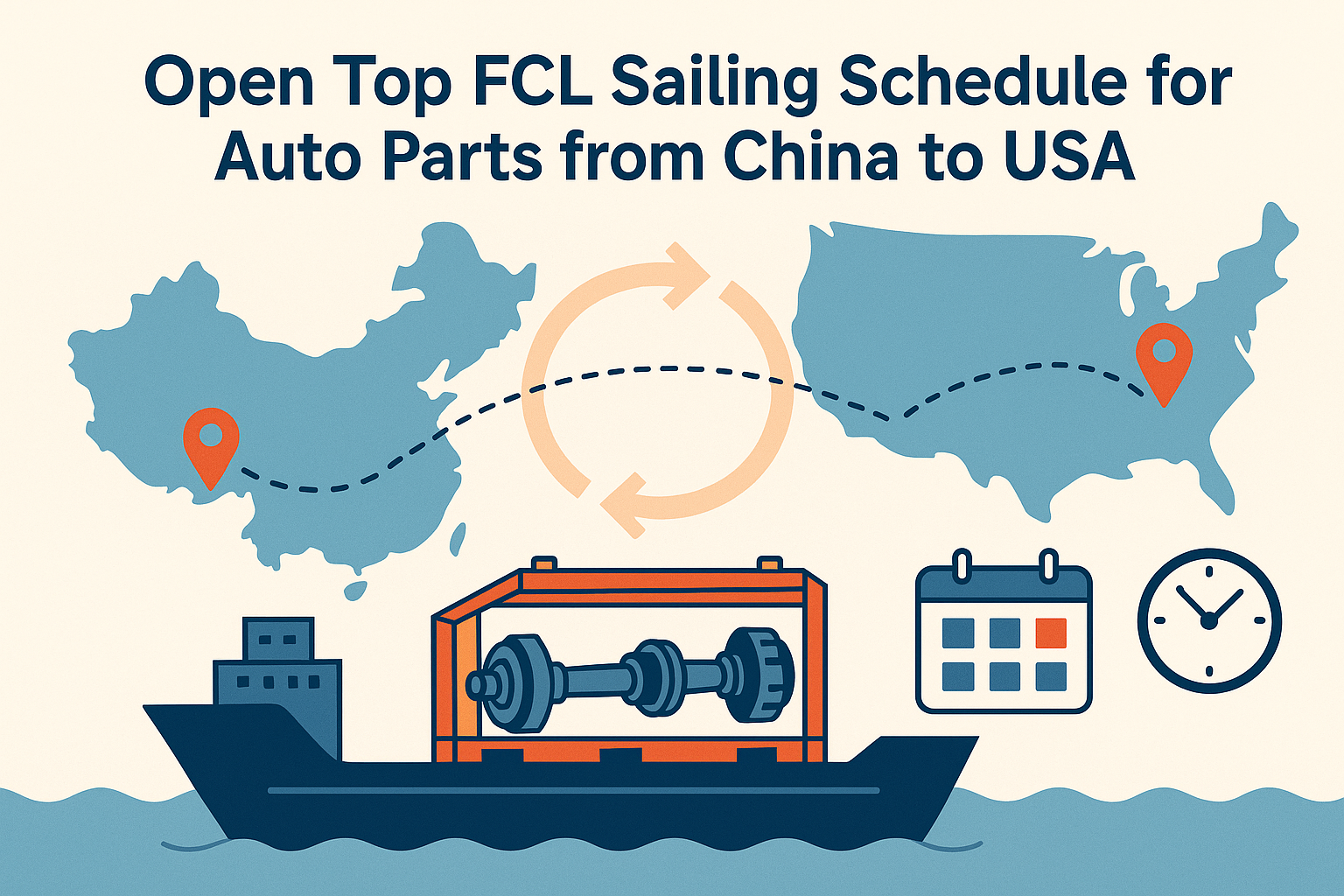
As demand for oversized and irregular auto parts increases across U.S. markets, shippers often struggle to match production cycles with the Open Top FCL sailing schedule for auto parts from China to USA. Therefore, this guide breaks down real scheduling patterns, capacity variables, and planning strategies to help exporters strengthen timeline accuracy. Moreover, importers seeking deeper visibility may explore additional logistics resources through our homepage, ensuring their supply chain stays aligned with weekly departures.

What Determines the Open Top FCL Sailing Schedule for Auto Parts from China to the USA?
Open Top containers move on specialized routes that support heavy or oversized auto parts, including engines, axles, machinery assemblies, and unboxed metal structures. Therefore, sailing schedules depend on equipment availability, carrier routing preferences, and port congestion across China’s major gateways. Moreover, auto parts often require reinforced securing, which influences cutoff times and handling durations.
Core Variables Affecting Sailing Schedules
- Weekly Open Top equipment forecasts
- China–USA departure frequency by carrier
- Oversized cargo approval cycles
- Port labor availability and congestion conditions
- U.S. receiving port capacity and rail connections
Because Open Top equipment pools are smaller than standard FCL, early booking dramatically improves timeline consistency.
How Does Open Top Container Availability Influence Departure Timing?
Equipment availability directly shapes sailing schedules, especially when multiple exporters request the same Open Top units. Consequently, early confirmation helps secure containers before factory production peaks. Moreover, carriers sometimes reposition Open Top units to northern ports such as Qingdao or Tianjin, which temporarily increases availability for exporters flexible with origin choices.
Availability Factors
Auto Parts Dimensions
Large assemblies require more securing materials, extending gate-in times and influencing sailing readiness.
Equipment Reposition Cycles
Carriers circulate equipment based on trade imbalances; therefore, Open Top units appear earlier in some ports than others.
Booking Window Planning
Because the open top container availability for auto parts fluctuates, exporters gain reliability by booking 2–3 weeks ahead.
How Often Do China–USA Routes Offer Open Top FCL Departures?
Although standard FCL enjoys frequent departures, Open Top FCL relies on specific vessels or services that can accommodate oversized loads. Consequently, departure frequency varies by port and season.
Typical Weekly Departure Pattern
| Origin Port | Estimated Weekly Frequency | Notes |
|---|---|---|
| Shanghai | 2–3 sailings | Most stable for auto parts exporters |
| Ningbo | 1–2 sailings | Strong oversized cargo handling |
| Qingdao | 1–2 sailings | Good for northern suppliers |
| Shenzhen/Yantian | 2 sailings | Fast transit time to U.S. West Coast |
Because frequency changes during peak seasons, shippers should monitor China to USA open top FCL departure frequency to align production schedules with available sailings.
Why Do Oversized Auto Parts Require Special Sailing Window Planning?
Oversized cargo such as engines, transmissions, or assembled frames requires additional approval. Therefore, carriers often assign specific sailing windows to manage safety, space allocation, and balancing loads.
Approval Timeline Factors
- Cargo drawing review (for complex auto assemblies)
- Additional lashing requirements
- Top-load restrictions
- Weather-related lifting limitations
Because approval cycles can take 1–3 days, exporters should finalize cargo specifications early to avoid missing weekly departures.
Case Studies
Engine Assemblies (Shanghai → USA West Coast)
Cargo Type: Crated engine assemblies (heavy + oversized)
Challenge: Limited Open Top units during a high-volume month
Solution: Adjusted origin port + confirmed sailing window 10 days early
Transit Time: 15 days port-to-port
Outcome: Avoided rollover and reduced risk of production delay
Insight: Early alignment with carrier schedules enhances both equipment access and sailing reliability.
Oversized Axle Assemblies(Tianjin → USA East Coast)
Cargo: Large axle assemblies + mechanical parts
Challenge: Congestion at the primary departure terminal + limited Open Top units
Solution: Shifted departure to Tianjin + confirmed specialized lashing team in advance
Transit Time: 22 days port-to-port
Outcome: Shipment avoided rollover despite congestion
Insight: Proactive routing and approval planning significantly improve sailing schedule reliability for oversized auto parts.

What Documentation Helps Protect the Sailing Schedule for Open Top Containers?
Accurate documentation speeds up both customs and terminal approval. Therefore, exporters should finalize paperwork well before the shipping date. Additionally, auto parts often require HS code validations, material declarations, and machinery labeling, which must align with U.S. import regulations.
Documentation Checklist for Open Top Auto Parts Cargo
| Document | Purpose | Best Practice |
|---|---|---|
| Commercial Invoice | Declares value & item classification | Include explicit auto part descriptions |
| Packing List | Confirms size & weight | Provide drawings for oversized components |
| Export Declaration | Supports customs clearance | Submit 48 hours early |
| Lashing Certificate | Confirms securing method | Required for heavy machinery items |
Because documentation accuracy reduces risk of missing sailing windows, exporters should prepare materials at least 2–3 days before container gate-in.
How Top China Freight Enhances Sailing Schedule Accuracy
Top China Freight supports exporters by tracking carrier sailing schedules, managing auto parts documentation, coordinating oversized lashing, and aligning cutoff times across major ports. Additionally, our integrated solutions—such as sea freight and customs brokerage—help maintain end-to-end supply chain visibility, ensuring your shipment remains synchronized with production cycles and delivery deadlines.
Why Should Exporters Track Carrier Reliability for Open Top FCL?
Carrier reliability shapes transit time stability more than rate differences. Therefore, exporters should compare on-time performance, equipment pool size, and U.S. port partnerships across carriers. Moreover, premium carriers with stronger oversized cargo capabilities typically provide smoother operations for Open Top FCL movements.
What to Monitor
- Weekly on-time performance
- Space allocation consistency
- Open Top equipment reposition cycles
- U.S. inland rail partnerships
Because Open Top capacity is limited, choosing a reliable carrier prevents avoidable delays.
Conclusion
In summary, the Open Top FCL sailing schedule for auto parts from China to USA depends on container availability, carrier departure frequency, cutoff times, and documentation readiness. Moreover, exporters who plan early, validate cargo drawings, and evaluate routing options consistently achieve more stable scheduling. Therefore, companies seeking predictable timelines should integrate proactive planning and partner with forwarders experienced in oversized auto cargo.
Request A Free Quote
Start shipping smarter with TopChinaForwarder today! 🚢✨ Request a Free Quote 📝 and get a tailored logistics plan built around your cargo and timeline.
FAQ:
What affects the sailing schedule for Open Top auto parts cargo?
Equipment availability, port congestion, and cutoff times influence departure reliability.
How early should I book an Open Top container?
Booking 2–3 weeks before production completion improves equipment access.
Does weather impact Open Top sailing schedules?
Strong winds or storms may delay loading, especially for tall machinery.
Are extra fees applied to oversized auto parts?
Additional lashing, lifting, or handling fees may apply depending on the cargo.
Should I avoid peak seasons for Open Top shipments?
Planning ahead mitigates peak impacts, but early booking remains essential.