
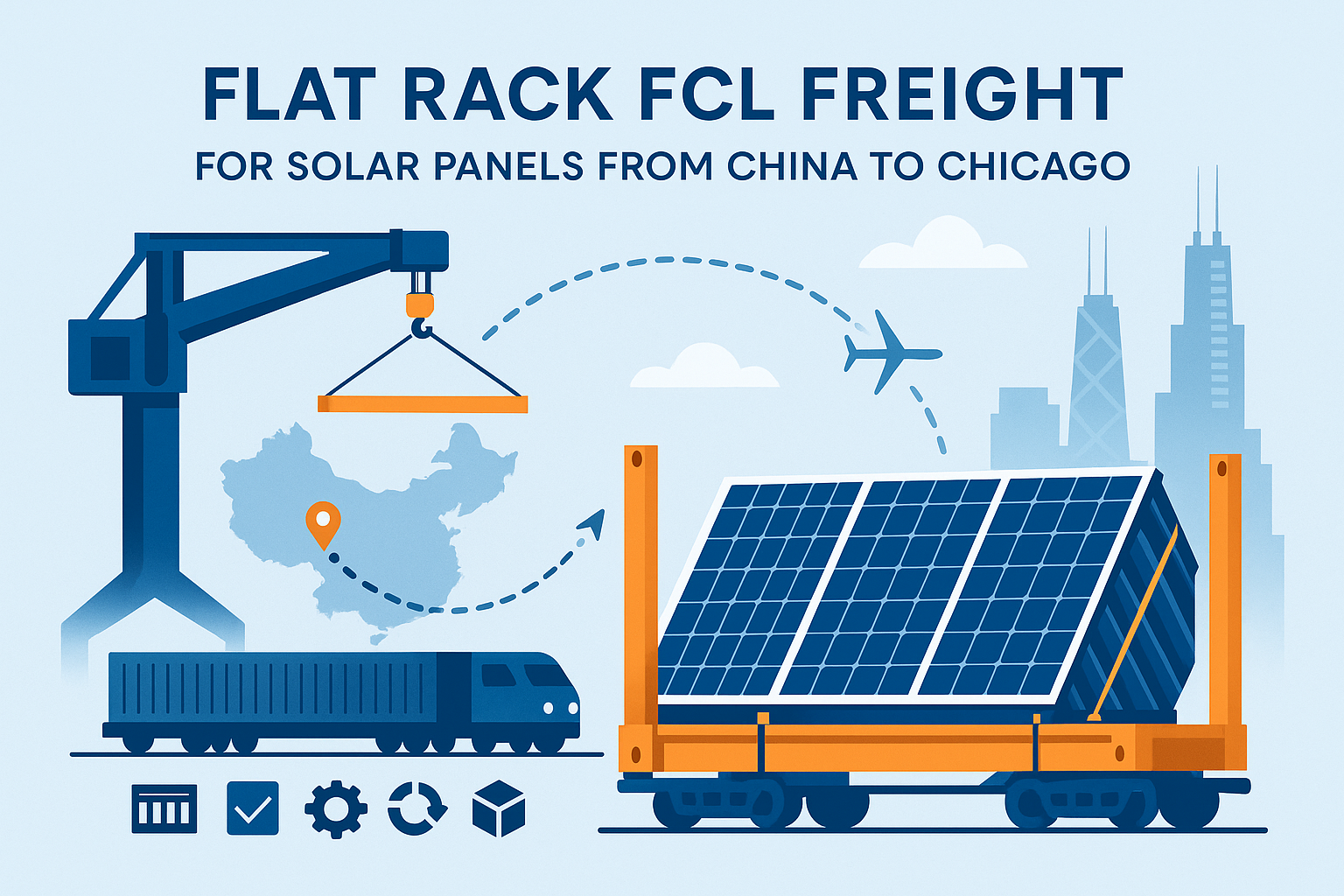
Although solar energy projects in the United States are expanding rapidly, managing the Flat Rack FCL freight rate for solar panels from China to Chicago remains challenging due to oversized cargo requirements, inland transport constraints, and fluctuating equipment availability. Therefore, importers must understand how pricing, handling rules, and terminal processes interact, and resources like the Top China Freight homepage provide a reliable starting point. Moreover, this guide delivers practical insights that help renewable-energy companies reduce risk, improve predictability, and control the total landed cost of Flat Rack shipments.
What Makes Flat Rack FCL the Preferred Choice for Solar Panel Shipping?
Flat Rack containers accommodate oversized solar modules, mounting frames, and long palletized bundles that do not fit inside standard containers. Additionally, Flat Racks allow flexible loading from the sides or top, making them ideal for heavy renewable-energy equipment. Because solar panels require delicate handling, the open design helps improve loading accuracy and reduce stress on fragile modules.
Moreover, many U.S. inland terminals—including Chicago rail ramps—can support Flat Rack transfers, enabling a smooth multimodal route from major Chinese ports to the Midwest.

How Are Flat Rack FCL Freight Rates for Solar Panels Calculated?
Flat Rack rates differ from general FCL pricing because they include multiple special-handling components. Although carriers publish base rates, renewables cargo often incurs adjustments based on weight, dimensions, and equipment imbalance along key trade lanes.
Primary Pricing Factors
- Cargo dimensions exceeding standard footprint limits
- Heavy-duty lashing and securing requirements
- Equipment shortages during peak renewable-energy seasons
- Inland rail haulage from West Coast gateways to Chicago
- Variations in bunker and GRI adjustments
Because these elements fluctuate, solar energy companies must follow structured cost-control strategies to maintain stable budgeting for long-distance movement.
Why Do Oversized Solar Panels Require Special Lashing and Handling?
Oversized solar panels often exceed traditional pallet widths, so they demand reinforced loading surfaces and precise tie-down arrangements. Since Flat Racks expose cargo to open-air conditions, correct lashing becomes essential to prevent shifting during ocean transit or inland rail movement.
Typical Heavy-Duty Lashing Requirements
- Steel or polyester straps with certified tension strength
- Corner reinforcement and padding for fragile panel edges
- Cross-lashing patterns to stabilize long bundles
- Anti-slip mats under pallet bases
- Moisture-resistant protective wrapping
Moreover, carriers may reject improperly secured cargo at origin ports, which increases delays and cost exposure. Therefore, importers must align lashing methods with international standards and renewable-energy shipping guidelines.

What Shipping Time Should Importers Expect from China to Chicago?
Shipping solar panels to Chicago involves a multimodal structure: ocean transport from China to a U.S. gateway port, then inland rail to the Midwest. Because of this, shipping time varies depending on routing choice, port congestion, and seasonal equipment demand.
Estimated Transit Time for China–Chicago Flat Rack Solar Cargo
| Route Type | Estimated Time | Notes |
|---|---|---|
| China → LA/LB → Chicago Rail | 23–32 days | Most common for Flat Rack cargo |
| China → Seattle/Tacoma → Chicago Rail | 26–35 days | Stable but capacity-dependent |
| China → Houston → Chicago Truck/Rail | 28–38 days | Useful when West Coast congestion rises |
Moreover, renewable-energy importers must integrate transit-time variation into their supply-chain strategies because project sites often operate with fixed installation windows.
Case Studies
Flat Rack Solar Panels via Shanghai → LA → Chicago Rail
Origin: Shanghai, China
Destination: Chicago, USA
Cargo Type: Oversized solar modules + steel mounting frames
Container Type: Flat Rack FCL
Total Transit Time: 30–33 days
Freight Reference: Mid-range with seasonal surcharges
Key Advantages: Early equipment booking, stable rail schedule, reinforced lashing
Because the importer secured Flat Rack units one month early and prepared documentation accurately, the cargo passed through LA quickly and reached Chicago without delays. Additionally, strong coordination with drayage teams ensured rapid retrieval from the rail ramp.
Mixed Solar Equipment via Ningbo → Tacoma → Chicago Rail
Origin: Ningbo, China
Destination: Chicago, USA
Cargo Type: Solar panels, inverters, hardware kits
Container Type: Flat Rack FCL
Total Transit Time: 32–36 days
Freight Reference: Higher due to wide equipment dimensions
Key Advantages: Cross-lashing certification, pre-cleared customs data, warehouse readiness
Because the shipment involved unusually wide panels, the team worked with a specialized project-cargo partner to certify lashing patterns. Moreover, customs filings were completed before vessel arrival, allowing timely transfer to inland rail without demurrage or storage charges.
Documentation & Handling Workflow Checklist
Flat Rack Solar Panel Shipping Workflow
| Step | Action Required | Notes |
|---|---|---|
| Pre-shipment audit | Verify dimensions, pallet structure, certifications | Prevents rejection at CY |
| ISF & documentation | File early and match invoice/packing list | Avoids customs delays |
| Flat Rack loading | Apply reinforced lashing & padding | Reduces breakage risk |
| Port handling | Coordinate lift plans with terminal | Ensures safe crane operations |
| Rail transfer | Confirm ramp appointment & drayage slots | Prevents dwell and extra fees |
| Final delivery | Schedule warehouse unloading crew | Maintains project timelines |
Because each step involves technical coordination, maintaining a unified workflow improves both predictability and cost control for renewable-energy importers.
How Can Renewable-Energy Importers Reduce Freight Rate Fluctuations?
Importers who plan proactively and collaborate with experienced project-cargo teams achieve more stable pricing. Although renewable-energy cargo often moves under time-sensitive schedules, several strategies reduce cost volatility and improve predictability.
Key Cost-Control Strategies
- Secure Flat Rack equipment early during peak solar cycles
- Request multi-route quotations to compare inland options
- Standardize pallet dimensions to reduce oversized surcharges
- Bundle shipments to leverage carrier allocation priority
- Use visibility tools to anticipate congestion trends
Because solar equipment is high value and often shipped in bulk, developing a long-term rate program yields measurable financial benefits.
Can Equipment Availability Influence Flat Rack Pricing for Solar Panels?
Yes. Equipment imbalance significantly affects Flat Rack FCL freight rates because carriers reposition Flat Rack units based on project-cargo demand along global trade lanes. When renewable-energy shipments spike in Asia, equipment shortages drive costs upward. Moreover, solar panels often move in seasonal waves that reflect construction cycles in the U.S. Midwest.
Therefore, importers should secure equipment reservations early, especially between March–June and September–December. Because carriers allocate Flat Rack units selectively, partnering with experienced logistics providers can help maintain access to equipment even during high-demand periods.
Conclusion
Managing the Flat Rack FCL freight rate for solar panels from China to Chicago requires deep understanding of oversized cargo requirements, inland infrastructure constraints, and seasonal freight trends. Moreover, importers who proactively secure Flat Rack equipment, validate documentation, and coordinate rail and drayage operations consistently achieve lower costs and more reliable transit times. When renewable-energy companies need dedicated support, experienced logistics partners can streamline every stage—from origin loading to final Midwest delivery.
Request A Free Quote
Start shipping smarter with TopChinaForwarder today! 🚢✨ Request a Free Quote 📝 and get a tailored logistics plan built around your cargo and timeline.
FAQ:
What determines Flat Rack FCL freight rates for solar panels?
Rates depend on cargo dimensions, lashing needs, equipment availability, and inland rail costs.
Do oversized solar panels require special customs procedures?
They require accurate HS codes, certifications, and matching packing data to avoid delays.
How early should I reserve Flat Rack equipment?
Booking 3–4 weeks early helps secure capacity during peak renewable-energy seasons.
Booking 3–4 weeks early helps secure capacity during peak renewable-energy seasons.
They alert teams to vessel delays, rail updates, and terminal advisories in real time.
Are Flat Rack shipments better than Open Top for solar equipment?
Flat Racks handle oversized widths more efficiently, though each method suits different profiles.