
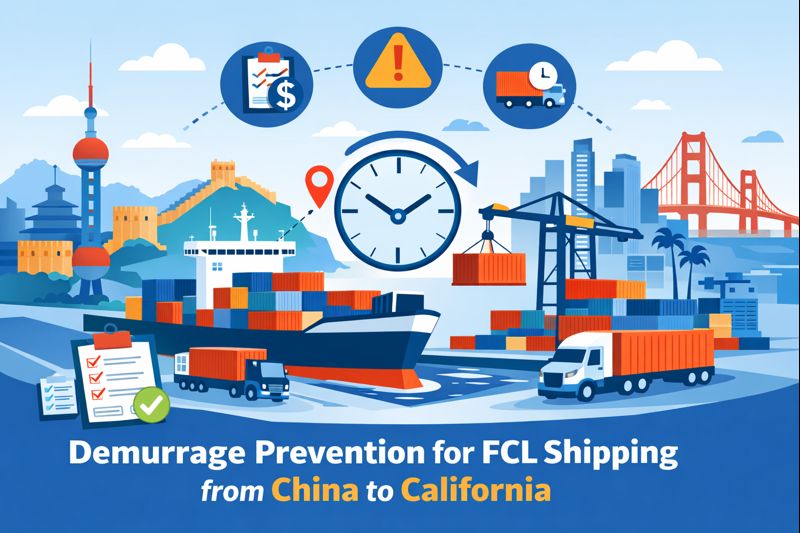
As West Coast congestion and stricter terminal rules continue to affect US imports, demurrage prevention for FCL shipping from China to California has become a top priority for importers seeking cost control and schedule certainty. Fortunately, with the right planning and execution model, many avoidable charges can be eliminated before containers even depart Asia.
Therefore, this guide explains proven, field-tested strategies used by experienced forwarders like Top China Freight to reduce demurrage exposure across California ports.

Why Does Demurrage Risk Increase for FCL Shipping to California?
Although FCL shipping offers cost efficiency and cargo security, demurrage risk rises sharply once containers arrive at congested California gateways. In practice, this risk rarely comes from a single failure.
Key Structural Factors Driving Demurrage
First, California ports operate under tight terminal schedules and limited free time windows. Second, inland trucking availability often fluctuates, especially during peak season. Finally, customs clearance delays can quickly consume free days.
As a result, importers without end-to-end visibility face compounding risks that escalate costs daily.
How Free Time Mismanagement Leads to Demurrage Charges
Free time refers to the number of days a container can remain at the terminal without incurring demurrage. However, many importers misunderstand how quickly this window closes.
Common Free Time Pitfalls
- Free time often starts before customs release is completed
- Weekends and terminal holidays may count as chargeable days
- Early arrival without trucking readiness reduces usable time
Consequently, effective demurrage prevention for FCL shipping from China to California starts with realistic free time planning rather than optimistic assumptions.
What Documentation Errors Commonly Cause FCL Demurrage?
Even when vessels arrive on schedule, paperwork errors frequently delay container release. Therefore, documentation accuracy remains one of the most cost-effective prevention tools.
Typical High-Risk Documentation Issues
- Inconsistent HS codes between invoice and packing list
- Missing ISF elements or late ISF filing
- Incorrect consignee or bond information
Because customs holds often occur silently, proactive document checks before vessel arrival dramatically reduce demurrage exposure. Many importers rely on integrated customs brokerage support to avoid these blind spots.

How Port Congestion Impacts Demurrage at California Gateways
California ports experience recurring congestion cycles driven by vessel bunching, labor shifts, and rail backlogs. As congestion intensifies, terminal dwell times increase even when documentation is correct.
California Port Demurrage Risk Comparison
| Port Area | Average Free Time (Days) | Congestion Sensitivity | Demurrage Risk Level |
|---|---|---|---|
| Los Angeles | 4–5 | Very High | High |
| Long Beach | 4–5 | High | High |
| Oakland | 5–6 | Moderate | Medium |
Therefore, port selection and discharge timing play a critical role in demurrage prevention for FCL shipping from China to California.
Case Studies
Furniture FCL Shipment to Long Beach
Route: Shenzhen → Long Beach
Cargo: Flat-packed wooden furniture, 40HQ FCL
Challenge: High peak-season congestion and limited free time
Solution:
By pre-filing ISF, validating documents pre-departure, and securing drayage before vessel arrival, the importer avoided all demurrage charges.
Outcome:
- Demurrage cost: USD 0
- Total dwell time: 3.5 days
- Delivery completed within planned window
Electronics FCL Shipment to Oakland
Route: Ningbo → Oakland
Cargo: Consumer electronics, 40GP FCL
Challenge: Customs inspection risk and limited drayage
Solution:
The importer coordinated early customs filing, scheduled inland trucking five days ahead, and aligned warehouse receiving windows.
Outcome:
- Demurrage avoided: USD 1,200
- Clearance completed within 48 hours
- On-time warehouse delivery achieved
How Customs Clearance Timing Affects Demurrage Prevention
While ocean transit time often receives the most attention, customs clearance timing usually determines whether free time is used efficiently. Therefore, clearance preparation must begin long before vessel arrival.
Clearance Timing Best Practices
First, submit ISF and entry data early to avoid last-minute holds. Next, verify bond sufficiency to prevent automated system rejections. Finally, confirm cargo descriptions align precisely with HS classifications.
Because clearance delays consume free days invisibly, disciplined customs workflows remain essential to demurrage prevention for FCL shipping from China to California.
Why Forwarder Expertise Matters in California FCL Imports
California ports operate with complex terminal rules and fast-changing congestion patterns. As a result, local execution experience becomes critical.
Forwarders with structured demurrage prevention frameworks help importers anticipate risk rather than respond to invoices. Providers offering coordinated door-to-door services often deliver the highest consistency because responsibilities remain unified.
How End-to-End Coordination Reduces Hidden Costs
Demurrage rarely occurs alone. Instead, it often triggers detention, storage, and downstream delivery disruptions. Therefore, integrated coordination reduces total landed cost rather than addressing isolated fees.
Integrated Cost Control Areas
| Cost Category | Without Coordination | With End-to-End Planning |
|---|---|---|
| Demurrage | Frequent | Rare |
| Detention | High risk | Controlled |
| Truck Rescheduling | Common | Minimal |
By aligning ocean, customs, inland, and warehouse activities, importers stabilize both cost and delivery performance.
Conclusion
Demurrage prevention for FCL shipping from China to California depends on planning discipline, timing accuracy, and execution visibility rather than luck. When free time, customs clearance, inland trucking, and warehouse readiness align, most penalties become avoidable.
Ultimately, importers who adopt structured, end-to-end strategies gain predictable costs, stronger supply chain resilience, and fewer disruptions.
Request A Free Quote
Start shipping smarter with TopChinaForwarder today! 🚢✨ Request a Free Quote 📝 and get a tailored logistics plan built around your cargo and timeline.
FAQ:
What costs are included in demurrage charges?
Demurrage covers terminal storage fees charged when containers exceed free time. It excludes trucking, detention, and warehouse storage costs.
How long is free time at California ports?
Most California terminals offer 4–6 days of free time, though congestion and carrier rules can shorten usable days.
Does customs inspection automatically cause demurrage?
Inspections don’t guarantee demurrage, but delayed release often consumes free time if documents or bonds are unprepared.
Is FCL safer than LCL for demurrage control?
FCL offers better control, but without coordination, it can still incur demurrage at congested ports.
Should importers choose ports based on demurrage risk?
Yes. Port selection influences congestion exposure and available free time.