
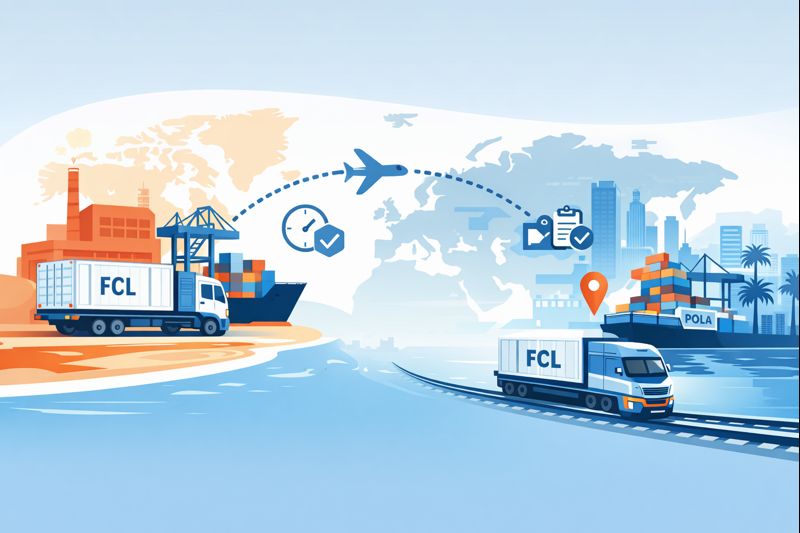
When managing US-bound supply chains, China FCL factory pickup to Los Angeles is often the most efficient way to control cost, timing, and cargo responsibility from the very first mile. However, many importers struggle with factory coordination, inland trucking, and export customs alignment, which can quickly disrupt delivery schedules. Therefore, this guide explains how to structure factory pickup FCL shipments step by step, starting directly from Chinese manufacturing zones with support from experienced providers such as Top China Freight.
What Does China FCL Factory Pickup Mean in Practice?
China FCL factory pickup refers to a full-container shipment collected directly from the supplier’s factory rather than being delivered by the shipper to a port warehouse.
Why factory pickup matters for FCL shipments
First, factory pickup consolidates responsibility under one logistics plan. Instead of coordinating multiple vendors, importers rely on a single FCL supply chain flow. As a result, handover errors and miscommunication are significantly reduced.
Factory pickup versus port drop-off
Although port drop-off appears cheaper, it often shifts hidden risks to the buyer. By contrast, factory pickup FCL shipping provides clearer accountability for trucking, export documentation, and scheduling from origin to destination.
How Does the China FCL Factory Pickup Process Work?
Understanding the full workflow helps importers avoid delays and cost overruns.
Factory readiness and container positioning
Initially, the factory confirms cargo readiness, packaging standards, and loading windows. Meanwhile, the forwarder arranges container positioning and inland trucking to the factory gate.
Loading and export handover
Once loading is completed, the container is sealed and transported to the export port. Because the shipment moves as a single FCL unit, cargo integrity remains intact throughout inland transit.
Port handling and ocean departure
After port arrival, export customs clearance is completed, and the container is loaded onto the vessel bound for Los Angeles. Consequently, the shipment transitions smoothly from inland trucking to ocean freight.
How Are Costs Structured for China FCL Factory Pickup?
Instead of focusing only on ocean freight rates, importers should evaluate the full cost structure.
Key cost components
Typical cost elements include:
- Factory pickup trucking fees
- Export documentation and customs clearance
- Ocean freight
- Destination port charges in Los Angeles
By reviewing these components together, buyers gain better cost predictability and avoid surprise surcharges.
Indicative cost ranges
| Cost Item | Typical Range (USD) |
|---|---|
| Factory pickup & inland trucking | 300 – 900 |
| Export clearance & port handling | 200 – 450 |
| Ocean freight (FCL) | 2,000 – 3,800 |
Actual rates vary by season, fuel costs, and equipment availability. Therefore, coordinated planning with a provider experienced in FCL & LCL shipping remains essential.
What Are the Typical Transit Times to Los Angeles?
Transit time depends on both inland pickup distance and ocean routing.
| Route Stage | Estimated Time |
|---|---|
| Factory pickup & inland trucking | 2–5 days |
| Port handling & export clearance | 2–4 days |
| Ocean freight to Los Angeles | 13–18 days |
| Total China factory to LA port | 18–27 days |
Because vessel schedules and port congestion fluctuate, buffer time should always be built into delivery planning.
Case Studies
Factory Pickup to Los Angeles
Shipment overview
Origin: Shenzhen factory
Destination: Los Angeles port
Cargo: Consumer electronics accessories
Container: 40HQ FCL
Execution
The container was picked up directly from the factory, sealed onsite, and trucked to Yantian Port. Ocean transit followed a direct service to Los Angeles.
Result
Total transit time reached 22 days, while end-to-end coordination reduced administrative workload for the importer.
Inland Factory Pickup to Los Angeles Distribution Hub
Shipment overview
Origin: Zhejiang factory
Destination: Los Angeles distribution center
Cargo: Home improvement tools
Container: 40GP FCL
Execution
The shipment used factory pickup trucking to Ningbo Port, followed by direct ocean service to Los Angeles. After customs clearance, the container moved directly to the importer’s warehouse.
Cost and timeline
Total transit time: 24 days
Estimated logistics cost: USD 3,900
Outcome
The importer reduced coordination overhead and improved on-time delivery for retail replenishment.
Can Factory Pickup Reduce Risk for US Importers?
Factory pickup is often chosen not only for convenience but also for risk control. When responsibility starts at the factory gate, visibility improves across the entire shipment lifecycle.
Fewer handovers, fewer errors
First, factory pickup minimizes cargo handovers. Instead of relying on factory-arranged trucking, the container moves under one logistics plan from origin to destination. Consequently, loading mistakes, missed cutoffs, and document mismatches occur less frequently.
Clear accountability from origin
Moreover, when one forwarder manages inland transport, export clearance, and ocean freight, accountability remains clear. As a result, issue resolution becomes faster and less disruptive to delivery schedules.

Should You Choose Door-to-Port or Door-to-Door?
Factory pickup FCL shipments can be structured in different responsibility models, depending on your operational needs.
Door-to-port for experienced importers
Door-to-port works well for importers who have customs brokers and trucking partners in the US. However, coordination increases after arrival, especially at busy ports like Los Angeles.
Door-to-door for simplified operations
In contrast, door-to-door solutions integrate factory pickup, ocean freight, customs clearance, and final delivery. Therefore, many growing importers prefer complete workflows through professional door-to-door logistics to reduce internal workload.
When Should You Avoid Factory Pickup?
Although factory pickup suits most FCL shipments, it is not always the best option.
Small or unstable production volumes
If production schedules change frequently, port drop-off may offer more flexibility. However, this approach increases coordination complexity.
Limited factory loading capability
Some factories lack equipment for container loading. In such cases, warehouse consolidation may provide a safer alternative.
Conclusion
Choosing China FCL factory pickup to Los Angeles allows importers to gain earlier control over cost, scheduling, and risk. By integrating inland trucking, export clearance, and ocean freight into one coordinated flow, factory pickup supports more predictable US-bound supply chains. When structured correctly, it becomes a scalable solution for growing import volumes.
Request A Free Quote
Start shipping smarter with TopChinaForwarder today! 🚢✨ Request a Free Quote 📝 and get a tailored logistics plan built around your cargo and timeline.
FAQ:
What is included in China FCL factory pickup pricing?
Pricing usually covers inland trucking, export clearance, ocean freight, and basic documentation fees.
Does factory pickup increase customs complexity?
Not necessarily. With correct documents, export clearance proceeds smoothly and predictably.
How flexible are factory pickup schedules?
Pickup schedules depend on factory readiness and vessel cutoffs, so early coordination is key.
Can factory pickup reduce demurrage risk?
Yes. Better cutoff alignment and faster port entry help limit demurrage exposure.
How is cargo tracked after factory pickup?
Most shipments use tracking tools that provide updates from pickup through arrival.