
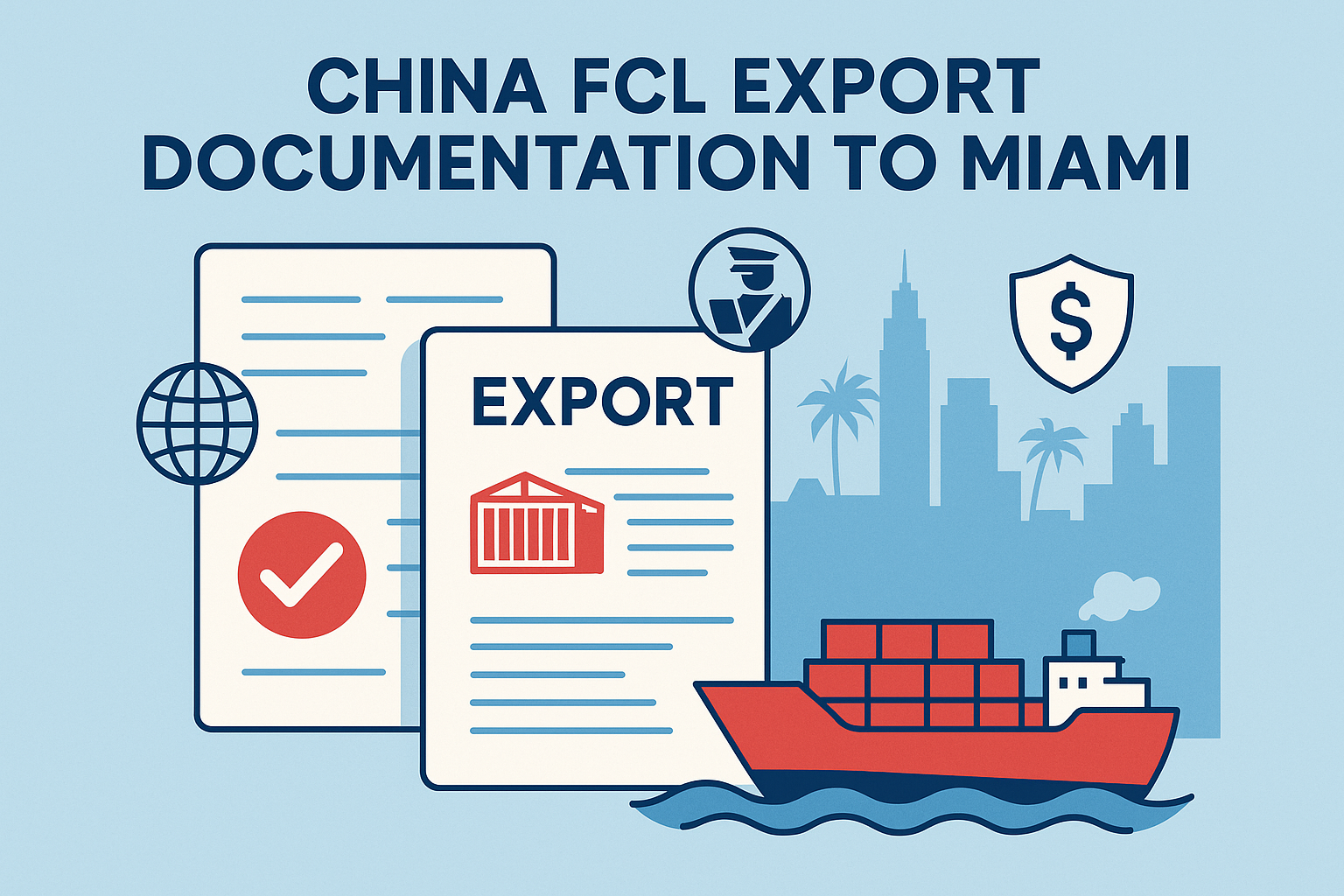
Because China FCL export documentation to Miami involves multiple checkpoints—from export filing in China to customs release in Florida—many exporters struggle with errors that delay container movement. However, with a structured workflow, clear document accuracy, and proactive coordination, your FCL cargo can pass through both sides smoothly. Moreover, companies often rely on experienced partners such as Top China Freight, whose expertise is referenced here: Top China Freight.
What Documents Are Required for China FCL Export Documentation to Miami?
FCL shipments from China to Miami require a complete and error-free document package because the US has strict screening rules. Although the list seems simple, minor mistakes easily cause customs holds or late cargo release.
Key documents include:
- Commercial Invoice with correct HS codes
- Packing List matching container content
- Bill of Lading (Master or House BL)
- Certificate of Origin
- Export License for restricted items
- ISF Filing data submitted before loading
- Booking Confirmation + Sailing Notice
These documents form the backbone of Miami-bound import clearance and must align perfectly.
Why Is Commercial Invoice Accuracy Critical for Miami Customs?
Although the commercial invoice appears straightforward, US Customs and Border Protection (CBP) uses it as the foundation for classification, valuation, risk scoring, and duty assessment. Therefore, errors create immediate red flags.
Essential invoice elements include:
- Accurate HS codes for textile equipment, machinery, electronics, or consumer goods
- Detailed product descriptions
- Correct declared value
- Clear Incoterms
- Manufacturer information
- HTS-to-HS consistency
Since the invoice drives the entire Miami clearance process, exporters must review it carefully. When needed, they may rely on structured processes from Top China Freight’s customs brokerage.
How Should China-Based Factories Prepare the Packing List for Miami Cargo?
The packing list is the second most important document because it verifies the physical cargo inside the FCL container. Although shippers often overlook details, Miami terminals cross-check this document during inspections.
A compliant packing list should include:
- Carton count and exact weight
- Dimensions for each SKU
- Container number and seal number
- Internal packaging format
- Material type and export labeling
Because Miami ports handle large volumes, any mismatch may trigger visual inspection or CET exams, which extend unloading timelines.
What Transit Times Should Exporters Expect for China FCL Shipments to Miami?
Estimated Transit Time from China to Miami(FCL)
| Origin Port | Transit Time | Notes |
|---|---|---|
| Shanghai | 31–37 days | Stable East Coast routing |
| Ningbo | 33–38 days | Slightly longer peak-season delays |
| Shenzhen/Yantian | 32–39 days | Good reliability for consumer goods |
| Qingdao | 35–42 days | Possible transshipment |
| Tianjin | 36–46 days | Longer routing pattern |
Because document readiness affects final delivery timing, exporters must align filing schedules with vessel ETAs.
Case Studies
Smooth Miami Clearance Through Early Documentation
Origin: Shenzhen
Destination: Miami
Cargo: 21 tons of assorted electronics
Container: 40HQ FCL
Transit Time: 33 days
Outcome: By preparing HS codes, COO, invoice, and packing list 6 days before loading, the importer obtained same-day Miami release, avoiding unnecessary terminal fees.
Preventing Miami Delays Through Digital Filing
Origin: Ningbo
Destination: Miami
Cargo: Commercial-grade LED lighting equipment
Container: 20GP FCL
Transit Time: 35 days
Outcome: Using digital documentation platforms and forwarder-assisted BL review, the shipment cleared Miami within 4 hours of discharge, avoiding congestion-related delays.

What Are the Most Important Documents for Smooth Miami Entry?
Miami Import Documentation Priority List
| Document | Priority | Comments |
|---|---|---|
| Commercial Invoice | High | Determines classification & valuation |
| Packing List | High | Used to verify container contents |
| Bill of Lading | High | Required for cargo release |
| ISF Filing | Medium | Must be accurate & early |
| COO | Medium | Essential for duty calculation |
| Export License | Case-by-case | Required for restricted goods |
Because Miami CBP focuses heavily on data consistency, cross-checking these items reduces clearance times.
How Should Exporters Prepare for Miami’s Inspection Types?
Miami inspections vary depending on cargo type, HS code, risk profile, and port congestion. Although not every shipment is inspected, exporters must be prepared for potential delays.
Common inspection types include:
- X-ray exam (NII) – quick, but delays release for hours
- CET intensive exam – longer physical exam
- USDA inspection – for wooden pallets or agricultural products
- Document verification – for import license–controlled goods
- Commodity-based exam – especially for electronics or chemicals
When documentation is clean and consistent, the chance of intensive inspection decreases.
How Does China’s Export Filing System Affect Miami-Bound FCL Cargo?
China’s export filing system ensures that cargo entering international routes complies with domestic regulations. Although the export filing is administrative, it impacts the timeline for Miami-bound shipments.
Key filing components include:
- China Customs export declaration
- HS code verification
- Export tax rebate (when applicable)
- Export license validation
- Inspection certificates for special products
Because Miami customs examines the outbound record when needed, ensuring accuracy in China’s system reduces questions during US entry.
Conclusion
In conclusion, managing China FCL export documentation to Miami requires disciplined preparation, precise data consistency, and early coordination with forwarders. Although the documentation process seems demanding, exporters who follow structured workflows achieve predictable clearance, lower operational risks, and faster cargo release. For companies seeking reliable China–Miami FCL handling, a well-organized documentation framework delivers significant performance advantages.
Request A Free Quote
Start shipping smarter with TopChinaForwarder today! 🚢✨ Request a Free Quote 📝 and get a tailored logistics plan built around your cargo and timeline.
FAQ:
How early should I prepare documents for Miami-bound FCL cargo?
Prepare invoice, packing list, and HS codes 5–7 days before loading to ensure accurate filing and avoid last-minute mistakes.
What causes most Miami clearance delays?
Data mismatches, late BL submission, inaccurate ISF information, and incomplete packing lists are common triggers.
Do I need a COO for every FCL export to Miami?
Most products benefit from COO submission because it ensures accurate duty calculation and reduces verification time.
Should factories participate in document preparation?
Factories should provide accurate cargo details, weights, and specifications because they influence packing list accuracy.
Can digital documentation improve clearance time?
Yes. Digital platforms eliminate version errors and speed up communication between exporters and customs brokers.