
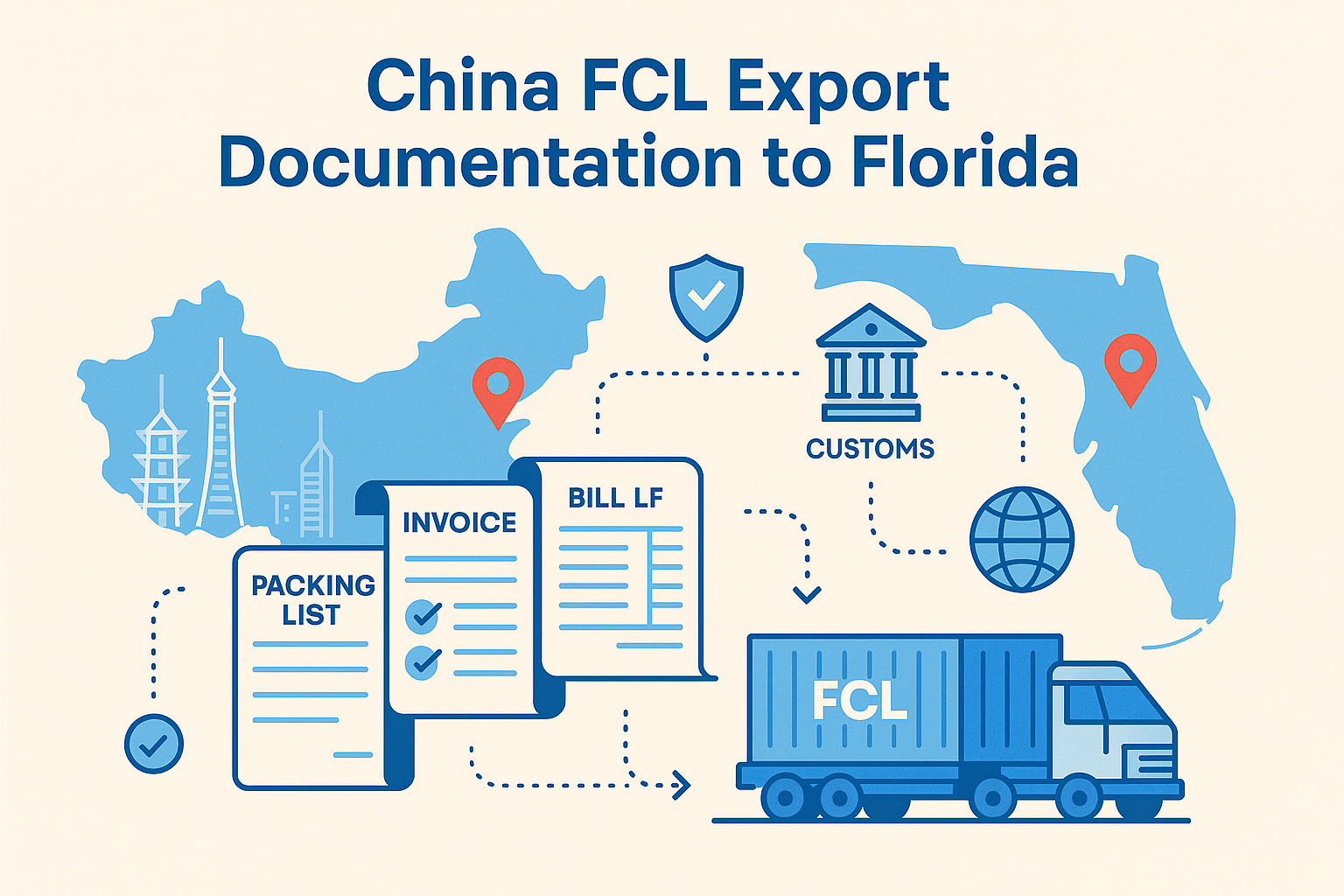
Because China FCL export documentation to Florida involves strict compliance, detailed paperwork, and coordinated filing, many exporters feel overwhelmed; however, a clear structure can dramatically simplify the entire workflow. Moreover, companies looking for accuracy and smoother customs clearance can rely on disciplined preparation supported by digital tools and guidance from partners such as the Top China Freight homepage. Therefore, this guide breaks down every essential document, timing requirement, and compliance step needed to ship FCL containers from China to Florida without costly delays.
What Documents Are Required for China FCL Export Documentation to Florida?
Although documentation varies by commodity, several core documents appear in every China–Florida FCL shipment. Moreover, because US Customs enforces strict data accuracy, even small errors may trigger examinations or storage charges. Therefore, exporters must prepare consistent and complete files before cargo reaches the loading terminal.
Essential Documentation Categories
- Commercial Invoice
- Packing List
- Bill of Lading
- Certificate of Origin
- Compliance Certificates (FCC/CE, fumigation, etc.)
- HS Code declarations
- Export license (if applicable)
Because each document serves a distinct legal purpose, exporters must keep data aligned across all fields.
How to Prepare the Commercial Invoice for Florida-bound FCL Cargo
Although the commercial invoice appears simple, it forms the basis of customs valuation and classification. Therefore, exporters must ensure accuracy and consistency. Moreover, Florida ports such as Miami and Jacksonville often verify invoice data more strictly for electronics, machinery, and mixed retail goods.
Key Invoice Requirements
- Accurate product descriptions
- Correct HS codes
- Detailed quantity and unit value
- Total price and Incoterms
- Exporter and consignee details
- Country of origin
Additionally, exporters should avoid generic product names, which often slow down US customs processing.
What Should the Packing List Include for China–Florida FCL Shipments?
Although the packing list supports load planning, it also ensures customs can cross-check quantities and dimensions. Moreover, precise carton or pallet details help freight forwarders optimize 20GP or 40GP loading patterns.
Packing List Must Include
- Carton dimensions and weight
- SKU-level breakdown
- Number of pallets or crates
- Container loading sequence
- Total cbm and total weight
Because packing lists drive both freight cost calculations and customs checks, accuracy reduces warehouse inspection risks.
Document Alignment Checklist for FCL Exporters
| Document | Critical Fields | Common Errors to Avoid |
|---|---|---|
| Commercial Invoice | HS codes, values | Generic descriptions, wrong Incoterms |
| Packing List | Dimensions, SKU details | Missing weights, incorrect totals |
| Bill of Lading | Consignee, container number | Misspelled names, mismatched counts |
| Certificate of Origin | Product origin | Incorrect HS code pairing |
| Compliance Cert. | FCC/CE/fumigation | Missing certificates for restricted goods |
Because misalignment between documents is the top reason for US customs exams, exporters should apply a three-step verification before submitting files.
Case Studies
Electronics Shipped to Miami Port
Origin: Shenzhen
Destination: Miami
Cargo: Small electronics (32 cbm)
Key Challenge: Inconsistent HS coding across documents
Result: After harmonizing invoice and packing list data, the exporter avoided an expected customs exam. Moreover, a telex release accelerated container pickup.
Furniture Shipment to Jacksonville
Origin: Ningbo
Destination: Jacksonville
Cargo: Mixed wooden furniture
Key Challenge: Missing fumigation certificate
Result: The exporter obtained the certificate before loading, preventing a port hold. Additionally, accurate loading details reduced drayage waiting time.
How US Customs Filing Influences Export Documentation Timing
Although filings are done on the US side, exporters must provide accurate data early. Moreover, mistakes in the bill of lading, HS codes, or carton counts often trigger additional requests from the importer’s customs broker.
Required Filing Data for US Customs
| Filing Item | Source Document | Why It Matters |
|---|---|---|
| HS Code | Invoice | Determines duties, controls, exams |
| Carton/Pallet count | Packing List | Validates cargo integrity |
| Value declaration | Invoice | Supports customs valuation |
| Container number | B/L | Matches physical cargo |
| Origin details | COO | Confirms compliance |
Accurate filings speed up cargo release, especially important at high-volume Florida ports.
Why Working With an Experienced Forwarder Improves Documentation Accuracy
Because documentation errors are the #1 cause of China–Florida shipping delays, exporters benefit significantly from structured support. Moreover, experienced forwarders help verify data, coordinate certificates, and ensure customs compliance.
Top China Freight provides:
- Full export-document review
- Compliance checks for electronics, furniture, apparel, machinery
- Bill of lading preparation
- Coordination of telex release and customs filing
- Integrated routing and container loading advice
Furthermore, exporters may explore customs brokerage support when buyers need guidance during Florida-side clearance.
How Documentation Impacts Total Export Cost
Although documentation costs seem minor, errors often trigger substantial additional charges such as re-submission fees, exam fees, storage, demurrage, and trucking delays. Therefore, ensuring accuracy is not merely a compliance task but a financial strategy.
Documentation Errors & Their Financial Impact
| Error Type | Potential Cost Impact | Typical Range |
|---|---|---|
| HS code error | Customs exam | $100–$600+ |
| Missing certificate | Port hold | $200–$800+ |
| Incorrect consignee info | B/L amendment | $50–$200 |
| Weight mismatch | VGM correction | $30–$80 |
| Packing data error | Warehouse rework | $100–$500 |
Moreover, exporters who maintain strict documentation discipline consistently achieve lower total landed costs for Florida shipments.
Conclusion
In summary, managing China FCL export documentation to Florida requires disciplined data alignment, early certificate collection, accurate HS coding, and predictable workflow planning. Moreover, exporters who verify documents before loading consistently avoid costly delays and enhance delivery performance. Therefore, companies aiming for smoother US market entry should invest in structured documentation systems and trusted logistics partners.
Request A Free Quote
Start shipping smarter with TopChinaForwarder today! 🚢✨ Request a Free Quote 📝 and get a tailored logistics plan built around your cargo and timeline.
FAQ:
When should I prepare export documents for Florida shipments?
Ideally 3–5 days before CY cut-off to allow time for verification and corrections.
Do all Florida-bound shipments need a certificate of origin?
Not always. It depends on product category and importer requirements.
What causes most documentation errors?
Inconsistent data across invoice, packing list, and B/L.
How can I reduce chances of a customs exam?
Ensure accurate HS codes, aligned descriptions, and complete certificates.
Does Florida have stricter customs checks than other states?
Certain categories—electronics, furniture, consumer goods—often receive more scrutiny at Miami and Jacksonville ports.