When containers arrive in Georgia, customs decisions often determine whether delivery stays on schedule or stalls unexpectedly; therefore, China FCL customs clearance to Georgia demands precise documentation and timing. As volumes grow through Savannah, even small errors can trigger inspections and fees. For this reason, many importers coordinate early with experienced partners like Top China Freight to keep clearance predictable and compliant.
What Does China FCL Customs Clearance to Georgia Involve?
Although the process follows federal rules, local port practices shape outcomes. Consequently, understanding each step reduces uncertainty.
Core Clearance Stages
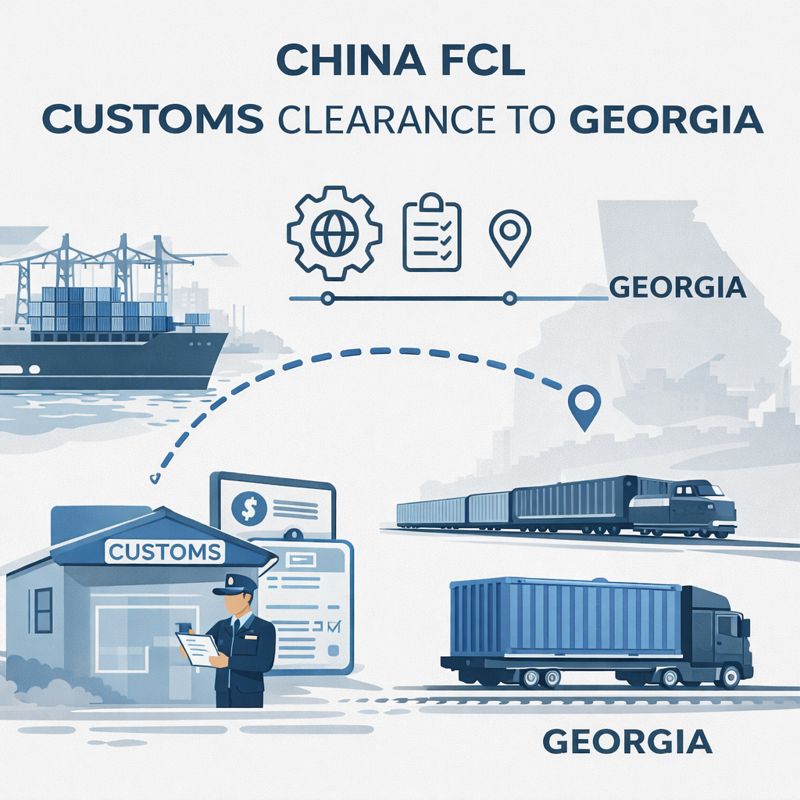
First, shipment data is transmitted before departure, including ISF and commercial details. Next, upon arrival at a Georgia port—most commonly Savannah—customs reviews filings and risk profiles. Finally, once released, the container proceeds to inland delivery or a bonded facility if required.
Because FCL shipments move as sealed units, accuracy at the start often determines speed at the end.
How Long Does FCL Customs Clearance Take in Georgia?
Clearance time varies by cargo type, season, and data quality. Nevertheless, realistic planning windows help operations teams avoid downstream delays.
Scenario
Typical Clearance Time
What Influences It
Clean entry, low risk
1–2 business days
Accurate HS codes and values
Document review
2–4 business days
Minor discrepancies
Physical inspection
5–10 business days
Random or risk-based exams
Therefore, when delivery deadlines are tight, building buffer time remains a prudent supply chain strategy.
How Much Does China FCL Customs Clearance to Georgia Cost?
Costs extend beyond duties alone. Instead, importers should evaluate the full clearance-related expense.
Typical Cost Components
Customs duties and taxes
Brokerage service fees
Terminal handling and exam charges
Storage or demurrage if delays occur
Because inland delivery often follows immediately after release, coordinating clearance with FCL and LCL services helps control the total landed cost.
What Are the Most Common Clearance Risks in Georgia?
Risk management begins with awareness. As a result, identifying frequent issues allows teams to prepare countermeasures.
High-Frequency Risk Triggers
Value discrepancies versus historical imports
Missing safety or compliance certificates
Peak season congestion increasing inspection backlogs
Therefore, proactive data checks and early submissions often prevent avoidable delays.
Case Studies
Electronics FCL Clearance in Georgia
Case 1 Origin: Shenzhen, China Destination: Savannah, Georgia Cargo: Consumer electronics, 40GP FCL Clearance Time: 2 business days Outcome: Clean entry achieved through accurate HS codes and pre-arrival ISF filing, enabling immediate inland delivery.
Furniture FCL Clearance to Georgia
Case 2 Origin: Shanghai, China Destination: Savannah, Georgia Cargo: Flat-packed furniture, 40HQ FCL Clearance Time: 4 business days Outcome: Minor document review resolved quickly through pre-arrival data validation, avoiding demurrage and maintaining delivery schedules.
Can Door-to-Door Services Simplify Customs Clearance to Georgia?
For many importers, customs clearance becomes more manageable when logistics responsibility is centralized. Therefore, door-to-door solutions often reduce coordination gaps.
When ocean freight, customs filing, and inland delivery are managed as one flow, documentation consistency improves. As a result, release decisions tend to be faster, especially for time-sensitive FCL cargo entering Georgia.
What Documents Are Required for China FCL Customs Clearance to Georgia?
Documentation accuracy sits at the center of customs success. As a result, importers should verify files well before vessel arrival.
Document
Why It Matters
Commercial Invoice
Declares value and transaction terms
Packing List
Confirms quantities, weights, and cartons
Bill of Lading
Establishes ownership and routing
ISF Filing
Meets US security requirements
Import Licenses (if applicable)
Required for regulated goods
Because missing or inconsistent data often causes holds, many shippers rely on professional customs brokerage services to maintain compliance.
How Does Port of Savannah Influence FCL Clearance Outcomes?
Savannah’s growth has improved infrastructure while increasing scrutiny. Consequently, preparation has become more important.
Savannah offers:
Efficient terminal operations
Strong rail and trucking connections
High customs throughput during peak periods
Because volumes surge seasonally, early coordination with sea freight services and customs teams improves release speed.
Conclusion
Effective China FCL customs clearance to Georgia depends on preparation, accuracy, and coordination across every logistics stage. By aligning documentation, HS classification, and inland delivery planning, importers minimize risk and improve predictability. Ultimately, structured customs strategies turn Georgia into a reliable gateway rather than a bottleneck. pulvinar dapibus leo.
Request A Free Quote
Start shipping smarter with TopChinaForwarder today! 🚢✨ Request a Free Quote 📝 and get a tailored logistics plan built around your cargo and timeline.