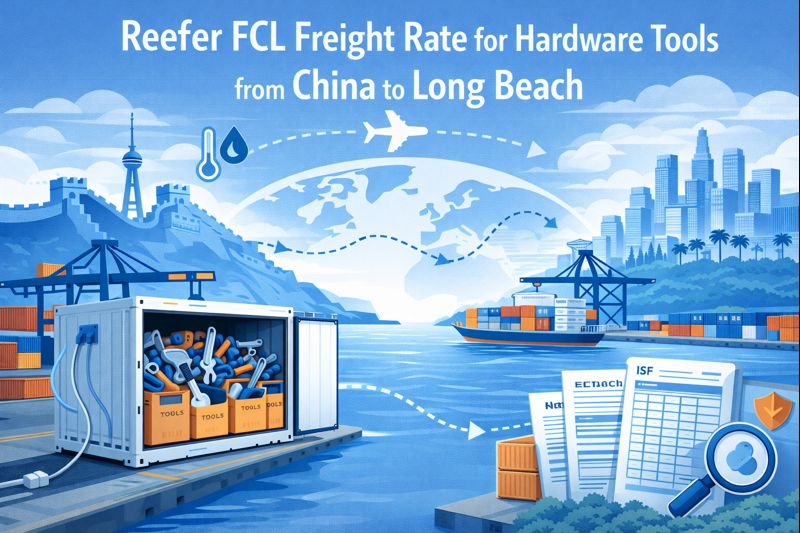
As supply chains diversify, the Reefer FCL freight rate for hardware tools from China to Long Beach increasingly appears in cost reviews—not because tools need cooling, but because temperature stability, condensation control, and schedule reliability matter. Therefore, importers planning West Coast arrivals often coordinate early with partners like Top China Freight to align reefer availability, surcharges, and delivery timelines before booking.
What Does the Reefer FCL Freight Rate Include for Hardware Tools?
Although reefers are designed for perishables, their pricing structure applies equally when used for non-food cargo. Consequently, the reefer FCL freight rate combines base ocean freight with equipment-specific charges.
Key components typically include:
Base ocean freight to Long Beach
Reefer equipment surcharge
Power and monitoring fees
Origin and destination terminal handling
However, inland delivery and customs services usually price separately, which makes total cost planning essential.
Why Would Hardware Tools Ship in a Reefer Container?
At first glance, reefer use seems unnecessary for metal tools. Nevertheless, several operational reasons drive this choice.
Common reefer-use scenarios:
Moisture-sensitive tools requiring humidity control
As a result, importers often view reefer containers as risk-mitigation equipment rather than cooling assets.
What Customs Factors Matter for Reefer FCL to Long Beach?
Customs clearance applies equally to reefer and dry containers. However, inspection timing can affect reefer power costs if delays occur.
Typical considerations include:
Correct HS classification for tools
Accurate valuation to avoid exams
Advance coordination with brokers
When aligned early with customs brokerage services, clearance delays—and extra power charges—remain manageable.
Which China–Long Beach Routes Influence Reefer Pricing Most?
Route structure affects reefer availability and cost. Direct West Coast services usually offer more stable reefer supply.
Route Option
Transit Time
Rate Stability
Direct Pacific service
14–18 days
High
Indirect via hub
18–25 days
Medium
Because reefers require power connections at terminals, routes with fewer transshipments often perform better.
Case Studies
Precision Tools from Ningbo to Long Beach
Origin: Ningbo, China Destination: Long Beach, California Cargo: Precision metal tools Container: Reefer FCL Transit Time: 16 days Cost Outcome: Higher than dry FCL, lower damage risk
Because humidity control mattered, the importer accepted a higher reefer freight rate to protect tool calibration.
Power Tool Components from Shenzhen to Long Beach
Origin: Shenzhen, China Destination: Long Beach, California Cargo: Power tool components Container: Reefer FCL Transit Time: 17 days Cost Outcome: Stable reefer rate with no transshipment
By choosing a direct service, the shipper minimized reefer surcharges linked to terminal power time.
How Can Importers Reduce the Reefer FCL Freight Rate?
Although reefer equipment carries a premium, importers still control several levers. Therefore, cost reduction starts with operational choices rather than rate negotiation alone.
Practical ways to optimize reefer costs
Area
Action
Expected Impact
Booking timing
Secure reefer space early
Medium–High
Route choice
Prefer direct Pacific services
Medium
Power time
Minimize terminal dwell
High
Loading plan
Optimize weight distribution
Medium
As a result, disciplined planning often offsets part of the reefer surcharge without increasing risk.
Can Door-to-Door Planning Improve Cost Control?
Yes. When ocean transport, customs clearance, and inland delivery align under one plan, cost visibility improves.
By coordinating reefer movements through door-to-door services, importers reduce handoffs, shorten dwell time, and avoid unnecessary power charges at destination terminals.
Why Does Reefer Rate Visibility Matter for Supply Chains?
Visibility transforms reefer shipping from a premium option into a strategic tool. When importers understand cost drivers, they plan inventory and pricing more accurately.
Over time, tracking the Reefer FCL freight rate for hardware tools from China to Long Beach supports:
Better landed-cost forecasting
Smarter container selection decisions
Improved response to logistics trends
As a result, reefer usage becomes deliberate rather than reactive.
Conclusion
The Reefer FCL freight rate for hardware tools from China to Long Beach reflects more than cooling—it reflects risk control, schedule reliability, and cargo protection. By aligning container choice, routing, and documentation, importers balance higher equipment costs with lower damage and delay risk. Ultimately, informed reefer planning strengthens supply chain resilience.
Request A Free Quote
Start shipping smarter with TopChinaForwarder today! 🚢✨ Request a Free Quote 📝 and get a tailored logistics plan built around your cargo and timeline.