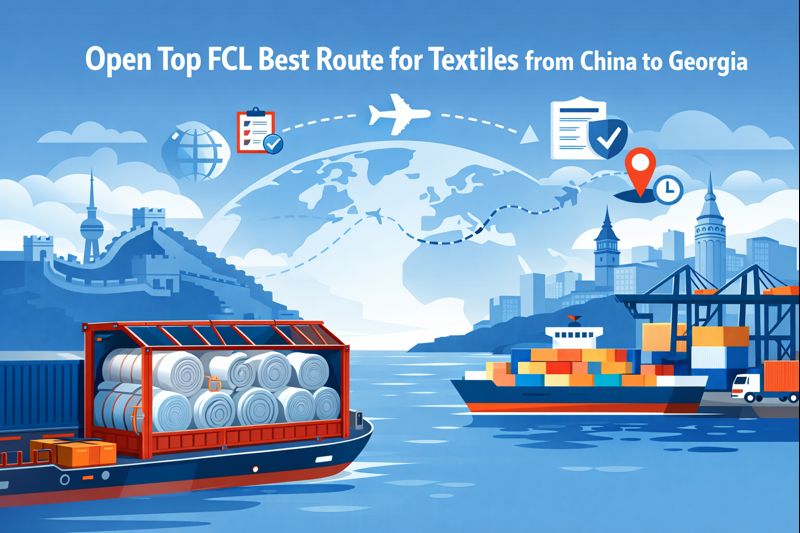
As textile exports grow larger and more specialized, Open Top FCL best route for textiles from China to Georgia becomes a critical planning question rather than a simple booking choice. Unlike standard containers, Open Top units demand precise routing, loading control, and port coordination. Therefore, importers working with partners like Top China Freight often focus on route optimization first to protect cargo integrity and delivery schedules.
What Makes Open Top FCL Necessary for Textile Shipments?
Textile cargo does not always fit standard containers. While fabrics are flexible, textile machinery, looms, dyeing equipment, and oversized rolls frequently exceed height limits.
When Open Top FCL is the right option
Open Top FCL becomes suitable when cargo:
Exceeds internal container height
Requires top loading by crane
Cannot be tilted or compressed
As a result, exporters gain safer loading conditions and reduce deformation risks during long-distance sea freight.
How Does Route Selection Impact Open Top FCL Shipments?
Because Open Top containers face more handling restrictions, route choice directly affects transit stability. Certain ports offer better crane access, storage conditions, and vessel compatibility.
Key routing considerations
Availability of Open Top–approved vessels
Port crane capacity and terminal handling rules
Transshipment risks along the route
Consequently, a well-chosen route minimizes re-handling and protects delicate textile cargo.
How Does Customs Planning Affect Route Choice?
Customs clearance plays a larger role with oversized textile cargo. Accurate documentation ensures smoother inspection at Georgian ports.
What Are the Main Sea Routes from China to Georgia?
Georgia relies primarily on Black Sea access, which shapes Open Top FCL routing decisions.
Route Option
Typical Path
Transit Time Range
Risk Level
Via Mediterranean & Black Sea
China → Med Hub → Poti/Batumi
40–48 days
Medium
Via Northern Europe
China → EU Hub → Black Sea
45–55 days
Higher
Combined Sea + Land
China → Med Port → Rail/Truck
38–45 days
Medium
Therefore, Mediterranean-connected routes often represent the Open Top FCL best route for textiles from China to Georgia.
Case Studies
Textile Machinery from Shanghai to Poti
Origin: Shanghai Destination: Poti, Georgia Cargo: Oversized textile weaving machine Container Type: Open Top FCL Route: China → Mediterranean hub → Black Sea Transit Time: 46 days Cost Range: Higher than standard FCL, lower than Flat Rack
By selecting a Mediterranean route, the importer avoided double crane handling and minimized cargo movement.
Fabric Rolls from Ningbo to Batumi
Origin: Ningbo Destination: Batumi, Georgia Cargo: Large-diameter fabric rolls Container Type: Open Top FCL Route: Direct Med–Black Sea connection Transit Time: 43 days Cost Range: Mid-range Open Top freight
Because cargo loaded vertically, Open Top FCL prevented compression damage during transit.
How Can Importers Reduce Risks on Open Top FCL Routes?
Although Open Top FCL offers flexibility, it also introduces specific risks. Therefore, proactive planning becomes essential rather than optional.
Common Open Top FCL risks and mitigation
Risk Type
Typical Issue
Practical Mitigation
Weather exposure
Rain or humidity damage
Waterproof tarpaulin + desiccants
Lashing failure
Cargo shifting
Certified lashing plans
Port handling limits
Crane unavailability
Pre-check terminal capability
As a result, importers who integrate risk control into route selection experience fewer delays and claims.
Should Open Top FCL Be Combined with Other Transport Modes?
In some scenarios, combining transport modes improves both speed and control. For example, sea freight remains the core leg, yet inland delivery can vary.
When urgency rises, part of the shipment may move separately via air freight while oversized items continue by sea. Consequently, supply chains stay flexible without sacrificing cost efficiency.
Why Is Visibility Critical for Open Top FCL Shipments?
Tracking oversized cargo requires more than basic milestones. Importers benefit from knowing when loading completes, when containers enter terminals, and when vessels depart.
Therefore, enhanced visibility improves:
Delivery schedule accuracy
Inventory planning
Exception response speed
When managed by experienced providers such as Top China Freight, Open Top FCL routes gain transparency without extra administrative burden.
Conclusion
Selecting the Open Top FCL best route for textiles from China to Georgia requires balancing cargo protection, port capability, transit time, and cost control. By prioritizing Mediterranean-linked routes, proper loading strategies, and customs readiness, importers can move oversized textile cargo with confidence. Ultimately, the right route transforms logistical complexity into a predictable and scalable shipping solution.
Request A Free Quote
Start shipping smarter with TopChinaForwarder today! 🚢✨ Request a Free Quote 📝 and get a tailored logistics plan built around your cargo and timeline.