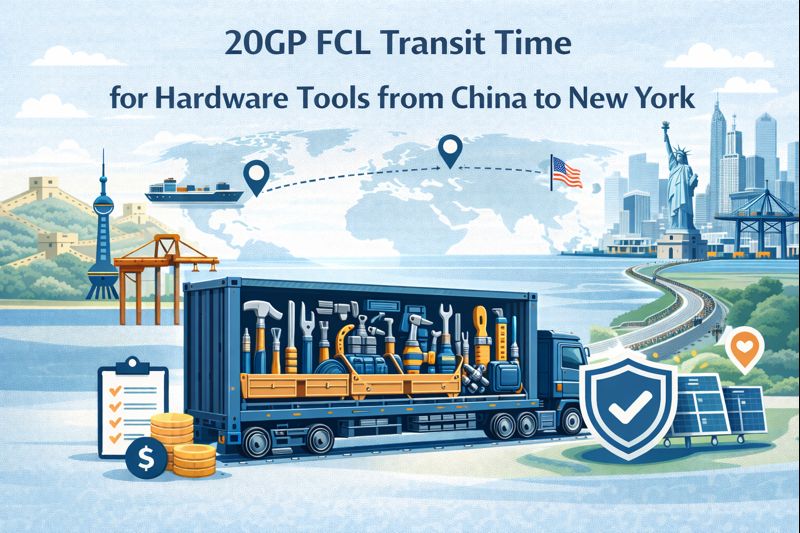
When importers evaluate 20GP FCL transit time for hardware tools from China to New York, uncertainty often appears around port handling, customs clearance, and inland delivery timing. However, with a structured view of each shipping stage, transit time becomes predictable rather than speculative. Therefore, this guide breaks down realistic timelines, key delay drivers, and planning strategies based on real-world operations handled by Top China Freight.
What Does 20GP FCL Transit Time Actually Include?
Although many shippers focus only on ocean sailing days, true transit time starts much earlier and ends much later. In practice, 20GP FCL shipping for hardware tools involves multiple connected stages.
Core Transit Stages
Export cargo readiness and container loading in China
Port handling and vessel departure
Ocean freight sailing to the U.S. East Coast
New York port discharge and customs clearance
Inland trucking or rail delivery
Because each stage has its own risk profile, managing them as one timeline improves predictability.
How Long Does Ocean Freight Take from China to New York?
Ocean freight remains the longest single segment in the timeline. Nevertheless, its duration varies depending on port pairings and carrier routing.
Origin Port (China)
Destination Port
Typical Sailing Time
Shanghai
New York
30–35 days
Ningbo
New York
31–36 days
Shenzhen
New York
32–38 days
While sailing schedules appear stable, congestion and weather can still introduce fluctuations.
How Does Customs Clearance Influence Transit Time?
Customs clearance often acts as the silent variable in hardware tool imports. While most shipments clear smoothly, delays occur when documentation lacks consistency.
Hardware tools typically require accurate HS classification, commercial invoices, and packing lists. Even small mismatches can trigger inspections and extend clearance.
Shippers using professional customs coordination through services like customs brokerage reduce uncertainty during this stage.
Why Port Handling Time Matters for Hardware Tools
Although hardware tools are not fragile, they often ship in heavy cartons or pallets. As a result, port handling speed directly affects container availability after arrival.
New York terminals typically require several days for unloading, yard positioning, and release processing. Therefore, understanding port dwell time prevents unrealistic delivery expectations.
Port Stage
Average Time
Vessel discharge
1–2 days
Yard positioning
1–2 days
Container availability
2–4 days
Planning inland pickup before arrival helps minimize idle container time.
Case Studies
Shanghai to New York Hardware Tools
Origin: Shanghai, China Destination: New York warehouse Container: 20GP Cargo: Power tools and hand tools Total Weight: 18.5 tons
Export handling: 4 days
Ocean freight: 33 days
Port clearance: 4 days
Inland trucking: 2 days
Total door-to-door time: 43 days
Early booking and documentation alignment prevented inspection delays.
Ningbo to New York Hardware Tools
Origin: Ningbo, China Destination: New Jersey distribution center Container: 20GP Cargo: Industrial hardware kits Total Weight: 19.2 tons
Export handling: 5 days
Ocean freight: 35 days
Port clearance: 3 days
Inland delivery: 2 days
Total door-to-door time: 45 days
Seasonal congestion slightly extended sailing time, but inland delivery remained smooth.
What Are the Main Delay Risks for 20GP Hardware Tool Shipments?
Although transit time estimates look straightforward, real delays often emerge from small operational gaps. Therefore, understanding common risk points allows importers to intervene early.
Delay Risk
How It Affects Transit Time
Practical Mitigation
Port congestion
+3–6 days
Flexible vessel selection
Customs inspection
+2–5 days
Accurate HS codes
Truck shortage
+1–3 days
Pre-book inland transport
Documentation mismatch
+2–4 days
Early compliance checks
Because these risks rarely appear alone, layered planning remains essential.
Why Hardware Tool Weight Affects Scheduling
Although size matters, weight often matters more for hardware tools. Heavier containers may face slower handling or stricter trucking availability after discharge.
Because of this, load planning and weight declaration accuracy directly influence inland transport speed. Early coordination with FCL & LCL services helps avoid post-arrival bottlenecks.
How Professional Coordination Reduces Transit Variability
Managing 20GP FCL shipments involves synchronizing carriers, ports, customs, and inland transport. Without coordination, small delays compound quickly.
Top China Freight integrates booking, documentation, and inland delivery into a single workflow. This approach stabilizes timelines and improves predictability for hardware tool importers shipping to the U.S. East Coast.
Conclusion
The 20GP FCL transit time for hardware tools from China to New York typically ranges from 38 to 45 days, depending on routing, seasonality, and inland coordination. By breaking transit into stages, identifying delay risks, and planning inland delivery early, importers gain control over timelines that often feel uncertain. With structured planning, transit time becomes a measurable and manageable supply chain element.
Request A Free Quote
Start shipping smarter with TopChinaForwarder today! 🚢✨ Request a Free Quote 📝 and get a tailored logistics plan built around your cargo and timeline.