
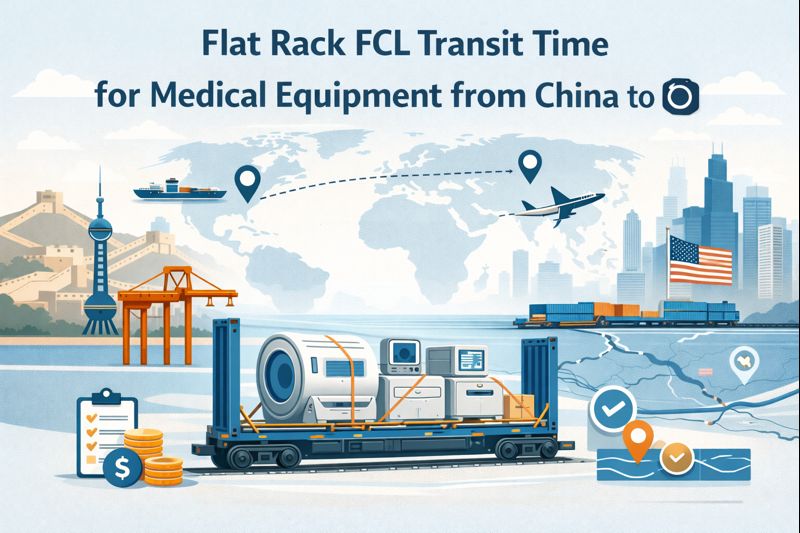
Because oversized medical equipment cannot fit into standard containers, Flat Rack FCL transit time for medical equipment from China to Chicago often becomes harder to predict than regular FCL shipments. Therefore, importers must plan not only ocean schedules but also port handling and inland transit with greater precision. With structured coordination and support from Top China Freight, Flat Rack timelines can be stabilized instead of left to chance.

Why Does Flat Rack FCL Transit Time Differ from Standard Containers?
Flat Rack containers serve cargo that exceeds height or width limits, which immediately changes how terminals and carriers handle the shipment. As a result, transit time variability increases.
First, Flat Rack cargo usually requires special loading and lashing at origin ports in China. Because these operations depend on crane availability and safety checks, vessel cut-off times are often earlier. Second, at destination ports, Flat Rack containers are discharged separately, which can delay availability compared to standard boxes.
Consequently, flat rack FCL transit time China to Chicago must be evaluated as a multi-stage timeline rather than a single ocean leg.
How the China to Chicago Route Shapes Flat Rack Transit Time
Chicago is an inland hub, so Flat Rack shipments always involve at least two major legs: ocean transport to a U.S. port and inland movement by rail or truck.
Most medical equipment flat rack shipping from China to USA routes through West Coast ports such as Los Angeles or Long Beach. From there, containers move inland to Chicago by rail. Therefore, port congestion and rail capacity directly influence the final delivery date.
Moreover, weather disruptions or labor issues at coastal ports can extend dwell time for Flat Rack cargo more than for standard FCL.

What Role Do Ports Play in Flat Rack Transit Time?
Ports represent the most sensitive points in the Flat Rack timeline. Because Flat Rack containers are non-standard, terminals allocate limited handling windows.
In busy seasons, flat rack containers may wait longer for discharge. Therefore, medical equipment ocean freight flat rack schedule planning should always include buffer days at destination ports.
Importers that coordinate closely with sea freight services can anticipate congestion patterns and select ports with more reliable handling capacity.
What Is the Typical Flat Rack FCL Shipping Timeline?
Although exact timing varies, a realistic flat rack FCL shipping timeline for medical devices usually includes several fixed stages.
| Shipping Stage | Typical Time Range | Key Risk Factors |
|---|---|---|
| Origin loading & lashing | 3–6 days | Crane scheduling, safety checks |
| Ocean transit China–USA | 14–20 days | Vessel delays, transshipment |
| Port handling & discharge | 3–7 days | Congestion, special handling |
| Inland rail to Chicago | 5–9 days | Rail capacity, terminal dwell |
Because each stage carries different risks, total port to door transit time flat rack FCL Chicago often falls between 28 and 42 days.
Case Studies
Diagnostic Equipment Shipped to Chicago
Route: Shanghai → Los Angeles → Chicago
Cargo: Oversized diagnostic imaging unit
Container: Flat Rack FCL
Total transit time: 34 days
Because load plans and medical compliance documents were approved before booking, port handling remained smooth. As a result, inland rail transfer proceeded without delay.
Industrial Medical Machinery from South China
Route: Shenzhen → Long Beach → Chicago
Cargo: Heavy sterilization equipment
Container: Flat Rack FCL
Total transit time: 38 days
In this shipment, minor congestion at the destination port added extra dwell time. However, pre-booked rail slots limited overall delay and protected the delivery schedule.
How Do Demurrage and Detention Affect Flat Rack Timelines?
Demurrage and detention represent hidden extensions of transit time. Even when the vessel arrives on schedule, Flat Rack containers may remain idle at ports due to inspection queues or handling constraints.
| Risk Area | Impact on Transit Time | Typical Cause | Mitigation Approach |
|---|---|---|---|
| Port demurrage | +3–7 days | Congestion, inspection backlog | Early clearance, buffer days |
| Equipment detention | +2–5 days | Delayed inland pickup | Pre-book rail or truck |
| Yard repositioning | +1–3 days | Special handling limits | Terminal coordination |
Because Flat Rack cargo is non-standard, these risks affect it more strongly than dry containers. Therefore, transit time planning must include buffer strategies rather than relying on best-case scenarios.

Can Customs Clearance Extend Flat Rack Transit Time?
Customs clearance for medical equipment often involves more scrutiny than general cargo. When combined with Flat Rack handling, clearance delays can compound transit time risk.
Flat rack container customs clearance medical equipment processes typically focus on cargo value, technical specifications, and import compliance. If documents mismatch physical cargo, inspections may occur.
By aligning documentation early and working with experienced brokers, importers reduce the likelihood of extended holds. Many shippers integrate clearance planning with customs brokerage services to maintain schedule stability.
How Supply Chain Visibility Improves Flat Rack Time Control
Visibility does not shorten ocean distance, yet it improves decision-making speed. When milestones remain visible, importers can react before delays compound.
For example, if discharge is delayed by congestion, inland rail schedules can be adjusted immediately. Similarly, when clearance completes early, pickup can be accelerated. As a result, end to end flat rack FCL logistics China to Chicago become more manageable.
Conclusion
Flat Rack FCL transit time for medical equipment from China to Chicago depends on far more than ocean distance. By planning each stage—origin handling, port operations, customs clearance, and inland delivery—importers can turn a complex shipment into a controlled process. With structured coordination, Flat Rack timelines become predictable enough to support critical medical supply chains.
Request A Free Quote
Start shipping smarter with TopChinaForwarder today! 🚢✨ Request a Free Quote 📝 and get a tailored logistics plan built around your cargo and timeline.
FAQ:
What is the average Flat Rack FCL transit time to Chicago?
Most shipments arrive within 28–42 days, depending on port congestion and inland rail availability.
Why does Flat Rack cargo face longer port handling times?
Flat Rack containers require special lifting and inspection, which limits handling windows.
Does medical equipment require special customs checks?
Often yes. High-value or technical equipment may trigger additional reviews.
Can transit time be guaranteed for Flat Rack shipments?
Exact guarantees are rare, but experienced planning significantly improves reliability.
Should insurance be used for Flat Rack medical equipment?
Insurance is strongly recommended due to cargo value and handling complexity.