
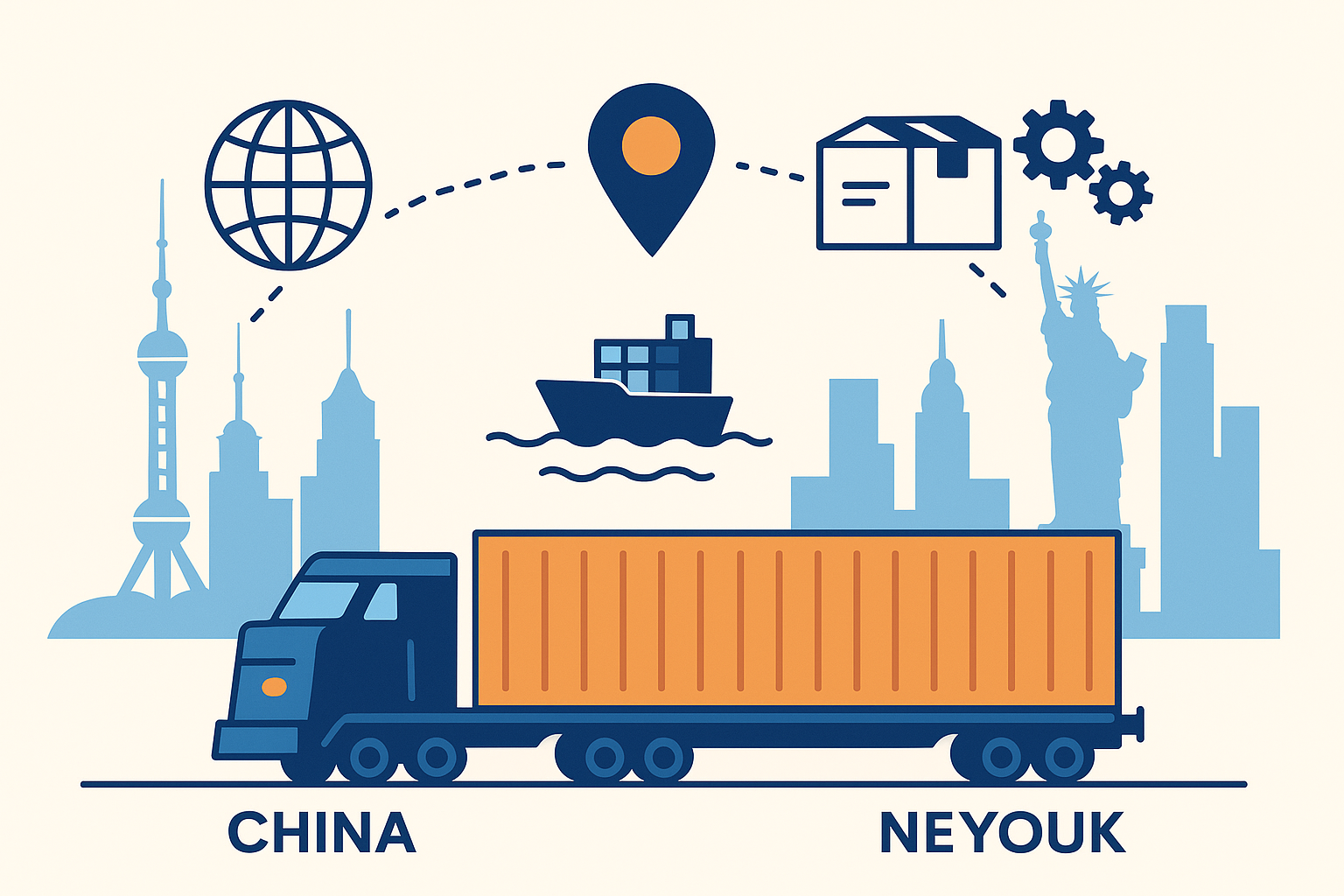
In today’s volatile trade environment, a China FCL supply chain solution to New York has become essential for importers seeking cost control and delivery reliability. However, fluctuating freight rates, port congestion, and compliance risks often complicate full container load planning. Therefore, this guide breaks down a practical, end-to-end approach—backed by real operations—starting directly from trusted partners like Top China Freight to help you move containers with confidence.
What defines a China FCL supply chain solution to New York?
A China FCL supply chain solution to New York goes far beyond booking vessel space. Instead, it integrates origin operations, ocean transport, customs, and inland distribution into one controlled workflow.
Why FCL matters for U.S. East Coast importers
Compared with LCL, FCL shipping from China to New York offers clearer cost predictability and stronger cargo security. Moreover, when volumes exceed 15–18 CBM, full container load logistics often reduce the per-unit landed cost. As a result, many import/export managers favor FCL to stabilize delivery schedules.
Core components of an effective FCL supply chain
Although routes vary, most successful solutions include:
- Factory pickup and container stuffing
- Export documentation and customs filing
- Ocean freight to New York or nearby ports
- U.S. customs clearance and compliance
- Drayage, warehouse handling, and final delivery
Each stage must align to avoid idle containers and unexpected detention.
How does FCL shipping from China to New York actually flow?
To understand performance, it helps to view the journey as a connected chain rather than isolated steps.
Origin coordination in China
First, container planning starts at the factory level. Carton dimensions, palletization, and container type (20GP, 40GP, 40HQ) directly affect freight rates and load efficiency. Additionally, exporters often rely on integrated FCL & LCL services to secure equipment during peak season.
Ocean transport and carrier selection
Next, vessels typically depart from ports such as Shanghai, Ningbo, or Yantian. While sailing time to the U.S. East Coast averages 30–38 days, routing choices via Panama or Suez influence both transit time and risk exposure. Consequently, supply chain managers balance cost against schedule reliability.

What are realistic FCL transit times and costs?
Although pricing fluctuates, understanding benchmarks helps decision-making.
| Route Segment | Typical Range |
|---|---|
| China port → New York port | 30–38 days |
| Port clearance & drayage | 3–7 days |
| Door-to-door total | 35–45 days |
| FCL ocean freight (40HQ) | USD 4,000–7,500 |
Figures shown as reference ranges, not fixed quotes.
Because freight rates change weekly, proactive planning often saves more than last-minute bookings.
How do customs and compliance impact the supply chain?
Customs clearance represents one of the highest risk points in a China FCL supply chain solution to New York.
U.S. import requirements to manage early
Importers must prepare ISF filings, commercial invoices, packing lists, and HS code classifications in advance. Furthermore, inaccuracies may trigger inspections that delay delivery schedules and increase demurrage.
To reduce exposure, many companies integrate professional customs brokerage support directly into their FCL workflow, ensuring documents align before containers even sail.
Case Studies
Electronics importer to New York
Route: Shenzhen → New York
Cargo: Consumer electronics, 40HQ
Mode: FCL ocean freight + door delivery
Cost: ~USD 6,200
Transit time: 37 days door-to-door
Because shipment visibility was prioritized, the importer reduced inventory buffer by one week and avoided peak-season rollovers.
Furniture shipment to the New York metro area
Route: Ningbo → New York
Cargo: Flat-pack furniture, 2 × 40HQ
Mode: FCL ocean freight + warehouse distribution
Cost: ~USD 11,800 total
Transit time: 41 days door-to-door
Because delivery slots were reserved before vessel arrival, the importer avoided peak-season demurrage and maintained retail launch timelines.
Why does risk management define a strong China FCL supply chain solution to New York?
Because full container shipments concentrate value into a single unit, risk control becomes a core design principle rather than an afterthought.
Key risks to anticipate early
Most disruptions stem from:
- Incomplete export or import documentation
- Port congestion or labor slowdowns
- Seasonal equipment shortages
- Misaligned delivery appointments
However, when risks are identified upfront, mitigation strategies can be built into the supply chain.
Proactive visibility and tracking
Instead of reactive updates, advanced tracking allows supply chain managers to adjust downstream plans in real time. Consequently, inventory teams can rebalance stock or reschedule deliveries before delays escalate into lost sales.

How can importers optimize FCL cost without sacrificing reliability?
Although freight rates remain volatile, cost optimization is still achievable with the right structure. More importantly, savings usually come from process alignment rather than chasing the lowest ocean rate.
Strategic booking and container utilization
To begin with, aligning production schedules with vessel cut-off dates reduces storage and rollover risk. At the same time, accurate carton planning improves container utilization, which directly lowers the cost per unit. For many shippers, leveraging consolidated planning through reliable sea freight solutions helps secure stable space allocation during peak periods.
Inland and destination-side efficiencies
Equally important, New York-area drayage and warehouse coordination should be planned before the vessel arrives. Otherwise, containers may sit idle, accumulating detention charges. Therefore, importers often pre-book chassis and bonded warehouse slots to protect delivery schedules.
How should UK-based supply chain teams manage China–US FCL flows?
Even though the destination is the U.S., UK-based companies often oversee procurement and logistics decisions.
Centralized oversight with regional execution
In practice, UK supply chain leaders focus on KPI visibility—freight rates, transit time, and customs compliance—while local agents execute on the ground. Therefore, standardized reporting and milestone tracking become critical to maintaining control across time zones.
Aligning global compliance standards
Furthermore, harmonizing documentation standards across China, the UK, and the U.S. reduces errors. This alignment also speeds up audits and internal approvals, which is essential for scaling operations.
Conclusion
A well-designed China FCL supply chain solution to New York combines planning, compliance, and execution into one controlled process. By optimizing container utilization, managing customs risk, and coordinating destination delivery, importers can protect margins and timelines. Ultimately, scalable FCL logistics enable consistent growth across competitive U.S. markets.
Request A Free Quote
Start shipping smarter with TopChinaForwarder today! 🚢✨ Request a Free Quote 📝 and get a tailored logistics plan built around your cargo and timeline.
FAQ:
What factors influence FCL pricing from China to New York?
Pricing depends on container size, seasonality, carrier availability, fuel surcharges, and destination drayage costs.
How much does customs clearance impact delivery time?
Proper documentation usually clears within 1–3 days, while inspections may add several days if issues arise.
Is insurance recommended for FCL shipments?
Cargo insurance is strongly advised, as FCL concentrates shipment value into a single container.
Can FCL shipments be tracked in real time?
Most providers offer milestone tracking from departure through port arrival and final delivery.
How early should FCL space be booked during peak season?
Booking 2–3 weeks in advance is recommended to secure equipment and vessel space.