
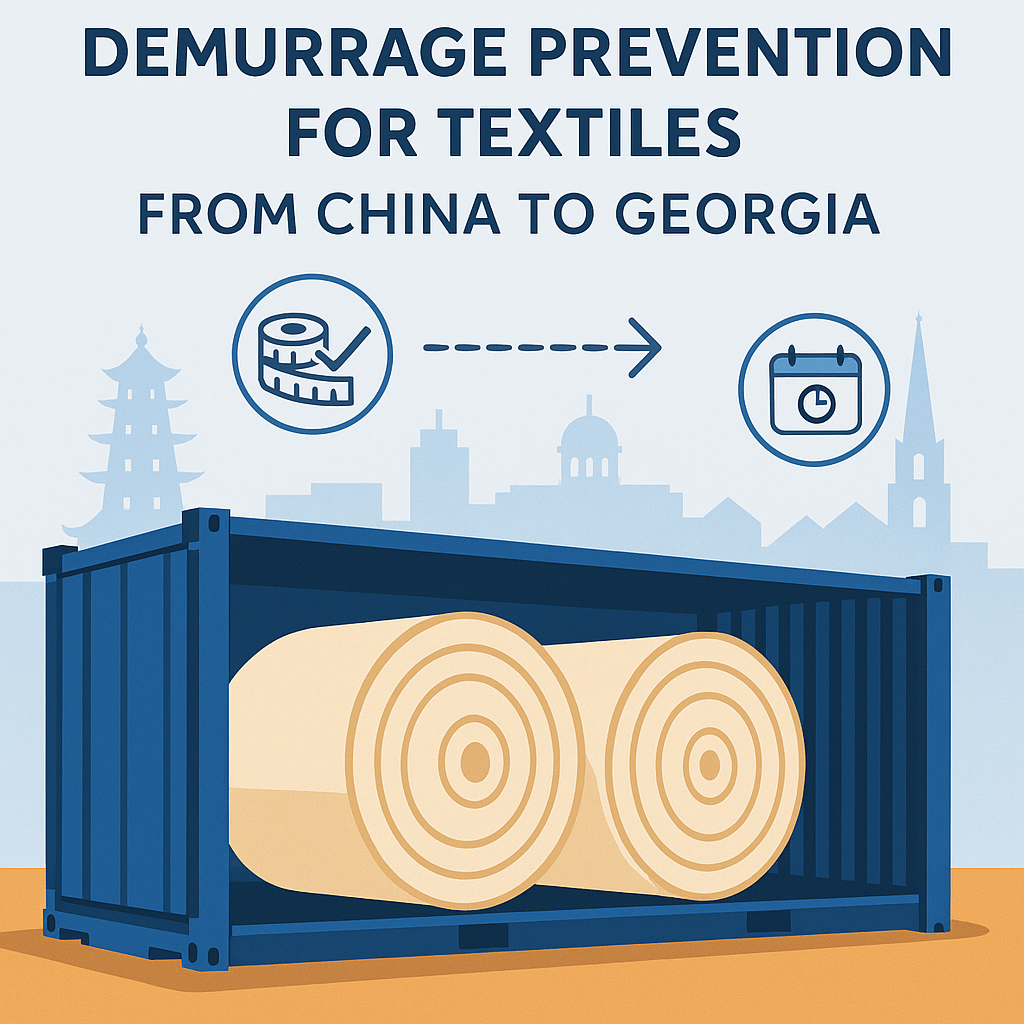
Although many importers underestimate the complexity of oversized textile cargo, Open Top FCL demurrage prevention for textiles from China to Georgia requires precise planning across loading, customs, transport scheduling, and inland delivery. Therefore, this guide explains how textile buyers can reduce demurrage before it occurs by improving forecasting, documentation accuracy, and port coordination—especially when working with experienced partners such as Top China Freight. Moreover, you will discover preventive steps that keep storage fees under control while maintaining transit stability across the China–Georgia lane.

What Makes Open Top FCL Ideal for Textile Cargo?
Textile cargo—especially oversized rolls, stacked fabrics, and industrial materials—often exceeds the height limits of standard containers. Because Open Top units allow loading from above and accommodate taller cargo, they offer unmatched flexibility.
Benefits for Textile Shipments
- Allows crane or side-loading for bulky rolls
- Supports uneven or irregular stacking layouts
- Reduces compression-damage risk to delicate fabrics
- Eases loading for heavy textile machinery
- Ensures safer handling for long or awkward-shaped cargo
Additionally, Open Top FCL shipments reduce the need for repacking at origin, which helps avoid delays that can trigger demurrage later.
Why Do Textiles Face Higher Demurrage Risks?
Although textiles seem simple to handle, their volume, weight variations, and customs sensitivity often create bottlenecks at ports. Moreover, documentation inconsistencies frequently cause extended inspections.
Common Risk Drivers
- Incorrect cargo measurements for Open Top bookings
- Delayed customs clearance due to textile classification
- Lack of prior communication about oversized cargo
- Insufficient trucking availability at destination
- Slow unloading arrangements at the buyer’s warehouse
Because Georgia’s port infrastructure sometimes experiences congestion, proactive planning becomes essential to mitigate these delays.

How Can Importers Reduce Demurrage Through Proper Cargo Measurement?
Accurate cargo dimensions are the foundation of demurrage prevention. Although Open Top containers offer height flexibility, carriers still require precise measurements to confirm stowage plans.
Measurement Checklist
- Record length, width, height of each textile roll
- Confirm total stack height after palletization
- Account for securing materials such as belts or nets
- Provide 3D layout sketches when cargo is irregular
- Validate final measurements with the supplier before booking
Since incorrect data may cause vessel rejection or rebooking, precise measurement prevents costly storage time.
What Documentation Helps Prevent Demurrage for Textile Imports to Georgia?
Customs delays are one of the biggest causes of demurrage. Therefore, maintaining compliant and accurate documentation is crucial.
Required Documents for Textile Cargo
| Document | Purpose | Importance |
|---|---|---|
| Commercial Invoice | Declares textile value & specs | Must include fabric type & composition |
| Packing List | Shows roll quantity & dimensions | Helps inspection and classification |
| Bill of Lading | Confirms shipment details | Needed for cargo release |
| HS Classification Sheet | Confirms textile category | Prevents customs reclassification |
| COO (Certificate of Origin) | Determines duty rate | Important for trade preference |
| Import License (if applicable) | Required for some textile types | Avoids regulatory delays |
Working with logistics partners who offer customs brokerage ensures customs steps stay on track and demurrage stays under control.
Case Studies
Textile Rolls from Guangzhou to Savannah
Cargo: 40’ Open Top with oversized industrial fabric rolls
Transit Time: 36 days
Challenge: High risk of compression damage and unloading delays
Solution: Customized pallet layout, reinforced netting, and pre-filed customs documentation
Outcome: No delays at port; demurrage fees avoided entirely
Apparel Fabrics from Ningbo to Savannah
Cargo: 20’ Open Top with mixed textile lots
Transit Time: 34 days
Challenge: Supplier provided incorrect cargo measurements
Solution: Reassessment of dimensions, updated carrier stowage plan, early appointment booking
Outcome: Shipment loaded without rollover; demurrage reduced by 90%
What Are Typical Transit Times for Textile Shipments to Georgia?
Transit time greatly influences storage planning. Although schedules vary, textile shipments moving from China to Georgia generally follow predictable patterns.
Approximate Transit Time Table
| Origin Port | Georgia Port | Transit Time | Notes |
|---|---|---|---|
| Shanghai | Savannah | 30–37 days | Most stable textile route |
| Ningbo | Savannah | 31–38 days | Good Open Top availability |
| Shenzhen | Savannah | 33–40 days | Ideal for apparel/accessories |
| Qingdao | Savannah | 34–42 days | Longer customs screening |
Since transit times fluctuate, importers should monitor sailing changes weekly and adjust warehouse plans accordingly.
Can Digital Tracking Tools Help Avoid Demurrage for Open Top FCL?
Yes. Because digital platforms provide visibility across each shipping stage, they help importers respond quickly when milestones shift.
Useful Tracking Features
- Automated alerts for vessel delays
- Real-time drayage scheduling updates
- Customs clearance progress notifications
- Terminal storage countdown reminders
- Document upload and verification portals
Additionally, partnering with providers offering full-route visibility—such as Top China Freight—allows textile importers to make informed decisions before deadlines expire.
How Do Inland Delivery Challenges Influence Demurrage Outcomes?
Although many importers focus mainly on port operations, inland delivery is often the final cause of demurrage. Moreover, Georgia’s distribution hubs—Atlanta, Savannah, Augusta—experience variable trucking availability.
Inland Risk Factors
- Driver shortages during peak seasons
- Long unloading times at textile warehouses
- Limited receiving hours for small distributors
- Weather-driven route disruptions
- Appointment backlogs during retail cycles
Prevention Measures
- Pre-book drayage at least 3–5 days before vessel arrival
- Confirm warehouse unloading capability
- Maintain backup carriers during busy months
- Schedule deliveries outside peak receiving hours
Consequently, early coordination reduces the chance of containers sitting at the terminal beyond free time.
Conclusion
The process of Open Top FCL demurrage prevention for textiles from China to Georgia requires proactive planning, precise documentation, accurate measurements, and coordinated communication across every logistics stage. Moreover, textile cargo’s oversized nature makes compliance, loading consistency, and schedule management even more crucial. Therefore, importers who adopt preventive strategies—combined with reliable logistics partners—can significantly reduce demurrage costs while improving supply-chain stability and cargo integrity.
Request A Free Quote
Start shipping smarter with TopChinaForwarder today! 🚢✨ Request a Free Quote 📝 and get a tailored logistics plan built around your cargo and timeline.
FAQ:
Why are Open Top containers used for textile cargo?
They allow overhead loading and accommodate oversized rolls or machinery that exceeds standard container height.
What causes most demurrage charges for textile shipments?
Delays from customs review, incorrect measurements, lack of trucking availability, or slow warehouse unloading.
How early should I book an Open Top container?
Booking 2–3 weeks before cargo readiness ensures space and prevents rollover delays.
Can warehouse delays contribute to demurrage?
Yes. If receiving teams cannot unload on time, containers may remain at the terminal past free time.
How do tracking tools support demurrage prevention?
They provide real-time alerts for vessel delays, customs progress, and trucking updates.