
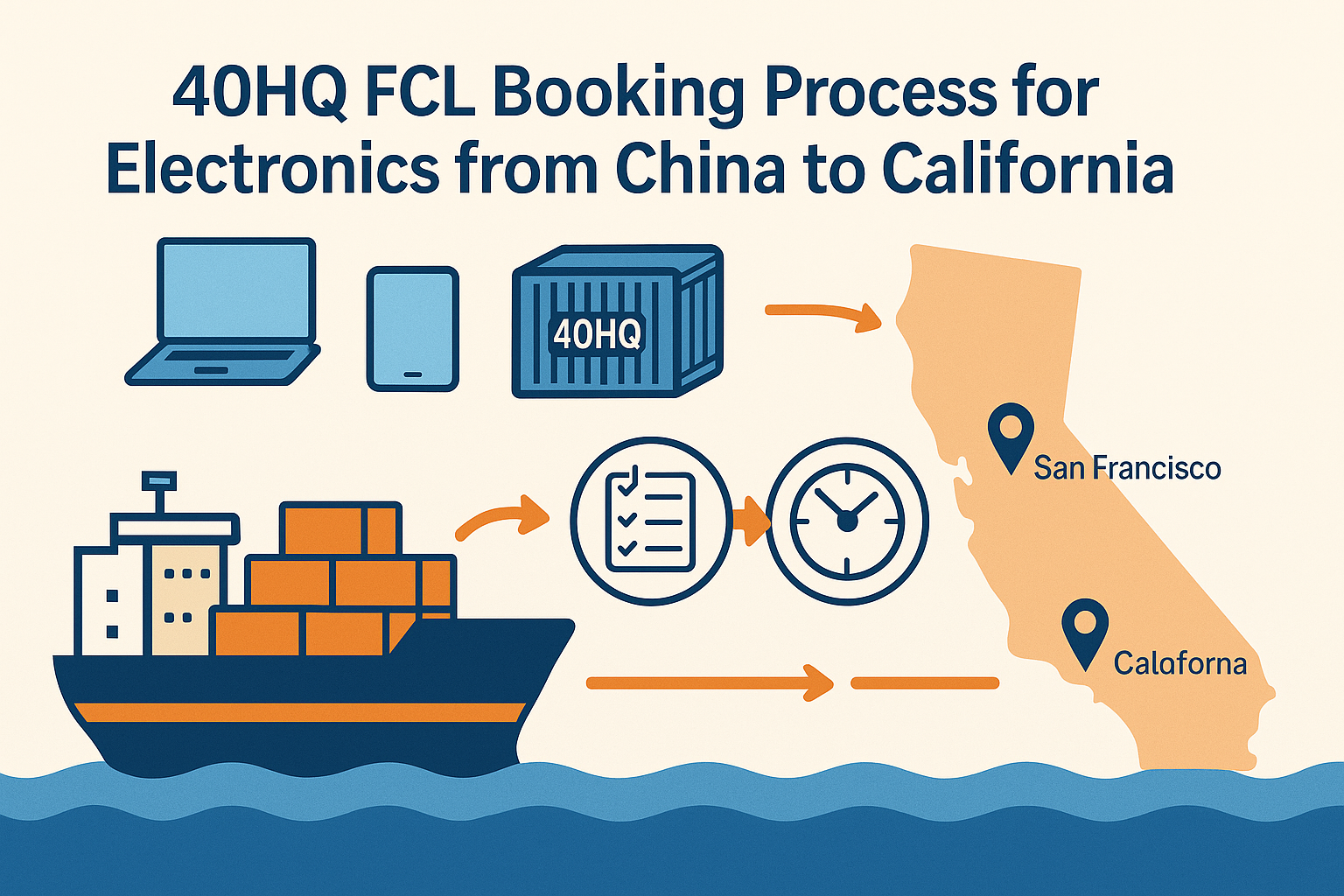
However, managing the 40HQ FCL booking process for electronics from China to California has become increasingly complex as manufacturers face equipment shortages, schedule fluctuations, and tight cut-off times. Since electronics require precise coordination between production, export documentation, and sailing schedules, teams must adopt a structured approach to protect deadlines and cost predictability. To support better planning, this guide outlines every essential step and offers practical solutions backed by operational experience from Top China Freight, whose insights begin on our home page.
What Makes the 40HQ FCL Booking Process Different for Electronics?
Because electronics are high-value, time-sensitive, and often fragile, the booking process must minimize disruptions across manufacturing, export compliance, and ocean scheduling. Moreover, tight delivery commitments for California distribution centers require predictable ETAs, which means every FCL booking step must run smoothly. Since electronics FCL booking timeline for US West Coast routes depends on accurate production forecasts, procurement teams must communicate cargo-ready dates early to avoid equipment shortages or rollovers.
Furthermore, electronics frequently include lithium batteries or sensitive components, and therefore require additional declarations that increase the importance of early booking. When each step is aligned—from purchase orders to container release—importers reduce cost volatility and improve service stability.
How Should Shippers Plan the Booking Timeline for 40HQ Electronics Cargo?
Although most exporters begin planning 7–10 days before vessel cut-off, electronics shipments benefit from a more structured schedule. Therefore, adopting a proactive freight scheduling strategy for 40HQ cargo ensures both equipment availability and documentation readiness.
Typical Booking Timeline
- Day 1–2: Confirm cargo-ready date and receive production-to-sailing coordination updates.
- Day 3–4: Submit booking request and review sailing options for California ports.
- Day 5: Secure 40HQ equipment and confirm stuffing date with the factory.
- Day 6–7: Finalize customs-ready documentation and issue shipping instructions.
Because delays at any stage can push the shipment into the next sailing cycle, early action helps importers avoid unnecessary storage or airfreight alternatives.

What Documents Are Essential Before Booking a 40HQ Container?
Since California-bound electronics face strict customs and security rules, exporters must prepare complete paperwork before the booking request is submitted. Additionally, because missing information leads to corrections that slow FCL workflows, shippers should create a standardized compliance checklist.
Core Documentation for Electronics
- Commercial invoice with HS codes and product descriptions
- Packing list including carton count, dimensions, and net/gross weights
- Product certifications for electronic components
- Battery declarations (if applicable)
- Export license or compliance documents
Moreover, using an automated export compliance workflow for electronic equipment helps avoid discrepancies between invoice, packing list, and booking data.
Comparison of 40HQ Booking Requirements for General Cargo vs. Electronics
| Requirement | General Cargo | Electronics Cargo |
|---|---|---|
| Documentation Deadline | Moderate | Strict, requires certification & battery declarations |
| Cargo Sensitivity | Low | High (fragile, high-value, regulated) |
| Booking Lead Time | 3–5 days | 7–10 days recommended |
| Risk of Rollovers | Medium | High if documentation incomplete |
| Inspection Probability | Low | Higher for electronics components |
Therefore, electronics shippers must adopt more structured planning compared to general FCL exports.
Case Studies
Shenzhen Factory → Los Angeles DC
Origin: Shenzhen
Destination: Los Angeles
Cargo: 40HQ of consumer electronics
Transit Time: 14 days
Cost Level: Medium
Outcome: On-time delivery thanks to early booking
Because the exporter used detailed production forecasts and booked 12 days ahead, equipment was secured without issue. Moreover, customs documents were completed early, enabling fast discharge and immediate delivery to the distribution center.
Ningbo Supplier → Oakland Technology Hub
Origin: Ningbo
Destination: Oakland
Cargo: Mixed high-value electronics components
Transit Time: 19–21 days
Cost Level: Moderate
Outcome: Delay-free workflow due to precise coordination
Although the cargo involved regulated components, early compliance reviews prevented issues. Additionally, predictive ETA tools helped the importer prepare inland trucking schedules without bottlenecks.
Transit Time Comparison for California-Bound Electronics
| Destination Port | Typical Transit Time | Schedule Predictability | Notes |
|---|---|---|---|
| Los Angeles | 12–16 days | High | Fast discharge but peak congestion risk |
| Long Beach | 13–17 days | High | Ideal for retail supply chains |
| Oakland | 17–22 days | Moderate | Suitable for Northern California DCs |
Because transit times shift seasonally, shipping schedule optimization for California deliveries remains critical for electronics importers.
What Are the Key Steps in the 40HQ FCL Booking Workflow?
Although every forwarder follows a similar framework, electronics exporters benefit from a structured, repeatable model that merges documentation, equipment control, and sailing visibility.
Standard 40HQ Booking Workflow
- Confirm cargo-ready date with factory
- Select preferred sailing window for California delivery
- Submit booking request with detailed product data
- Receive booking confirmation from carrier
- Reserve equipment and issue delivery order
- Arrange trucking to factory for container pickup
- Complete loading and VGM submission
- Send final shipping instructions before SI cut-off
- Track vessel movement and update ETA for distribution teams
Since electronics shipments often require special handling or declarations, working with an experienced logistics partner like Top China Freight helps maintain consistency across all nine process steps.
Electronics Export Documentation Checklist
| Document | Required? | Purpose |
|---|---|---|
| Commercial Invoice | Yes | Confirms declared value & product type |
| Packing List | Yes | Details carton data for customs & carrier |
| Battery Declaration | If applicable | Safety compliance |
| Test Reports | Sometimes | Verification of electronic standards |
| Export License | If required | Compliance for regulated components |
Because electronics often contain restricted parts, document accuracy prevents booking delays and customs holds.
Conclusion
The 40HQ FCL booking process for electronics from China to California requires precise planning, early coordination, and strict compliance. Moreover, success depends on synchronizing production schedules, booking timelines, equipment allocation, customs preparation, and sailing visibility. When companies adopt structured workflows supported by experienced logistics partners, they reduce risk, protect commitments, and shorten lead times. For importers seeking reliability, partnering with a professional provider ensures every container moves on schedule—with fewer surprises and greater cost control.
Request A Free Quote
Start shipping smarter with TopChinaForwarder today! 🚢✨ Request a Free Quote 📝 and get a tailored logistics plan built around your cargo and timeline.
FAQ:
How early should I book a 40HQ container for electronics?
Booking 7–12 days ahead is ideal to secure equipment and avoid seasonal shortages.
What happens if the cut-off time is missed?
The shipment normally moves to the next vessel, extending lead time.
Which California port is best for electronics?
Los Angeles offers faster discharge, while Oakland is better for Northern California hubs.
How do I avoid customs issues?
Ensure HS codes, values, and product descriptions match across all documents.
Can visibility tools improve planning?
Yes, real-time ETA updates help coordinate trucking and warehouse labor.