
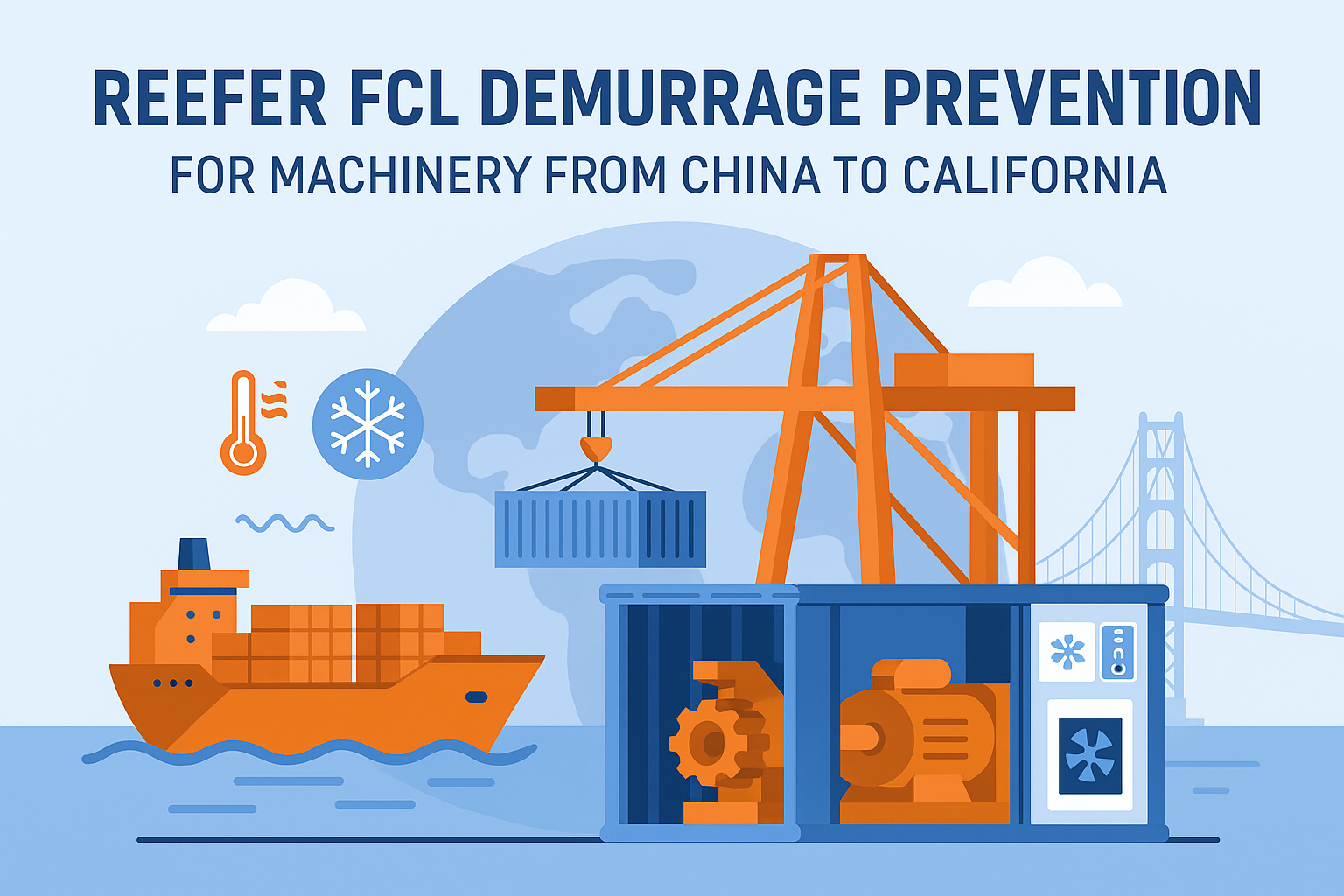
Because Reefer FCL demurrage prevention for machinery from China to California depends heavily on timing, documentation accuracy, and temperature-controlled handling, importers must coordinate closely with suppliers and carriers. Moreover, with reliable visibility and planning support through our homepage, shippers can reduce unexpected port delays and avoid costly demurrage penalties. This guide explains how to control timelines, documentation, reefer operations, and routing to keep machinery shipments on schedule.
What Makes Reefer FCL Demurrage Prevention Essential for Machinery?
Machinery shipments often include sensitive components, protective coverings, and temperature-stabilized materials requiring reefer control. Therefore, any delay at the terminal increases the risk of demurrage fees and potential temperature deviation.
Additionally, ports in California—especially Los Angeles, Long Beach, and Oakland—face seasonal congestion due to high import volumes, making demurrage prevention a priority for importers.
Key Factors Requiring Prevention
- Reefer plug-in requirements at terminals
- Customs clearance delays
- Inland truck appointment shortages
- Long dwell times during peak cargo season
- Temperature-sensitive machinery coatings or lubricants
Consequently, a structured plan is essential to avoid cost escalation.
How Should You Plan Reefer FCL Machinery Shipments Early?
Planning begins with verifying temperature requirements, confirming reefer settings, and checking machinery packing standards. Moreover, early booking is critical because reefer slots are more restricted than dry containers.
Since machinery is heavy and often oversized, loading operations require additional time, making schedule alignment especially important.
Key Early Planning Actions
- Confirm final machinery temperature range
- Pre-book reefer equipment 10–14 days before ETD
- Schedule factory loading with reefer pre-cooling
- Prepare customs documentation ahead of cutoff
- Request port plug-in timeline from the carrier
Additionally, early coordination with the supplier reduces the chance of last-minute delays.
Why Does Reefer FCL Experience Higher Demurrage Risk?
Reefer containers require special yard placement, limited reefer outlets, and additional monitoring. Therefore, if customs clearance or trucking is delayed, the container may remain in the terminal longer than expected, increasing demurrage risk.
Moreover, machinery often requires inspection or additional compliance checks, which can extend hold time without proper planning.
Common Causes of Reefer Demurrage
- Missing or incorrect HS codes
- Late ISF filing
- USDA or FDA inspection holds
- Incomplete packing list detail
- Unavailable trucking appointments
Because these issues disrupt the release timeline, importers should verify all data ahead of vessel arrival.
What Transit Time Should You Expect from China to California?
Transit time depends on the port of loading, carrier, and U.S. West Coast congestion. Although routes are relatively stable, seasonal delays or weather disruption may affect arriving schedules.
Estimated Shipping Time (China → California)
| Origin Port | Estimated Days | Notes |
|---|---|---|
| Shanghai | 12–16 | Fastest rotation |
| Ningbo | 13–17 | Strong reefer availability |
| Yantian / Shekou | 15–19 | Slightly longer routing |
| Qingdao | 16–21 | Northern route slower |
Moreover, importers should consider buffer days for customs processing and terminal dwell risk.
Real Case Study Cards
Precision Machinery (Shanghai → Los Angeles)
Cargo: CNC machinery requiring controlled temperature
Container: 40′ Reefer FCL
Weight: 18 tons
Route: Shanghai → Los Angeles
Transit Time: 14 days
Challenge: Equipment needed stable temperature and fast release
Solution: Early ISF filing, port plug-in arranged 24 hours before arrival, trucking booked 3 days in advance
Result: 0 demurrage, smooth customs clearance, and fast warehouse delivery.
Industrial Pumps (Ningbo → Oakland)
Cargo: Heavy-duty pumps with lubricant-sensitive materials
Container: 40′ Reefer
Weight: 16 tons
Route: Ningbo → Oakland
Transit Time: 17 days
Challenge: Customs requested additional HS code verification
Solution: Documentation reviewed by Top China Freight; reefer monitored during dwell; trucker secured same-day pickup
Result: Avoided demurrage entirely and achieved early delivery.
How Can Top China Freight Support Reefer Demurrage Prevention?
Top China Freight provides end-to-end coordination for machinery reefer shipments, including temperature management, port handling, customs preparation, and inland scheduling. Moreover, our specialists help importers track vessel arrival, arrange plug-in services, and avoid dwell time risks.
Additionally, our sea freight and FCL & LCL solutions offer flexible routing options to support equipment-heavy industries shipping to California.
With comprehensive planning, importers achieve predictable transit timelines and effective demurrage control.
How Do Freight Rates and Reefer Charges Affect Demurrage Planning?
Reefer FCL costs include ocean freight, reefer surcharges, plug-in fees, and temperature management charges. Moreover, demurrage is billed daily after free time expires, so understanding cost structure is essential for planning.
Reefer Cost Structure for Machinery
| Cost Item | Description |
|---|---|
| Ocean Freight | Varies by carrier |
| Reefer Surcharge | Charged for temperature equipment |
| Plug-In Fee | Daily energy supply at terminal |
| Monitoring Fee | For reefer temperature control |
| Demurrage | Daily charge after free time |
| Inland Trucking | Depends on California route |
Because machinery is high-value, importers often prefer predictable schedules that reduce time-related cost risks.
How Does Customs Clearance Influence Reefer Demurrage?
Machinery imports may require additional documentation such as test certificates, material declarations, and compliance statements. Moreover, California ports have strict inspection criteria for industrial machinery.
Therefore, importers must prepare accurate data to avoid customs holds that increase demurrage.
Machinery Import Documentation Checklist
| Document | Purpose |
|---|---|
| Commercial Invoice | Declares value |
| Packing List | Shows machine dimensions |
| Bill of Lading | Confirms shipment |
| HS Code List | Ensures proper classification |
| Material Safety Sheet | For lubricants or coatings |
| COO | Origin confirmation |
To simplify compliance, many importers rely on professional customs brokerage services for document review and submission.
Conclusion
In conclusion, managing Reefer FCL demurrage prevention for machinery from China to California requires accurate documentation, strong supplier alignment, and fast inland transport. Although reefer cargo demands careful operational control, early planning and digital visibility dramatically reduce the risk of demurrage charges. Therefore, importers aiming for safe, on-time machinery delivery can benefit greatly from professional logistics support and structured coordination.
Request A Free Quote
Need a reliable logistics partner? Share your shipment details and we’ll provide a tailored quotation quickly and accurately.
FAQ:
Why is reefer demurrage common for machinery shipments?
Delays in customs, trucking, or temperature-handling procedures increase reefer dwell time.
How early should I book reefer machinery shipments?
Bookings should be placed 10–14 days before ETD due to limited reefer availability.
Do machinery shipments always require temperature control?
Not always. However, certain lubricants or components require stable temperature.
What reefer settings are used for machinery?
Most machinery requires a stable ambient temperature; however, settings vary by material.
Do reefer containers cost more?
Reefer FCL includes extra surcharges for equipment, electricity, and monitoring.