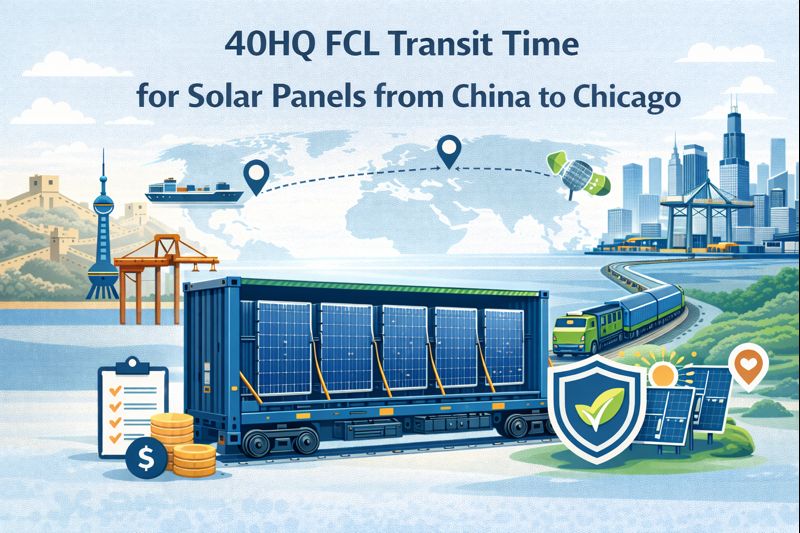
Because solar panels ship in large volumes and high-value units, 40HQ FCL transit time for solar panels from China to Chicago must be planned with precision rather than estimates. Therefore, importers need a clear view of ocean transit, U.S. port handling, and inland delivery timing to avoid costly disruptions. With structured coordination and visibility supported by Top China Freight, solar panel shipments can reach Chicago with predictable schedules instead of reactive adjustments.
Why Do Solar Panels Commonly Ship in 40HQ FCL Containers?
Solar panels are lightweight but highly space-consuming. As a result, exporters often rely on 40HQ containers to maximize cubic capacity while maintaining safe stacking.
Because panels require protective packaging and stable positioning, full container load shipping reduces handling frequency and damage risk. In addition, 40HQ FCL delivery schedule for photovoltaic panels allows importers to control loading patterns and avoid mixing cargo types.
Consequently, container choice directly affects transit stability and downstream planning.
How the China to Chicago Route Shapes Transit Time
Chicago is an inland logistics hub, which means solar panels never arrive directly by sea. Instead, shipments move through coastal U.S. ports before continuing inland.
Most China to Chicago solar panel logistics timelines route through West Coast ports such as Los Angeles or Long Beach. After discharge, containers move inland by rail, followed by final trucking. Therefore, overall transit time depends on both maritime reliability and inland rail availability.
When either segment slows, total lead time extends quickly.
What Is the Typical 40HQ FCL Transit Time Breakdown?
Rather than viewing transit time as a single number, importers benefit from breaking it into stages.
Transit Stage
Typical Time Range
Key Influencers
Origin port handling in China
3–5 days
Export documentation, port congestion
Ocean transit to U.S. West Coast
14–18 days
Vessel schedule, weather
U.S. port discharge & dwell
3–7 days
Terminal congestion, inspections
Inland rail to Chicago
5–8 days
Rail capacity, terminal slots
As shown above, port to door transit time solar panels China to Chicago usually ranges between 25 and 38 days under normal conditions.
How Do U.S. Ports Affect Solar Panel Transit Time?
U.S. port performance often determines whether schedules hold or slip. During peak import seasons, container handling time increases noticeably.
Solar panel container handling time at U.S. ports may extend due to inspection backlogs or terminal congestion. Because solar panels are often part of energy infrastructure projects, documentation checks can also take longer.
To reduce risk, many importers plan arrivals outside peak windows and coordinate closely with sea freight services for schedule visibility.
Case Studies
Solar Panel Shipment from Shanghai to Chicago
Route: Shanghai → Los Angeles → Chicago Cargo: Photovoltaic panels Container: 40HQ FCL Total transit time: 32 days
Because inland rail was pre-booked before vessel arrival, the container transferred quickly after discharge. As a result, delivery met project installation deadlines without buffer overruns.
South China Solar Panels with Peak Season Pressure
Route: Shenzhen → Long Beach → Chicago Cargo: Utility-scale solar panels Container: 40HQ FCL Total transit time: 36 days
In this case, port congestion added extra dwell time. However, early documentation submission prevented further delays and kept the overall schedule within acceptable limits.
How Inland Rail Transit Influences Delivery to Chicago
After port release, inland rail transit becomes the critical path. Chicago benefits from extensive rail connections, yet rail slots are not unlimited.
Inland Transport Mode
Average Time
Reliability
Best Use Case
Rail
5–7 days
High
Long-distance inland moves
Truck
4–6 days
Medium
Urgent or short-haul needs
Therefore, inland rail transit time from U.S. ports to Chicago solar cargo should be reserved early to avoid bottlenecks during peak seasons.
Can Customs Clearance Extend Solar Panel Transit Time?
Customs clearance time for solar panel imports USA varies depending on documentation accuracy and compliance checks. Although solar panels are not hazardous, they may still face scrutiny related to origin, valuation, or trade policy.
If documents align with cargo details, clearance often completes quickly. However, discrepancies can add several days to port dwell time. As a result, customs readiness plays a direct role in 40HQ FCL transit time stability.
Many importers coordinate clearance planning alongside customs brokerage services to minimize surprises.
Should Importers Build Buffers into Solar Panel Schedules?
Buffers often feel inefficient, yet they protect critical timelines. For solar projects tied to installation deadlines, missing a delivery window can halt operations entirely.
Rather than padding every stage, smart buffers focus on the most volatile segments—ports and inland rail. This targeted approach balances efficiency with reliability.
Conclusion
The 40HQ FCL transit time for solar panels from China to Chicago depends on coordinated execution across ocean transport, U.S. ports, customs clearance, and inland rail. By breaking transit into stages, identifying risks, and planning buffers strategically, importers gain control over timelines that often feel unpredictable. With structured planning, solar panel logistics become a managed process rather than a recurring disruption.
Request A Free Quote
Start shipping smarter with TopChinaForwarder today! 🚢✨ Request a Free Quote 📝 and get a tailored logistics plan built around your cargo and timeline.