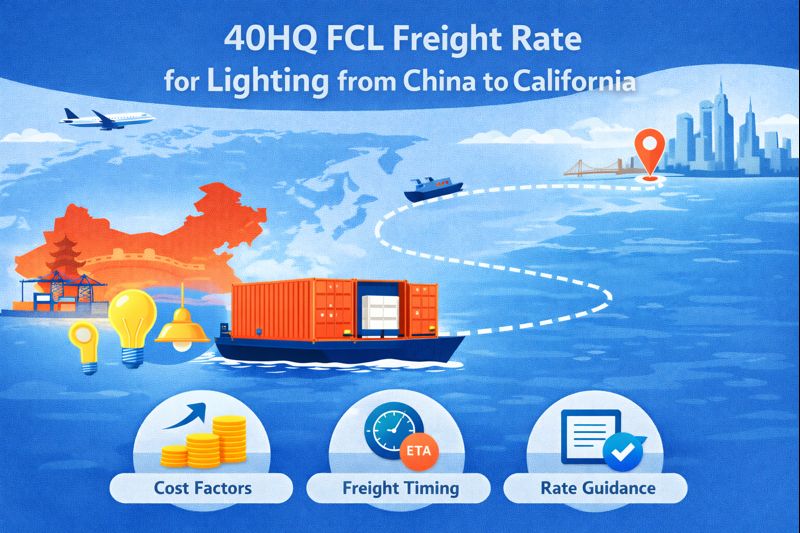
When importers evaluate the 40HQ FCL freight rate for lighting from China to California, pricing transparency often becomes the biggest challenge. However, by understanding how ocean freight rates are structured and what drives cost changes, lighting brands can plan budgets more accurately. Therefore, this guide explains real-world rate logic and cost drivers, drawing on practical experience from Top China Freight.
What determines the 40HQ FCL freight rate for lighting?
Several factors combine to form the final freight rate. While base ocean freight sets the foundation, additional variables frequently influence the total cost.
First, cargo characteristics matter. Lighting products often mix fragile items with bulky packaging, which affects container utilization. Second, route selection and port congestion shape carrier pricing. As a result, freight rates fluctuate even when shipment volume stays stable.
Why do lighting shipments usually choose 40HQ FCL?
Lighting exporters typically select 40HQ containers because of their higher cubic capacity. Compared with 40GP, 40HQ accommodates tall cartons, assembled fixtures, and protective packaging more efficiently.
Moreover, FCL shipping reduces cargo handling. Because lighting products are sensitive to vibration and impact, fewer handling points help limit damage risk. Consequently, 40HQ FCL becomes the preferred balance between cost efficiency and cargo safety.
Should lighting importers choose port-to-port or door-to-door?
Service scope affects both budgeting and execution. Port-to-port shipping works for importers with established U.S. logistics partners. However, door-to-door simplifies coordination when multiple SKUs or destinations exist.
By integrating door-to-door transport, importers gain a single timeline from factory to warehouse. Therefore, arrival planning improves and unexpected inland costs decrease.
How are China–California lighting freight rates structured?
Understanding the cost breakdown helps importers forecast spending more accurately.
Cost Component
Description
Cost Impact
Base ocean freight
Main sea transport
High
Bunker & carrier surcharges
Fuel and capacity costs
Medium
Terminal handling charges
Origin & destination ports
Medium
Documentation fees
B/L and admin
Low
Inland delivery (optional)
Truck or rail in California
Variable
Because each element fluctuates independently, importers who track cost components gain better control over the 40HQ FCL freight rate for lighting from China to California.
Case Studies
LED lighting shipment to Los Angeles
Origin: Shanghai, China Destination: Los Angeles, California Cargo: LED panel lights Container: 40HQ FCL Transit Time: 16 days Rate Outcome: Stable mid-range rate
By booking early and using a direct sailing, the importer avoided peak season surcharges and maintained predictable costs.
Decorative lighting to Long Beach
Origin: Ningbo, China Destination: Long Beach, California Cargo: Decorative lighting fixtures Container: 40HQ FCL Transit Time: 17 days Rate Outcome: Slightly higher base, lower inland cost
Selecting Long Beach reduced inland trucking distance. As a result, total landed cost remained competitive despite a higher ocean rate.
How does transit time affect freight rate planning?
Transit time and freight rates often move together. Faster routes may command higher base rates, while longer routes sometimes reduce upfront cost but increase inventory carrying expenses.
Transit Option
Transit Time
Cost Trend
Direct sailing
14–18 days
Mid–High
Congestion-adjusted
18–22 days
Variable
Indirect routing
20–25 days
Lower base
Therefore, importers assess total landed cost rather than freight rate alone when planning lighting shipments.
How do customs and compliance impact freight rates?
Customs readiness directly affects port dwell time and storage costs. Lighting products require accurate HS codes, safety documentation, and valuation consistency. When paperwork aligns, clearance proceeds quickly.
Partnering with customs brokerage services helps prevent holds that inflate total cost. Consequently, compliance discipline protects the effective freight rate.
What logistics trends will shape future lighting freight rates?
Looking ahead, capacity normalization and digital booking tools will increase pricing transparency. At the same time, sustainability surcharges and fuel adjustments will continue to influence rates.
Therefore, importers who plan earlier and leverage data-driven forecasts will maintain stronger control over the 40HQ FCL freight rate for lighting from China to California.
Conclusion
Managing the 40HQ FCL freight rate for lighting from China to California requires more than comparing spot quotes. Instead, success depends on port selection, load optimization, compliance readiness, and inland coordination. When these elements align, lighting shipments arrive safely, on time, and within budget. For importers seeking stability, structured planning remains the most effective strategy.
Request A Free Quote
Start shipping smarter with TopChinaForwarder today! 🚢✨ Request a Free Quote 📝 and get a tailored logistics plan built around your cargo and timeline.