
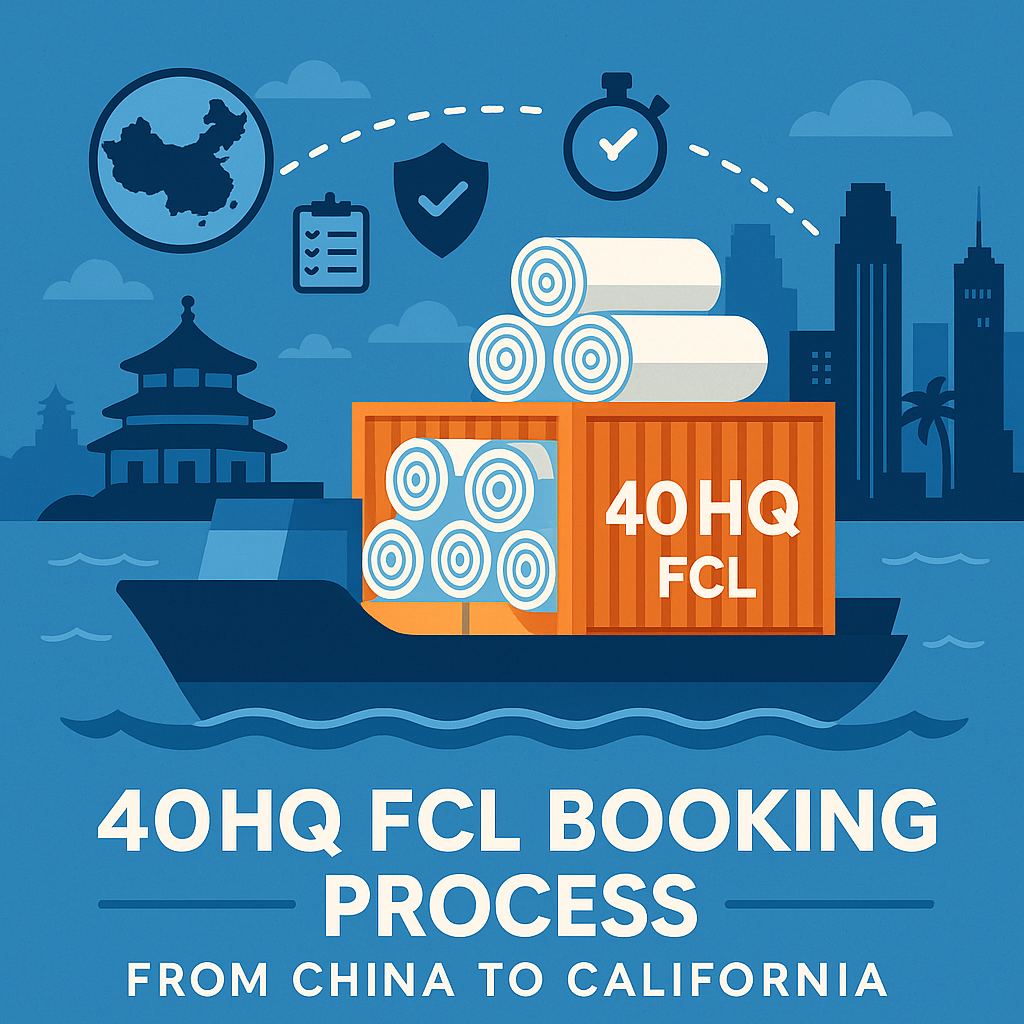
Although managing the 40HQ FCL booking process for textiles from China to California may seem challenging, importers can streamline each step by coordinating schedules, preparing documents early, and aligning transport plans with carrier cut-off times. Moreover, working with an experienced partner such as Top China Freight ensures stable space, reliable textile handling, and smooth California port clearance. Therefore, this guide provides a practical, step-by-step path to help you ship fabric, garments, and textile rolls from China to California efficiently.
What Does the 40HQ FCL Booking Process for Textiles from China to California Involve?
The booking workflow starts long before the container arrives at the port. Additionally, textile exporters must evaluate production schedules, carton dimensions, HS classification, and route options to avoid last-minute issues. Because textiles vary in density and packaging, the booking plan should include accurate volume estimates for 40HQ capacity.
Moreover, freight availability fluctuates during Q2 and Q4 when apparel brands replenish stock, meaning early booking is essential.
How Should You Prepare Textile Cargo for 40HQ FCL Shipping?
Textile shipments typically include rolls, cartons, or palletized garments, so packing consistency matters. Moreover, cargo fragility, moisture sensitivity, and SKU density all influence the loading plan.
Preparation Checklist
- Confirm textile roll dimensions and weight
- Prepare moisture-resistant packaging
- Apply clear SKU and fabric type labels
- Use reinforced pallets for heavy textile bundles
- Ensure carton stacking strength meets 40HQ load limits
Because textiles absorb moisture easily, exporters should prioritize dry warehouse staging to prevent mold before loading.
Why Is Accurate Volume Calculation Critical for 40HQ FCL Textile Shipping?

Although a 40HQ container holds more than a standard 40GP, textile rolls with irregular shapes reduce usable space. Therefore, calculating cubic meters (CBM) precisely allows accurate freight cost estimation and smoother loading.
Typical 40HQ Capacity for Textile Rolls
- 60–68 CBM usable space
- 24–28 tons weight limit
- 200–240 rolls depending on thickness
- 1000–1200 cartons for lightweight garments
Moreover, using digital measurement tools helps prevent overbooking or last-minute cargo overflow.
What Documents Are Required for Textile Exports from China to California?
Textile documentation must be accurate because US authorities enforce strict labeling and fiber-content rules.
Customs Document Checklist
| Document Type | Purpose |
|---|---|
| Commercial Invoice | Confirms textile value & fiber content |
| Packing List | Details roll/carton count & dimensions |
| HS Code Declaration | Ensures proper customs classification |
| Bill of Lading | Confirms ownership & shipping details |
| Textile Labeling Compliance | Required for garments & fabrics |
| Importer Security Filing (ISF) | Must be filed 24 hours before loading |
Additionally, incorrect HS codes for textiles can cause inspections, so exporters should verify them early.
How Does the 40HQ FCL Booking Timeline Work for Textile Exporters?
Although timelines vary by carrier and port, textile exporters should follow a structured schedule to avoid missing cut-off times.
Typical Booking Timeline
7–10 days before CY cut-off: Confirm cargo readiness, carton count, and volume
5–7 days before cut-off: Submit booking request to carrier
3–5 days before cut-off: Receive container number & pickup confirmation
1–2 days before cut-off: Load cargo at warehouse, return container to port
Before vessel departure: Submit SI, verify VGM, confirm ISF filing
Because California ports like Los Angeles and Long Beach can be congested, early preparation reduces risk significantly.
Case Study
Origin: Shanghai, China
Destination: Los Angeles, California
Cargo: 40HQ, 225 textile rolls (cotton & polyester)
Challenge: Factory delay risked missing CY cut-off
Solution: Early booking + weekend loading shift
Outcome: Cargo returned before cut-off, avoiding roll-over delays
Additionally, the importer optimized its textile supply chain management for future shipments.
Origin: Ningbo, China
Destination: Oakland, California
Cargo: 40HQ, 950 cartons of garments
Challenge: Incorrect HS code delayed documentation
Solution: Revised compliant HS codes + pre-clearance support
Outcome: Smooth customs clearance with no inspection fees
Moreover, the importer strengthened its textile import delivery schedules to prevent future issues.
How Can Top China Freight Support Textile FCL Shipments to California?


As a specialized forwarder, Top China Freight provides booking, consolidation, and customs support for textile exporters. Additionally, our team handles full‐cycle coordination through sea freight, and container optimization through FCL/LCL solutions. Because California ports demand precision, we ensure flawless document handling, schedule alignment, and end-to-end visibility across your textile supply chain.
What Are the Main Shipping Routes for Textiles from China to California?
Most textile shipments originate from Shanghai, Ningbo, Guangzhou, or Qingdao, and move to Los Angeles or Long Beach. Additionally, some containers move through Oakland for northern California distribution centers.
Transit Time & Route Overview
| Origin Port | California Destination | Transit Time |
|---|---|---|
| Shanghai | Los Angeles | 12–15 days |
| Ningbo | Long Beach | 14–17 days |
| Shenzhen | Los Angeles | 13–16 days |
| Qingdao | Oakland | 16–20 days |
Because vessel schedules change weekly, importers should monitor updates to maintain accurate delivery schedules.
Conclusion
Understanding the 40HQ FCL booking process for textiles from China to California allows importers to improve schedule reliability, reduce handling risks, and streamline customs procedures. Moreover, by aligning booking timelines, optimizing cargo preparation, and enhancing digital visibility, textile importers can secure smooth and predictable deliveries. If you need tailored support for textile shipments, our team can assist with planning, booking, and customs execution.
Request A Free Quote
Need a reliable logistics partner? Share your shipment details and we’ll provide a tailored quotation quickly and accurately.
FAQ:
How early should I book a 40HQ FCL for textiles?
Booking 7–10 days before cut-off ensures space and avoids roll-over delays.
Do textile rolls require special loading methods?
Rolls need careful stacking, balanced load distribution, and moisture protection.
Can I track my textile shipment in real time?
Yes, most carriers offer full digital visibility and milestone alerts.
What causes delays in textile clearance?
Incorrect HS codes, missing fiber content, and congestion cause delays.
Do garment shipments face inspections?
Some may be inspected if labeling or materials require verification.