
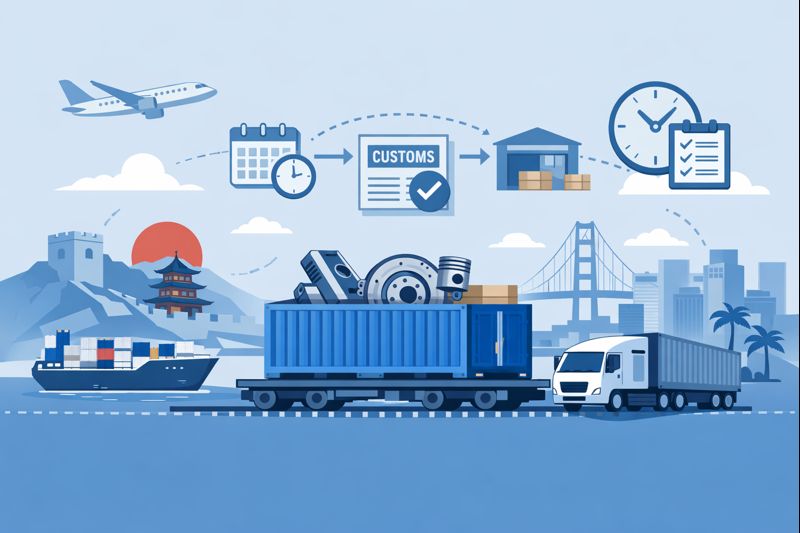
When shipping auto parts in 20GP containers from China to California, detention costs often appear suddenly and erode margins faster than expected. However, with the right planning, 20GP FCL detention prevention for auto parts from China to California becomes a controllable process rather than a recurring risk. Therefore, this guide explains actionable strategies importers can apply, supported by operational insights from real-world FCL shipments managed through Top China Freight.

What Causes 20GP FCL Detention for Auto Parts at California Ports?
Although detention fees are common across containerized trade, auto parts shipments face unique exposure due to compliance, timing, and inland delivery constraints. In practice, detention occurs when containers are not returned within the carrier’s free time after pickup.
Key Detention Triggers Importers Overlook
First, customs clearance delays frequently hold containers at terminals longer than planned. While auto parts are not typically restricted goods, HS code mismatches or missing importer security filings can stop release.
Second, port congestion in California—especially at Los Angeles and Long Beach—reduces truck appointment availability, which shortens effective free time.
Finally, inland trucking delays after port arrival California often result from chassis shortages or warehouse dock bottlenecks.
Because these issues often overlap, detention risks compound rather than occur in isolation.
How Does Free Time Management Affect 20GP FCL Detention Prevention?
Free time is the most underestimated variable in FCL shipping cost control. Essentially, it determines how long you can hold a container before detention charges apply.
Understanding Free Time Allocation
Typically, carriers offer 4–7 days of free time at destination for 20GP FCL containers. However, this window may shrink during peak season or congestion periods. As a result, importers relying on “standard” assumptions face higher detention exposure.
| Free Time Scenario | Risk Level | Impact on Detention |
|---|---|---|
| 7 days + pre-cleared customs | Low | Containers returned on time |
| 5 days + port congestion | Medium | Limited trucking flexibility |
| 4 days + customs inspection | High | Detention charges escalate |
Therefore, proactive negotiation of free time before booking plays a critical role in detention prevention.

Can Inland Trucking Strategy Reduce Detention Risk?
Inland transport decisions directly influence whether containers are returned within free time.
Smarter Inland Delivery Approaches
Instead of booking trucking after arrival, experienced importers secure drayage in advance. Additionally, splitting deliveries between nearby warehouses reduces dock congestion.
In some cases, door-to-door planning via integrated solutions—such as those offered through door-to-door logistics services—helps synchronize port pickup and final delivery.
As a result, inland delays become predictable rather than disruptive.
How Can Documentation Reduce 20GP FCL Detention at Destination?
Documentation accuracy directly influences how quickly containers exit the terminal. Even small errors can delay release by days.
Essential FCL Shipping Documentation Checklist
| Document | Purpose | Detention Impact |
|---|---|---|
| Commercial Invoice | Customs valuation | Delays cause terminal holds |
| Packing List | Cargo verification | Missing details trigger inspections |
| Bill of Lading | Cargo ownership | Errors block release |
| ISF (10+2) | US security filing | Late filing leads to holds |
| Arrival Notice | Pickup coordination | Delays slow trucking安排 |
Because documentation errors are avoidable, many importers reduce detention simply by validating paperwork before vessel departure.
Case Studies
20GP Auto Parts Shipment to California
Case 1: Shenzhen → Long Beach
Cargo: Brake components and suspension parts
Container: 1 × 20GP FCL
Transit Time: 18 days ocean + 4 days inland
Outcome: Detention avoided by pre-cleared customs and reserved trucking slots
In this case, early document validation and advance drayage booking eliminated detention despite mild port congestion.
Avoiding Detention Through Planning
Case 2: Ningbo → Los Angeles
Cargo: Engine accessories and metal fittings
Container: 1 × 20GP FCL
Transit Time: 20 days ocean + 5 days inland
Cost Control: Detention avoided by early ISF filing and pre-arranged drayage
Despite minor vessel delay, the container was returned within free time due to synchronized customs clearance and inland delivery.
Should Importers Rethink Booking Strategy to Prevent 20GP FCL Detention?
As detention risks increase, booking strategy has shifted from price-first to risk-balanced planning. While lower ocean freight rates look attractive, they often come with reduced free time or limited support at destination. Consequently, importers focusing only on freight rates expose themselves to higher downstream detention costs.
Smarter Booking Decisions
Instead of selecting carriers purely by rate, experienced importers evaluate:
- Historical port performance at California terminals
- Free time flexibility during congestion periods
- Local operational support for trucking and container return
By prioritizing reliability over marginal cost savings, 20GP FCL detention prevention becomes more predictable and controllable.

Why Partnering With the Right Freight Forwarder Matters
Detention prevention is rarely solved by a single action. Instead, it requires coordination across shipping, customs, trucking, and warehousing.
At Top China Freight, detention prevention strategies are built into FCL planning from origin to destination. By combining ocean expertise, inland coordination, and compliance support, importers gain stability rather than reactive problem-solving. In many cases, this integrated approach reduces detention exposure by 30–50% compared to fragmented logistics planning.
How Do Customs Clearance Delays Lead to Detention Charges?
Customs clearance remains one of the most frequent detention triggers. Even compliant auto parts shipments can be selected for inspection due to random checks or trade policy enforcement.
Clearance Timing Matters
When clearance begins only after vessel arrival, containers often sit idle at the terminal. However, when clearance preparation starts before departure, release occurs faster upon arrival.
Therefore, aligning customs brokerage with sailing schedules significantly reduces detention exposure.
Importers using integrated customs support—such as coordinated clearance planning through professional customs brokerage services—often shorten release time by 1–2 days.
Conclusion
Effective 20GP FCL detention prevention for auto parts from China to California depends on early planning, accurate documentation, and synchronized inland delivery. Rather than reacting to delays, importers who manage free time, customs clearance, and trucking proactively protect both margins and delivery schedules. Ultimately, detention prevention is not a cost-control tactic alone—it is a supply chain reliability strategy.
Request A Free Quote
Start shipping smarter with TopChinaForwarder today! 🚢✨ Request a Free Quote 📝 and get a tailored logistics plan built around your cargo and timeline.
FAQ:
How are 20GP FCL detention charges calculated?
Detention charges apply per day after free time expires, with daily rates increasing over time depending on the carrier and port.
Can detention be avoided if customs inspection occurs?
Inspection increases risk, but early document preparation and extended free time negotiation can still prevent detention.
Is detention different from demurrage in FCL shipping?
Yes. Demurrage applies at the terminal, while detention applies after container pickup when it’s not returned on time.
Does booking cheaper freight increase detention risk?
Often yes, because low-rate bookings may include shorter free time or limited destination support.
How early should trucking be booked to avoid detention?
Ideally before vessel arrival, especially during peak season or at congested California ports.