
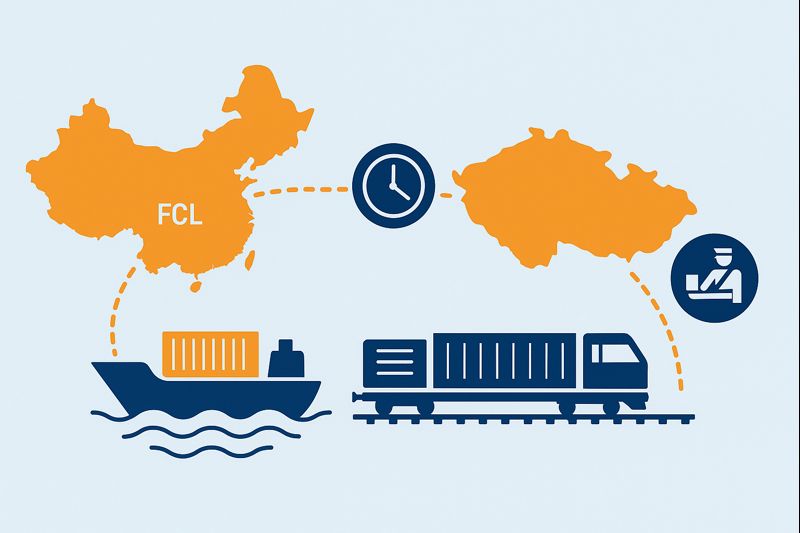
When planning containerized imports into Central Europe, transit time for FCL shipping from China to Czech Republic often determines inventory turnover and delivery commitments; however, the timeline varies by route, port choice, and inland leg. Therefore, this guide breaks down realistic shipping durations, key bottlenecks, and optimization strategies, while showing how experienced providers like Top China Freight help maintain predictable schedules. Ultimately, you will gain clear benchmarks to plan production, shipping, and customs with confidence.

What Does FCL Transit Time from China to the Czech Republic Include?
FCL shipping transit time from China to Czech Republic covers more than ocean days alone. As a result, importers should evaluate the full door-to-door timeline rather than vessel schedules in isolation.
Ocean transit and port handling
China to Czech Republic FCL shipping time by sea typically involves a European gateway port, followed by inland transport. Consequently, container transit time China to Czech Republic FCL includes terminal handling, unloading, and onward movement.
Inland delivery to final destination
Because the Czech Republic is landlocked, inland delivery by rail or truck adds several days. Therefore, inland delivery time after FCL arrival in Czech Republic becomes a critical planning factor.
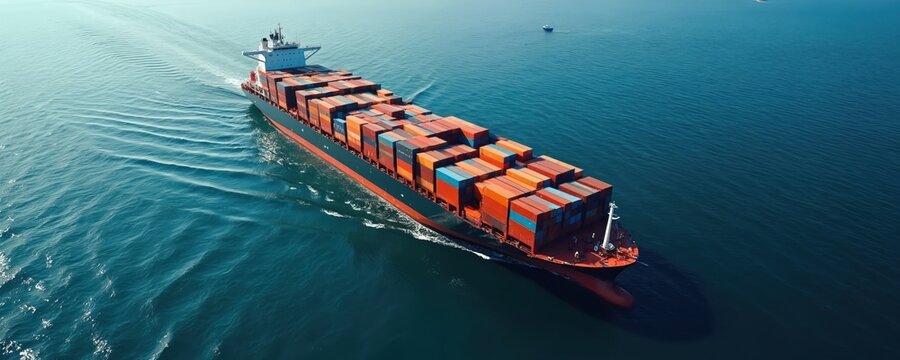
How Long Is the Sea Freight Transit Time from China to Europe?
Sea freight transit time China to Czech Republic FCL depends heavily on routing and port congestion. However, general benchmarks help establish expectations.
Typical ocean sailing durations
In most cases:
- East China to Northern Europe ports: 30–35 days
- South China to Northern Europe ports: 32–38 days
Although these ranges remain stable, weather disruptions or transshipment delays may extend schedules during peak periods.
Impact of direct vs transshipment services
Direct sailings reduce variability, while transshipment routes often increase China to Czech Republic FCL shipping lead time by 5–10 days. Therefore, route selection directly affects reliability.
How Does Rail Transport Affect FCL Transit Time?
Rail freight plays a growing role in China–Europe supply chains. Therefore, it often complements sea freight for inland delivery into the Czech Republic.
Rail from European ports
Rail connections from Hamburg or Rotterdam typically move containers to Czech hubs within 2–4 days. As a result, door to door FCL transit time China to Czech Republic becomes more predictable.
Direct China–Europe rail options
In some cases, full containers move directly via China–Europe rail corridors. While faster than sea freight, capacity and cost constraints limit availability. Many importers integrate rail options through professional rail freight planning for time-sensitive cargo.
How Do Freight Rates and Transit Time Interact?
Although speed is critical, freight rates often influence routing decisions. Therefore, balancing cost and time remains a core supply chain challenge.
| Routing Option | Transit Time | Cost Level | Reliability |
|---|---|---|---|
| Sea + rail via Hamburg | Medium | Moderate | High |
| Sea + truck via Koper | Shorter inland | Moderate | Stable |
| Direct China–EU rail | Short | Higher | Capacity-limited |
Because each option has trade-offs, importers should align shipping mode with inventory urgency and budget tolerance.
Case Studies
Electronics from Shanghai to Prague
A Czech electronics importer shipped a 40HQ FCL from Shanghai to Hamburg, followed by rail to Prague. The ocean leg took 33 days, while inland rail delivery required 3 days, resulting in a total port-to-door transit time of 38 days. By coordinating sea freight and inland rail through a single provider, the importer reduced handover delays and stabilized delivery schedules.
Machinery Shipment from Ningbo to Brno
A machinery importer shipped a 20GP FCL from Ningbo to Koper, followed by trucking to Brno. The sea leg required 35 days, while inland trucking added 4 days, resulting in a total transit time of 41 days. By selecting a southern gateway and pre-booking inland transport, the importer avoided congestion at Northern European ports.
What Factors Commonly Delay FCL Transit Time to the Czech Republic?
Although published schedules provide a baseline, transit time for FCL shipping from China to Czech Republic can shift due to several external factors. Therefore, identifying risks early helps importers build realistic buffers.
Port congestion and vessel rollovers
During peak seasons, European ports often face congestion. Consequently, containers may be rolled to later sailings, extending China to Czech Republic FCL shipping lead time by a week or more.
Weather and seasonal disruptions
Meanwhile, winter weather in Northern Europe can slow port operations and inland rail movement. As a result, inland delivery time after FCL arrival in Czech Republic may fluctuate even when ocean transit stays on schedule.
Why Mode Selection Matters for Central Europe Routes
Choosing the right transport mode influences both speed and stability. Therefore, mode selection should align with cargo type and urgency.
Sea freight remains the most cost-effective option for full containers, while rail offers faster transit for time-sensitive goods. Some importers supplement sea freight with express solutions for critical SKUs through express services when production delays threaten deadlines.
How Can Supply Chain Visibility Reduce Delays?
Visibility across the supply chain enables faster response to disruptions. Therefore, real-time tracking and milestone updates add significant value.
Tracking and communication
Shipment tracking allows teams to anticipate delays and adjust downstream plans. As a result, inventory and production schedules remain aligned.
Partner collaboration
Working closely with experienced providers such as Top China Freight helps importers adapt routes and modes when disruptions arise, maintaining control over transit time for FCL shipping from China to Czech Republic.
Conclusion
Transit time for FCL shipping from China to Czech Republic reflects a combination of ocean transit, port handling, inland delivery, and customs efficiency. By choosing suitable gateway ports, planning inland transport early, and preparing documentation accurately, importers can achieve stable and predictable timelines. With informed planning and the right logistics strategy, Central Europe supply chains remain resilient.
Request A Free Quote
Start shipping smarter with TopChinaForwarder today! 🚢✨ Request a Free Quote 📝 and get a tailored logistics plan built around your cargo and timeline.
FAQ:
What is the average transit time for FCL shipping to the Czech Republic?
Most shipments take 35–45 days door to door, depending on port choice and inland transport.
Which European port is fastest for Czech deliveries?
Hamburg and Koper are popular choices, with Hamburg offering strong rail links and Koper shorter inland distance.
Does rail always reduce transit time?
Rail often shortens inland delivery time, but capacity and cost must be considered.
How long does customs clearance usually take?
With correct documents, clearance typically completes within 1–3 working days.lit. Ut elit tellus, luctus nec ullamcorper mattis, pulvinar dapibus leo.
Is door-to-door shipping more reliable than port-to-port?
Door-to-door services improve coordination and reduce handover delays.