
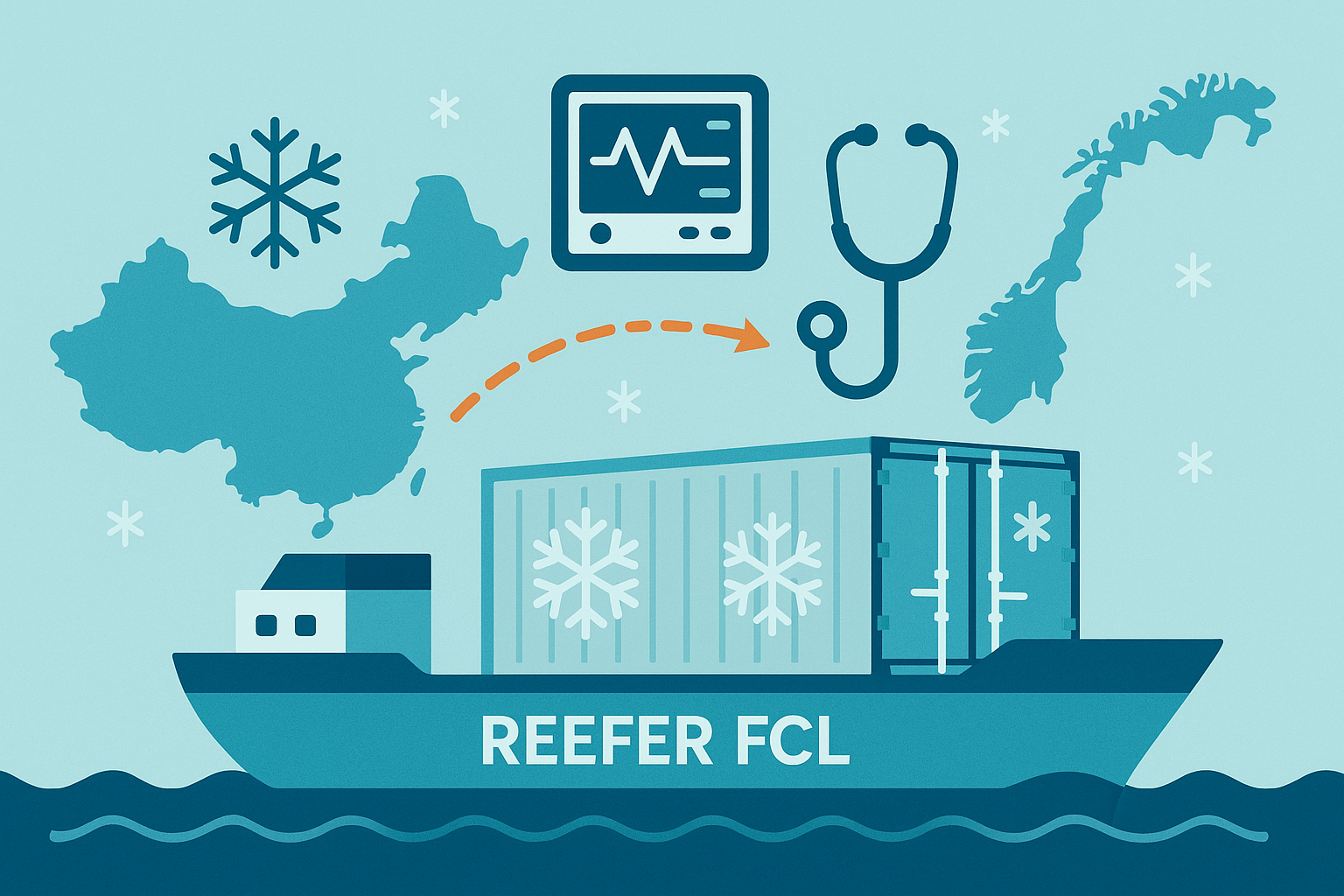
Although shipping medical-grade cargo requires precision, reefer FCL transit time for medical equipment from China to Norway often becomes the main bottleneck for importers. Therefore, in this guide, we break down the exact timing factors, compliance steps, and planning strategies your team can use right away. As your supply chain becomes more time-sensitive, partnering with a proven logistics provider like Top China Freight—starting from our homepage—gives you access to reliable cold-chain routing, compliant documentation, and faster coordination between China and Europe.
What Defines Reefer FCL Transit Time for Medical Equipment to Norway?
Reefer FCL transit time for medical equipment from China to Norway refers to the total shipping duration from factory pickup to arrival at the Norwegian port. Moreover, the clock includes multiple stages—origin handling, customs release, vessel sailing, and temperature-controlled storage. Because medical devices and diagnostic systems are sensitive, stable timing becomes essential for regulatory compliance and inventory continuity.
Additionally, cold-chain FCL shipping introduces stricter conditions: temperature validation, pre-trip inspections, and reefer monitoring. These steps ensure integrity throughout China–Norway transit planning.
To maintain predictable shipping windows, companies often combine sea freight schedules with data from stable FCL routes and historical vessel performance.
Why Does Reefer FCL Transit Time Vary Between Chinese and Norwegian Ports?
Transit time varies because different ports offer different departures, carrier frequencies, and equipment availability. Furthermore, northern Europe weather patterns and winter delays also influence refrigerated container transit.
Below are key timing factors:
Origin Port Capabilities
Chinese ports like Shanghai, Ningbo, and Shenzhen provide frequent reefer services. Nevertheless, holiday congestion can add 1–3 days.
Vessel Routing Structure
Direct routes reduce transit by 3–5 days. However, transshipment via Rotterdam or Hamburg may extend the timeline.
Norwegian Port Handling
Oslo, Bergen, and Stavanger operate advanced reefer terminals, yet certain inspections can add buffer time for medical cargo.
Seasonal Temperature Requirements
Although reefer containers maintain internal temperature, cold-chain protocols still slow down loading and validation in peak winter months.

How Long Is the Typical Reefer FCL Transit Time From China to Norway?
Typical sailing time ranges between 32–41 days depending on the route selected. Additionally, importers must include pre-carriage and port processing.
Estimated Reefer FCL Transit Time (China → Norway)
| Route Type | Sailing Time | Total Door-to-Door Estimate | Notes |
|---|---|---|---|
| Direct China → Northern Europe | 28–33 days | 32–41 days | Fastest, limited carriers |
| China → Rotterdam → Norway | 34–40 days | 39–47 days | Common for reefer routing |
| China → Hamburg → Norway | 33–38 days | 38–46 days | Balanced time & cost |
Because medical-grade freight routing is time-critical, companies prefer the most stable corridor even when costs are slightly higher.
What Documentation Affects Reefer FCL Transit Time for Medical Equipment?
Documentation accuracy can shorten or extend transit time by 2–5 days. Moreover, Norway’s import regulations for medical devices are strict, requiring compliant reefer container documentation and clean product declarations.
Essential Documents for Norway-Bound Medical Equipment
| Document Type | Purpose | Timing Impact |
|---|---|---|
| Commercial Invoice | Cargo validation | Reduces inspection delay |
| Packing List | Equipment classification | Supports fast clearance |
| Bill of Lading | Carrier identification | Required for release |
| Temperature Log | Confirms cold-chain integrity | Critical for reefer cargo |
| CE/ISO Certificates | Medical compliance | Reduces risk of hold |
| HS Code Alignment | Regulatory matching | Prevents re-inspection |
Although importers sometimes underestimate documentation speed, well-prepared paperwork dramatically boosts clearance performance.
To simplify paperwork, many companies use Top China Freight’s customs-support teams through our customs brokerage service to avoid misclassification or repeated reviews.
How Should Shippers Plan Temperature-Controlled Handling for Medical Equipment?
Temperature-controlled medical cargo demands more preparation because sensors, diagnostic items, and biomedical electronics cannot tolerate fluctuations. Consequently, precise loading and pre-trip inspection (PTI) are mandatory.
Pre-Trip Inspection (PTI)
Carriers perform PTI to verify temperature accuracy and electrical integrity. Although PTI adds 6–12 hours, it prevents major in-transit issues.
Loading Coordination With Factories
Factories must deliver equipment early because medical-grade cargo often requires additional protective layers.
Real-Time Reefer Monitoring
Tracking platforms allow shippers to monitor humidity, temperature, and location in real time.
To streamline cold-chain handling, many importers integrate FCL/LCL consolidation for synchronized departures.
Real Case Studies
Shanghai → Oslo (Medical Imaging Equipment)
Cargo Type: MRI cooling components
Container: 40′ Reefer FCL
Temperature: Constant +8°C
Route: Shanghai → Rotterdam → Oslo
Transit Time: 39 days door-to-door
Cost Level: Medium
Outcome: Predictable Norway import timing achieved; no temperature deviation recorded.
Because the client needed consistent thermal protection, we coordinated PTI, multi-layer packaging, and route selection using Top China Freight’s cold-chain planning team.
Shenzhen → Bergen (Portable Diagnostic Devices)
Cargo Type: Portable blood-analysis systems
Container: 20′ Reefer FCL
Temperature: +4°C
Route: Shenzhen → Hamburg → Bergen feeder vessel
Transit Time: 42 days
Cost Level: Lower
Outcome: Stable routing despite winter congestion; clearance completed with CE/ISO validation.
The shipper selected a balanced cost–time plan combined with door-to-door coordination for the last-mile delivery to a medical distributor.
Should Medical Shippers Use Reefer FCL Instead of Air Freight?
Many shippers compare reefer FCL with air freight because both support temperature-controlled logistics. However, the choice depends on urgency, budget, and cargo size.
When Reefer FCL Is Better
- Large volumes
- Heavy instruments requiring stabilization
- Budget-controlled shipments
- Non-emergency restocking cycles
When Air Freight Is Better
- Urgent medical device replenishment
- High-value or high-risk diagnostics
- Tight hospital deadlines
When air freight is needed, some companies integrate complementary shipments through our air freight service to balance cost and speed.
Can Customs Procedures in Norway Affect Reefer FCL Transit Time?
Yes. Although Norway’s customs for medical equipment is efficient, missing or incorrect documentation can introduce delays. Moreover, Norway enforces strict classification rules for medical devices, meaning HS code accuracy and CE certification alignment must be flawless.
Key Clearance Factors
- Complete invoice and detailed description
- Equipment purpose (diagnostic, surgical, monitoring)
- Temperature control requirements
- Correct medical regulatory category
- Accurate packing list
- Timely submission of arrival notices
Therefore, proactive compliance directly shortens clearance by 1–3 days.
Conclusion
Reefer FCL transit time for medical equipment from China to Norway depends on routing, documentation accuracy, carrier reliability, and temperature-controlled handling. Furthermore, when shippers use structured planning, early booking, and compliant documentation, the entire supply chain becomes more predictable. Therefore, if your organization requires stable cold-chain routing or dependable medical-grade shipping schedules, Top China Freight offers end-to-end reefer coordination, customs guidance, and real-time monitoring across China–Europe corridors.
Request A Free Quote
Need a reliable logistics partner? Share your shipment details and we’ll provide a tailored quotation quickly and accurately.
FAQ:
How early should I book reefer FCL for medical equipment?
Booking 2–3 weeks in advance ensures equipment availability and avoids seasonal shortages, especially during winter and peak demand cycles.
What impacts China–Norway reefer FCL transit time most?
Routing structure, carrier frequency, customs clearance, and weather influence total time. Early documentation reduces avoidable delays.
Can reefer FCL cargo be tracked in real time?
Real-time reefer monitoring is available through onboard sensors and digital platforms, offering temperature, humidity, and location visibility.
Is air freight faster for medical equipment?
Air freight is much faster, but reefer FCL is cost-effective for large volumes or non-urgent medical cargo.
What ports in Norway handle reefer containers best?
Oslo, Bergen, and Stavanger have advanced cold-chain terminals and efficient handling for medical equipment.