
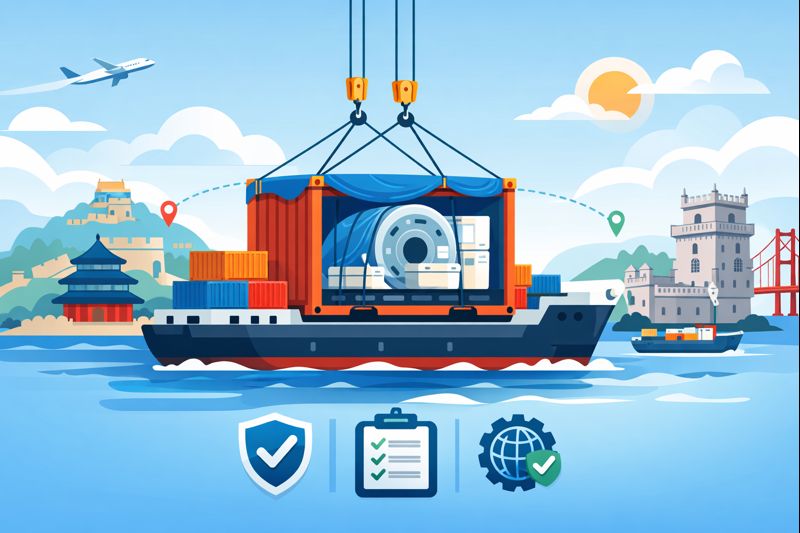
However complex oversized shipments may seem, Open Top FCL insurance for medical equipment from China to Portugal remains one of the most critical safeguards for importers handling high-value, sensitive cargo. When heavy or irregular medical machinery moves under open top containers, exposure to weather, handling damage, and compliance risks increases significantly. Therefore, this guide breaks down practical insurance strategies, costs, and risk controls—starting from China and supported by end-to-end logistics planning with Top China Freight.

Why does Open Top FCL insurance matter for medical equipment shipments?
Medical equipment is rarely standard cargo. In many cases, MRI frames, diagnostic systems, or hospital infrastructure exceed height limits, which makes open top containers unavoidable. As a result, insurance becomes more than a formality—it becomes a financial shield.
Because open top containers lack a fixed roof, cargo faces direct exposure during lifting, tarpaulin sealing, and port handling. Moreover, medical devices often involve high unit value and strict performance tolerance. Even minor impact damage can render equipment unusable or delay certification.
From a risk perspective, open top FCL insurance for medical equipment from China to Portugal typically addresses:
- Physical damage during crane lifting or lashing
- Rain or moisture ingress during loading and transit
- Shock damage affecting calibration accuracy
- Partial loss caused by improper securing
Consequently, importers without tailored insurance often face unrecoverable losses when claims are rejected under basic policies.
How is Open Top FCL insurance different from standard FCL insurance?
Although both policies fall under marine cargo insurance, coverage scope and exclusions vary widely.
Standard FCL insurance generally assumes sealed containers with minimal external exposure. In contrast, open top shipments require enhanced clauses due to higher operational risk.
Key differences include:
- Coverage scope
Standard FCL insurance focuses on collision, sinking, or general average. Open top FCL insurance extends to handling damage, lifting risks, and weather exposure. - Cargo declaration requirements
For medical equipment, insurers often require detailed packing lists, dimensions, photos, and lashing plans before approval. - Premium structure
Because risk probability rises, open top container insurance costs more, especially for high value medical equipment. - Claims scrutiny
Insurers review securing methods and compliance records more strictly for open top shipments.
Therefore, choosing a policy designed specifically for open top medical cargo is essential rather than relying on default freight insurance.
What documents are required for Open Top FCL insurance approval?
Unlike standard shipments, insurers rarely approve coverage based on invoice alone. Instead, they require technical documentation that demonstrates risk control.
Typical documentation includes:
- Commercial invoice and packing list
- Cargo dimension and weight breakdown
- Photos of cargo before packing
- Lashing and securing diagrams
- Container loading method statement
Additionally, when shipping into the EU, medical device shipping insurance compliance often links closely with customs documentation. Coordinating insurance with professional customs brokerage support helps avoid mismatches that could delay clearance or invalidate claims.
How does insurance pricing work for Open Top FCL medical cargo?
Insurance cost does not follow a fixed formula. Instead, premiums depend on a combination of cargo, route, and risk factors.
The most common pricing factors include:
- Declared cargo value
- Container type (open top vs standard)
- Packing and securing method
- Route from China to Portugal ports
- Claims history of shipper or consignee
To provide clarity, the table below shows indicative insurance cost ranges. These figures are for reference only and do not represent fixed quotations.
| Cargo Value Range (USD) | Insurance Rate (%) | Estimated Premium (USD) |
|---|---|---|
| 100,000 – 300,000 | 0.35% – 0.55% | 350 – 1,650 |
| 300,000 – 600,000 | 0.45% – 0.70% | 1,350 – 4,200 |
| 600,000+ | 0.60% – 0.90% | Case-by-case |
Because premiums rise with risk complexity, experienced forwarders often reduce cost by optimizing packing plans and documentation before underwriting.
Case Studies
Oversized Diagnostic System to Lisbon
Shipment profile:
Origin: Shanghai, China
Destination: Lisbon, Portugal
Cargo: Oversized diagnostic imaging frame
Container: Open Top FCL
Cargo value: USD 420,000
Solution and outcome:
The cargo exceeded standard height limits and required top loading. A customized open top FCL insurance policy covered lifting and moisture risks. Transit time reached 34 days, and the shipment arrived without damage. Insurance premium accounted for 0.58% of cargo value, avoiding potential six-figure exposure.
Hospital Infrastructure Equipment to Porto
Shipment profile:
Origin: Ningbo, China
Destination: Porto, Portugal
Cargo: Hospital sterilization system modules
Container: Open Top FCL
Cargo value: USD 680,000
Solution and outcome:
Due to high unit value, enhanced marine cargo insurance for medical equipment exports was arranged. Detailed lashing photos supported underwriting approval. Although minor port delays occurred, coverage extended until final delivery, ensuring full financial protection.
What role does EU compliance play in insurance claims?
Insurance approval does not override regulatory compliance. In fact, insurers often reject claims if customs or medical regulations are violated.
For shipments into Portugal, insurers expect:
- Accurate HS codes and product descriptions
- Alignment with EU medical device import rules
- Consistent documentation across invoice, packing list, and insurance certificate
Because discrepancies may delay clearance or trigger inspections, insurance for medical device shipping compliance in the EU must work hand-in-hand with customs strategy. As a result, early coordination between shipper, insurer, and broker reduces exposure.
How can importers reduce insurance risk for Open Top medical equipment?
Although insurance transfers financial risk, prevention still lowers premiums and claim disputes. Therefore, importers should focus on operational controls before cargo leaves China.
Firstly, cargo securing plans must match medical equipment weight distribution. Evenly balanced loads reduce stress during vessel motion. Secondly, waterproof protection should go beyond standard tarpaulins by adding inner moisture barriers and desiccants. Thirdly, surveyor inspection before loading often strengthens claim validity later.
In addition, working with a forwarder that integrates insurance planning into FCL and LCL services helps align packing, routing, and underwriting requirements from the start.
How does insurance interact with freight rates and supply chain strategy?
Insurance should never be isolated from broader logistics decisions. Instead, it must align with freight rates, transit time, and supply chain reliability.
For example, lower freight rates may involve additional transshipment points, which increase handling risk. Conversely, slightly higher freight costs may reduce insurance exposure by shortening transit or limiting handling.
As a result, balanced planning between freight rates, shipping time, and insurance scope creates more predictable landed cost outcomes.
Conclusion
In global healthcare logistics, Open Top FCL insurance for medical equipment from China to Portugal is not optional—it is a strategic safeguard. Because open top containers expose high-value medical cargo to elevated risk, tailored insurance ensures financial stability, regulatory alignment, and supply chain continuity. With careful planning, documentation discipline, and experienced logistics support, importers can protect both cargo integrity and long-term operations.
Request A Free Quote
Start shipping smarter with TopChinaForwarder today! 🚢✨ Request a Free Quote 📝 and get a tailored logistics plan built around your cargo and timeline.
FAQ:
What does Open Top FCL insurance typically cover for medical equipment?
Coverage usually includes physical damage, handling risk, weather exposure, and partial loss during lifting or transit, depending on declared terms.
How is insurance cost calculated for medical equipment shipments?
Insurers assess cargo value, container type, packing method, route risk, and claims history to determine premium rates.
Can insurance cover delays caused by customs inspections?
Insurance does not cover delays themselves but may extend protection duration while cargo remains under inspection.
What documents are most important for successful insurance claims?
Pre-loading photos, packing lists, surveyor reports, and consistent customs documentation play a critical role.
Does insurance remain valid during inland transport in Portugal?
Only if door-to-door or extended coverage is selected. Otherwise, coverage may end at port discharge.