
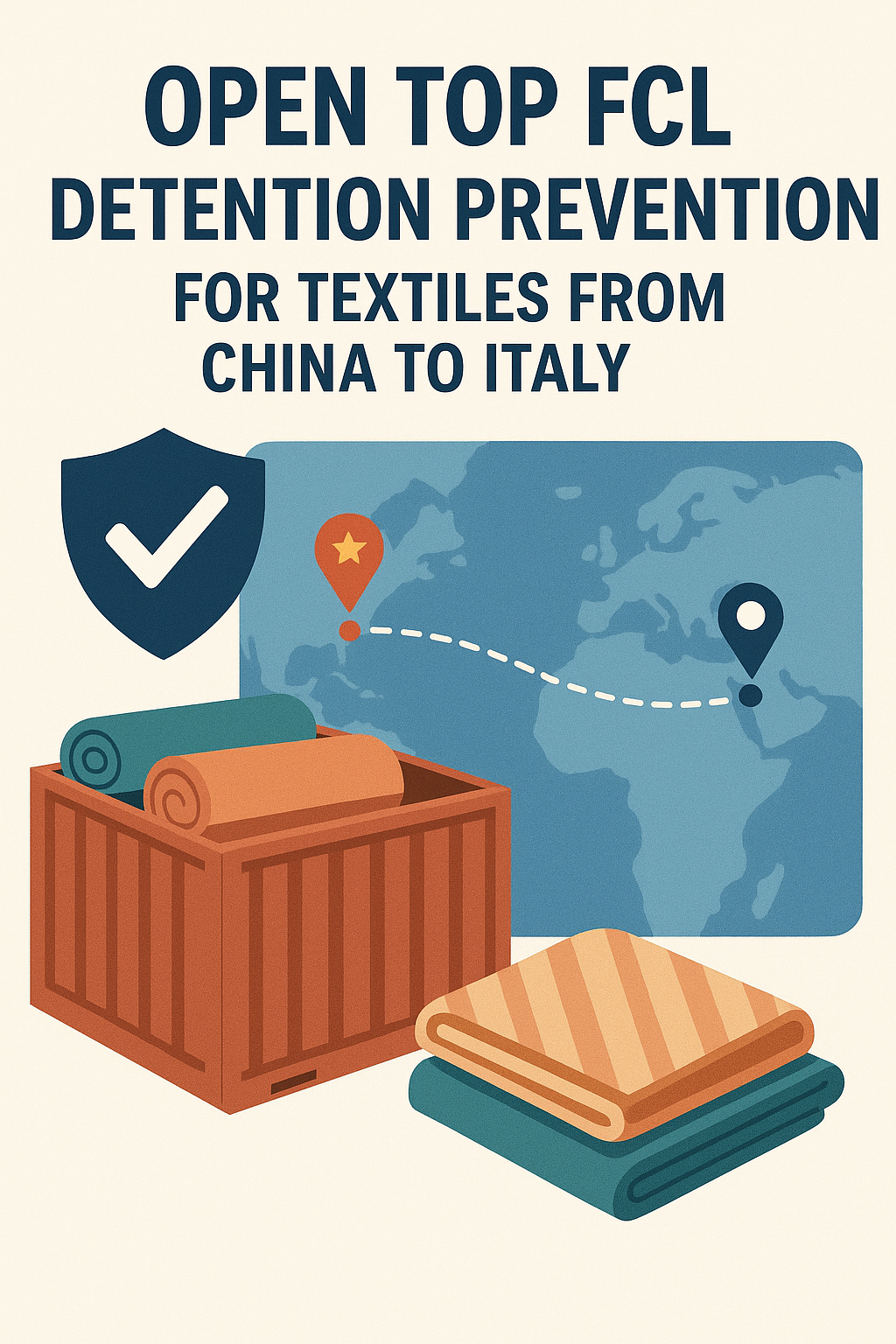
Shipping textile products internationally requires precision and careful time management. The Open Top FCL detention prevention for textiles from China to Italy is a critical logistics strategy that ensures smooth container turnover, cost control, and compliance with port regulations. This article provides a complete guide to avoiding detention fees while maintaining a cost-efficient, reliable supply chain between China and Italy.

What Is Open Top FCL Shipping and Why Use It for Textiles?
An Open Top FCL (Full Container Load) container features a removable tarpaulin roof, making it ideal for oversized or delicate textile cargo that requires top loading or ventilation. It’s commonly used for:
- Bulk textile rolls, industrial fabrics, or non-stackable items.
- Machinery-linked textile shipments requiring special handling.
| Container Type | Dimension (m) | Ideal For | Capacity (CBM) |
|---|---|---|---|
| 20GP | 5.9 × 2.35 × 2.39 | Standard textile pallets | 28 |
| 40GP | 12.0 × 2.35 × 2.39 | Large textile batches | 58 |
| 40’ Open Top | 12.0 × 2.35 × 2.35 | Tall or rolled fabric | 55 |
Why it matters: Open Top FCL prevents compression damage and improves unloading efficiency, especially in Italian ports like Genoa, Livorno, and Naples.
What Is Detention in FCL Shipping?
Detention occurs when the container is kept beyond the allowed free time outside the port after release. In other words, if you don’t return the container to the carrier’s depot within the specified timeframe (usually 5–7 days), detention fees apply.
| Term | Location | Description | Common Free Time |
|---|---|---|---|
| Demurrage | At port terminal | Delay in clearing cargo | 5–7 days |
| Detention | Outside terminal | Delay in returning container | 7–10 days |
| Storage | At warehouse or yard | Extended holding | Based on agreement |
Example: If your textile shipment arrives in Genoa and unloading takes longer due to customs inspection, you might face detention charges of USD 100–150 per container per day after the grace period.
Why Detention Prevention Is Critical for Textile Shipments
Textiles are time-sensitive due to seasonal trends, fashion cycles, and retail deadlines. Detention fees can not only increase logistics costs but also disrupt inventory flow.
Key Risks Without Prevention Measures
- Port Congestion: Busy hubs like Genoa cause unloading delays.
- Document Errors: Incomplete shipping papers delay customs clearance.
- Coordination Failures: Misalignment between forwarder, consignee, and trucking teams.
- Unexpected Inspections: Textile shipments often face fumigation or origin verification checks.
Therefore, having a detention prevention strategy ensures smoother delivery, cost control, and operational reliability.
How to Prevent Detention in Open Top FCL Shipments
Proactive planning minimizes detention exposure and boosts shipment efficiency.
| Strategy | Description | Result |
|---|---|---|
| Pre-Clearance Filing | Submit documents before vessel arrival | Faster customs release |
| Schedule Coordination | Align port, warehouse, and trucking times | Reduced idle time |
| Container Monitoring | Use GPS or EDI tracking systems | Real-time updates |
| Multiple Depots Option | Select nearest depot for return | Minimized return delay |
| Experienced Forwarders | Use providers like TopChinaFreight | End-to-end coordination |
Tip: Booking with shipping lines offering longer free-time allowances (like COSCO or MSC) can reduce detention risk by up to 30%.
Need a shipping solution? 🚢 Request a Free Quote 📝 from TopChinaFreight and get the best rates and fastest routes today!
Case Studies: Successful Textile Shipments from China to Italy
Case 1: Shenzhen → Genoa (Textile Rolls)
- Container: 40’ Open Top FCL
- Cargo: 25 tons of industrial fabric
- Transit Time: 32 days
- Free Time: 10 days
✅ Result: No detention charges due to early pre-clearance and flexible trucking schedule managed by TopChinaFreight.
Case 2: Ningbo → Livorno (Garment Materials)
- Container: 20GP Open Top
- Cargo: Fabric accessories and trims
- Transit Time: 30 days
✅ Result: Detention prevented by using warehouse storage near the port to handle customs clearance in advance.
Case 3: Qingdao → Naples (Decorative Textiles)
- Container: 40GP Open Top
- Cargo: High-value decorative fabrics
- Transit Time: 33 days
✅ Result: Shipment insured under All-Risk coverage; proactive coordination reduced port turnaround time by 3 days.
What Are the Shipping Costs and Timelines from China to Italy?
| Route | Transit Time | Average Cost (USD, Open Top FCL) |
|---|---|---|
| Shenzhen → Genoa | 31–33 days | 4,600–4,900 |
| Ningbo → Livorno | 30–32 days | 4,700–5,000 |
| Qingdao → Naples | 32–35 days | 4,800–5,100 |
Additional fees (if not managed properly):
| Cost Type | Range (USD) | Prevention Tip |
|---|---|---|
| Detention | 100–150/day | Early return coordination |
| Demurrage | 80–120/day | Fast customs clearance |
| Trucking Delay | 200–300 | Use pre-arranged transport |
What Documents Are Required for Textile Exports to Italy?
Accuracy in documentation prevents customs-related delays that can trigger detention fees.
| Document | Purpose | Issued By |
|---|---|---|
| Bill of Lading | Confirms shipment | Carrier |
| Commercial Invoice | Declares product value | Exporter |
| Packing List | Lists fabric types & quantities | Shipper |
| Certificate of Origin | Required for EU imports | Chamber of Commerce |
| Textile Labeling Certificate | Confirms fiber content & compliance | Manufacturer |
| Import Declaration | Required by Italian Customs | Consignee |
Make sure all textile descriptions match the HS Code (Chapter 63) classification to avoid customs hold-ups.
Comparing Open Top FCL with Standard Containers
| Feature | Open Top FCL | Standard FCL |
|---|---|---|
| Loading Type | Top loading via crane | Side or rear loading |
| Ideal Cargo | Oversized or tall fabric rolls | Folded or boxed textiles |
| Risk of Damage | Lower (less compression) | Moderate |
| Detention Sensitivity | High (requires faster turnaround) | Moderate |
| Cost | 10–15% higher | Standard rate |
Despite higher freight rates, Open Top FCL is indispensable for preserving textile quality during transport.
Conclusion
The Open Top FCL detention prevention for textiles from China to Italy strategy combines early documentation, efficient scheduling, and professional freight coordination to save both time and money. By partnering with experienced providers like TopChinaFreight, importers can ensure reliable port clearance, minimized detention risk, and consistent fabric quality upon arrival in Italy.
Ultimately, success in textile logistics lies not only in cost negotiation but also in proactive detention prevention planning that keeps your supply chain moving.
Request A Quote
Get started with TopChinaFreight today! 🚢✨ Simply Request a Free Quote 📝 to receive a customized shipping solution tailored to your needs. Our experts will provide the best rates 💰, fastest routes 🚀, and professional guidance 🌍 for your international logistics.
FAQs:
What causes detention fees in FCL textile shipments?
Detention occurs when containers are returned late to the carrier after the free time, often due to customs or trucking delays.
How long is the free time for container use in Italy?
Most carriers provide 7–10 days of free time for container usage before detention fees apply.
Can detention prevention save shipping costs?
Yes, proactive management can reduce total freight costs by up to 15%, avoiding daily fines and congestion delays.
Why choose Open Top FCL for textile shipments?
It allows top loading of bulky textile rolls, minimizing compression damage and preserving material quality during transit.
What is the best strategy to avoid detention?
Schedule early trucking, pre-clear customs, and return the container within the free-time window.