
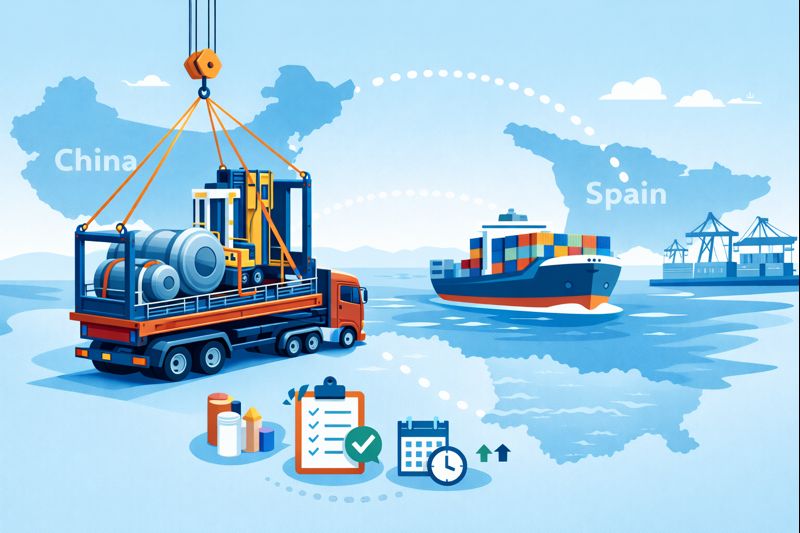
Managing Flat Rack FCL detention prevention for machinery from China to Spain becomes challenging when oversized cargo meets tight port free time rules. Therefore, many machinery importers rely on experienced partners like Top China Freight to reduce equipment delays and protect delivery schedules. In this article, you’ll learn practical, execution-focused strategies to prevent detention before it starts.

What Makes Machinery Shipments Vulnerable to Flat Rack Detention?
Machinery cargo introduces operational complexity from the first booking stage.
Oversized and Non-Standard Dimensions
Unlike palletized goods, machinery often exceeds container width or height. As a result, flat rack containers become necessary, but they also require additional port handling, special lifting, and detailed securing checks. Consequently, even minor delays can consume free time quickly.
Port Handling Sensitivity
Flat rack containers are handled differently at terminals. Therefore, they may wait longer for crane availability or inspection clearance, increasing detention exposure if coordination is weak.
How Does Flat Rack FCL Detention Differ From Demurrage?
Understanding the difference helps cost control planning.
Equipment Detention Explained
Detention refers to charges incurred when the flat rack container is not returned within the carrier’s free time after pickup. Therefore, delays in unloading or inland transport directly increase detention risk.
Why Flat Racks Face Higher Detention Risk
Because flat racks are limited and high-value equipment, carriers enforce stricter return timelines. As a result, machinery shipments face tighter margins for error than standard dry containers.
Flat Rack FCL vs Standard FCL for Machinery Shipments
| Item | Flat Rack FCL | Standard Dry FCL |
|---|---|---|
| Suitable machinery type | Oversized, over-width, irregular equipment | Compact, boxed machinery |
| Loading method | Crane or heavy-lift loading | Forklift or pallet loading |
| Securing requirements | Complex lashing and blocking | Standard securing |
| Port handling priority | Lower due to special handling | Higher |
| Detention risk level | Higher if unloading is delayed | Relatively lower |
| Equipment return urgency | Very high | Moderate |

What Role Does Customs Clearance Play in Detention Prevention?
Customs delays often cause detention indirectly.
Machinery Documentation Accuracy
Machinery imports require accurate HS codes, serial numbers, and technical descriptions. Therefore, documentation errors often trigger inspections that delay container pickup.
Coordinating Clearance and Pickup
When customs release aligns with pre-booked inland transport, flat racks exit terminals immediately. Consequently, detention risk drops significantly.
Many importers coordinate this step through integrated customs brokerage services to keep clearance and pickup synchronized.
How Should Importers Manage Free Time for Flat Rack Containers?
Free time strategy determines detention outcomes.
Understanding Carrier Free Time Policies
Flat rack free time is often shorter than standard containers. Therefore, importers must confirm detention terms during booking rather than after arrival.
Building Realistic Unloading Plans
Because machinery unloading takes longer, warehouses should prepare lifting equipment and labor in advance. As a result, containers are returned within free time windows.
Case Studies
Flat Rack Machinery Shipment From Shanghai to Barcelona
Route: Shanghai → Barcelona
Cargo: Industrial machinery on flat rack FCL
Dimensions: Over-width, reinforced base
Transit Time: 32 days
Outcome: Zero detention charges
Key Actions Taken:
• Early flat rack booking with confirmed free time
• Approved securing plan before port gate-in
• Inland crane scheduled prior to vessel arrival
As a result, the container was returned within free time despite complex unloading.
Flat Rack Machinery Shipment to Valencia
Route: Ningbo → Valencia
Cargo: Heavy manufacturing equipment
Dimensions: Over-height, multi-point lashing
Transit Time: 36 days
Outcome: One-day inspection, no detention
Key Actions Taken:
• Securing and lifting plans approved pre-arrival
• Customs clearance prepared in advance
• Truck and crane scheduled before discharge
As a result, the flat rack container exited the port within free time despite inspection.
How Can Port Selection in Spain Influence Detention Outcomes?
Choosing the right destination port often reduces detention pressure before arrival.
Comparing Major Spanish Ports for Flat Rack Handling
Although several Spanish ports accept flat racks, handling efficiency varies. Therefore, ports with stronger heavy-lift infrastructure and experienced operators process machinery faster, which preserves detention free time.
Avoiding Congested Entry Points
Meanwhile, during peak seasons, some ports experience equipment congestion. Consequently, routing flat rack cargo through less congested Spanish ports often shortens dwell time and improves return speed.

Why End-to-End Planning Delivers Better Detention Control
Fragmented logistics increases risk.
Single-Point Coordination Across the Chain
When ocean freight, customs clearance, and inland delivery operate under one plan, accountability improves. Therefore, delays are identified and resolved faster.
Many importers rely on experienced partners offering integrated door-to-door logistics services to keep machinery shipments moving smoothly.
Why Does Inland Coordination Matter More for Flat Rack Cargo?
Flat rack machinery demands precise timing after discharge.
Synchronizing Terminal Release and Truck Arrival
When truck arrival aligns exactly with terminal release, flat racks exit ports without delay. Therefore, coordination between port agents, truckers, and warehouses becomes essential.
Managing Return Logistics Proactively
Because flat rack containers must be returned promptly, return routes should be planned in advance. As a result, empty returns happen smoothly and within free time limits.
Conclusion
Effective Flat Rack FCL detention prevention for machinery from China to Spain relies on early booking, compliant securing, accurate documentation, and synchronized inland execution. While freight rates and transit time matter, detention control ultimately depends on preparation and coordination. With the right strategy, machinery importers can protect margins and maintain predictable delivery schedules.
Request A Free Quote
Start shipping smarter with TopChinaForwarder today! 🚢✨ Request a Free Quote 📝 and get a tailored logistics plan built around your cargo and timeline.
FAQ:
What is detention in flat rack shipping?
Detention refers to charges incurred when a flat rack container is not returned within the carrier’s allowed free time.
How much free time is usually granted for flat rack FCL?
Free time varies by carrier, but it is often shorter than standard containers and must be confirmed at booking.
Does customs inspection always cause detention?
Not always. Early documentation and coordinated pickup often prevent inspections from affecting free time.
Are flat racks suitable for all machinery shipments?
Flat racks suit oversized or irregular machinery, while standard containers work for compact equipment.
How can detention be reduced during peak season?
Early booking, flexible routing, and pre-arranged inland transport significantly lower detention exposure.