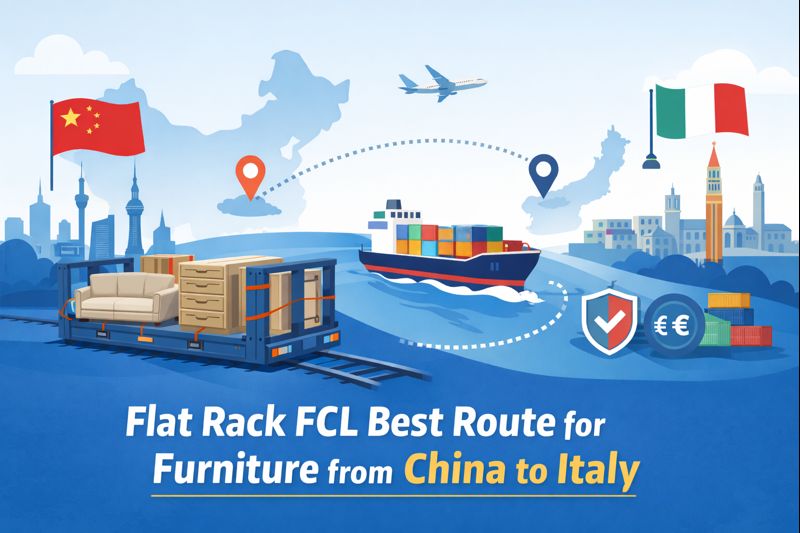
Flat Rack FCL best route for furniture from China to Italy is a key concern for exporters handling oversized, heavy, or non-stackable furniture. Therefore, choosing the wrong port or routing strategy can quickly lead to delays, extra handling costs, or customs complications. In this guide, we break down proven routing options, transit considerations, and risk controls, starting with practical experience supported by Top China Freight.
Why does furniture often require Flat Rack FCL shipping?
Furniture shipments frequently exceed the height or width limits of standard containers. As a result, flat rack FCL shipping becomes the preferred solution for items such as large sofas, marble tables, wooden cabinets, and custom-made fixtures.
Moreover, flat rack containers allow:
Top or side loading for bulky furniture
Secure lashing for irregular shapes
Reduced dismantling and repacking costs
Consequently, exporters shipping furniture from China to Italy rely on flat rack FCL to protect cargo integrity while maintaining loading efficiency.
What makes route selection critical for flat rack furniture cargo?
Unlike standard containers, flat rack cargo faces stricter vessel and port limitations. Therefore, not every route or port can handle flat rack FCL shipments efficiently.
Key route-related constraints include:
Limited flat rack slots on vessels
Port crane capacity and lifting restrictions
Terminal handling experience with oversized cargo
Because of these factors, selecting the flat rack FCL best route for furniture from China to Italy directly impacts transit time and cost predictability.
How does documentation readiness affect routing success?
Flat rack shipments face stricter documentation checks due to cargo dimensions and safety requirements. Therefore, incomplete paperwork can lead to rollovers or terminal delays.
The table below shows indicative transit times for common flat rack furniture routes. These ranges vary depending on carrier schedules and seasonal congestion.
Origin Port
Italian Port
Transit Time
Route Type
Shanghai
Genoa
32–36 days
Direct
Ningbo
La Spezia
34–38 days
Direct
Shenzhen
Genoa
38–42 days
Via hub
Because flat rack space is limited, earlier booking usually improves access to faster, more direct services.
How can exporters secure flat rack space on the best route?
Although flat rack capacity is limited, exporters can significantly improve success rates by adjusting planning and communication. Most importantly, space certainty depends on preparation rather than last-minute booking.
Effective practices include:
Sharing cargo dimensions and weight early
Providing photos and loading drawings before booking
Staying flexible on sailing dates within a short window
As a result, carriers are more willing to confirm flat rack slots on preferred China–Italy routes.
Flat rack vs open top: which suits furniture better?
Furniture exporters often compare flat rack containers with open top containers. While both handle oversized cargo, flat racks offer more flexibility for width and side loading.
Factor
Flat Rack FCL
Open Top
Width Flexibility
High
Limited
Loading Method
Side / Top
Top only
Lashing Control
Strong
Moderate
Best for Furniture
Yes
Case-by-case
As a result, flat rack FCL remains the dominant choice for large furniture exports to Italy.
Should furniture exporters consider alternative European gateways?
When Italian ports face congestion or flat rack shortages, alternative European gateways can become part of the routing strategy. Therefore, exporters sometimes ship to nearby Mediterranean or Northern ports and complete inland delivery afterward.
Common alternatives include:
Northern European ports with strong heavy-lift handling
Mediterranean transshipment hubs with better flat rack availability
Rail or truck connections into Italy
Consequently, route diversification helps protect delivery schedules during peak demand.
Conclusion
Choosing the flat rack FCL best route for furniture from China to Italy requires more than comparing sailing times. By evaluating port capability, space availability, inland delivery options, and customs readiness, exporters can protect both cargo and schedules. Ultimately, the right routing strategy transforms complex furniture logistics into a predictable, scalable supply chain.
Request A Free Quote
Start shipping smarter with TopChinaForwarder today! 🚢✨ Request a Free Quote 📝 and get a tailored logistics plan built around your cargo and timeline.