
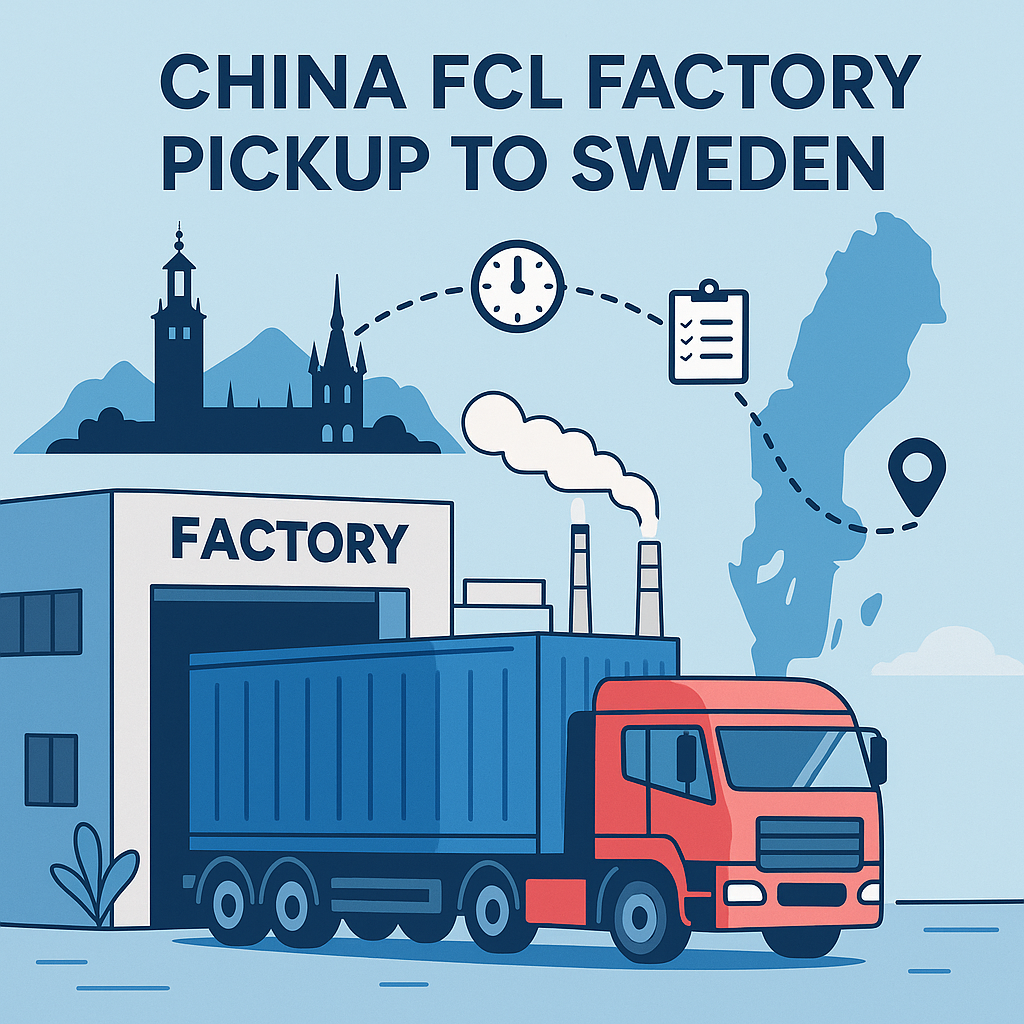
Although China FCL factory pickup to Sweden looks like a simple step in the export workflow, the real challenge lies in synchronizing factory readiness, inland trucking, container allocation and export documentation. Moreover, Sweden-bound shipments require precise timing because port schedules, customs procedures and delivery appointments can shift quickly. Therefore, this guide presents a clear and actionable framework—supported by Top China Freight and resources on our homepage—to help shippers control transit time, reduce risk and move FCL cargo from Chinese factories to Sweden smoothly.
What Makes China FCL Factory Pickup to Sweden So Critical for Supply Chain Stability?
Although factory pickup seems like a logistical formality, it is the first step that determines the entire China–Sweden shipping flow. Moreover, timing at the factory directly affects container loading, trucking coordination, customs filing and port entry. Because Sweden’s ports—such as Gothenburg and Helsingborg—run on precise delivery schedules, any upstream delay quickly increases total transit time. Therefore, building a structured factory pickup process helps shippers maintain predictable FCL performance.
Additionally, furniture, electronics and mixed retail goods often require varied handling procedures at the origin. When the supplier, trucking provider and forwarder communicate poorly, loading delays occur, which ultimately reduce the available buffer before CY cut-off. This is why professional coordination from Top China Freight becomes valuable when exporters need steady reliability.
How Does Factory Readiness Influence FCL Pickup Success?
Factory readiness shapes the speed, accuracy and safety of every FCL move. Although many suppliers claim the cargo is “ready,” discrepancies often appear in packaging, pallet size, weight distribution or labeling.
Common readiness issues
- Incorrect carton dimensions causing unstable stack height
- Pallet overhang exceeding forklift safety margin
- Unsorted SKUs slowing loading sequence
- Last-minute quantity changes disrupting VGM and manifest preparation
Moreover, when readiness gaps occur, the truck must wait longer, raising labor cost and risking missed cut-off at the port.
Why Is Inland Trucking Scheduling a High-Risk Step for China-to-Sweden FCL?
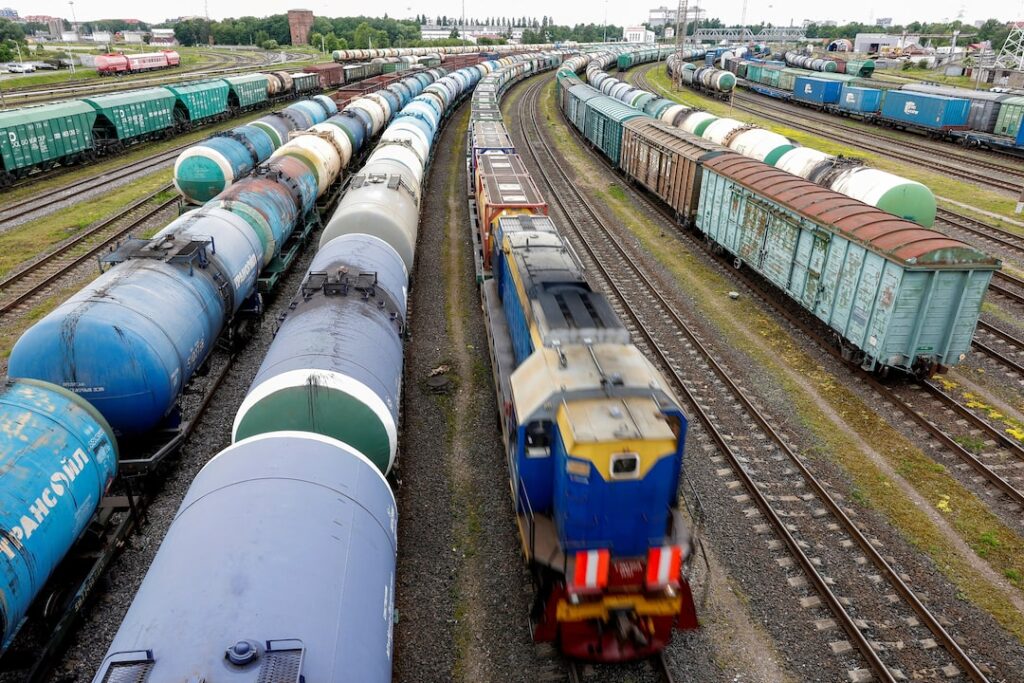
Although China’s inland trucking network is extensive, it becomes heavily congested near peak export periods. Because 40GP and 20GP tractors must follow regional booking windows, last-minute dispatch rarely succeeds. Therefore, shippers should schedule trucking at least 48 hours before planned loading.
Scheduling best practices
- Confirm pickup slot with the supplier one day before loading
- Verify the container is empty, clean and sealed properly
- Share ETA updates with both factory and warehouse teams
- Prepare alternative carriers for peak-season flexibility
Furthermore, inland transport delays affect not only factory loading but also export documentation filing, which must match the final cargo specifications.
For shippers who want origin-to-port reliability, Top China Freight provides coordinated inland transport through its door-to-door and factory service resources.
What Documentation Is Required Before Factory Pickup Can Proceed?
Although documentation is often considered a clearance step, it begins much earlier. The accuracy of key export documents influences VGM approval, compliance checks and port entry.
Required documents and their functions
| Document | Purpose | Why It Matters |
|---|---|---|
| Commercial Invoice | Declares value | Prevents customs mismatch |
| Packing List | Confirms cargo details | Ensures correct loading order |
| Booking Confirmation | Secures carrier space | Aligns loading with cut-off |
| VGM Certificate | Confirms weight | Mandatory before port entry |
| Export Clearance Files | Customs compliance | Reduces risk of inspection |
Moreover, drafting documents at least 24–48 hours before pickup reduces supplier-side errors that commonly delay cargo handover.
Case Studies
Guangzhou → Gothenburg (Furniture Manufacturer)
- Cargo: Mixed wooden and upholstered furniture
- Issue: Supplier failed to pre-sort products
- Solution: Top China Freight coordinated factory sorting and loading
- Outcome: Trucking time reduced by 45 minutes
- Result: Shipment cleared CY 2 hours before cut-off
Although the supplier initially underestimated preparation time, proactive coordination prevented a costly rollover.
Ningbo → Helsingborg (Outdoor Equipment Brand)
- Cargo: Bulky metal frames and packaged textiles
- Issue: Unstable pallets affecting loading
- Solution: Repacking and center-of-gravity adjustments
- Outcome: Smooth loading in 40 minutes
- Result: Zero delays at origin and stable transit to Sweden
Moreover, improved pallet stability reduced the risk of cargo shifting during ocean transit.
How Can Shippers Manage Shipping Time and Route Selection to Sweden?
Although most Sweden-bound cargo moves via Gothenburg or Helsingborg, alternative routings through northern Europe may enhance reliability during peak seasons.
Shipping time comparison
| Route | Time Range | Notes |
|---|---|---|
| China → Gothenburg | 30–36 days | Most efficient for large volumes |
| China → Helsingborg | 33–42 days | Suitable for mixed SKUs |
| China → Malmö | 35–45 days | Ideal for southern Sweden distribution |
Moreover, selecting routes with fewer transshipments can reduce delays associated with port congestion.
Should Shippers Consider Multimodal Alternatives for Urgent Sweden Shipments?
Yes. Although FCL remains the main mode, multimodal solutions offer flexibility when shipping time is critical.
Shippers may combine:
- Sea + Rail via Europe
- Sea + Air for high-value components
- Express for small urgent packages(via Top China Freight’s express service)
Moreover, multimodal routing helps Sweden importers bypass seasonal ocean delays.
How Does Port Operations Affect China–Sweden FCL Timelines?
Even if factory pickup is perfect, missing the port cut-off disrupts the entire schedule. Therefore, port operations must align with pickup timing.
Port operation timeline
| Step | Action | Impact on Sweden Transit |
|---|---|---|
| Gate-in | Truck enters CY | Ensures timely carrier acceptance |
| Customs Filing | Export docs submitted | Reduces inspection risk |
| VGM Submission | Weight confirmed | Mandatory for loading |
| Vessel Loading | Container loaded onboard | Secures planned departure |
Because shipping time to Sweden averages 30–45 days depending on the route, any port delay adds considerable buffer to the delivery schedule.
Conclusion
In summary, China FCL factory pickup to Sweden depends on synchronized factory readiness, accurate documentation, stable inland trucking and precise port operations. Moreover, shippers reduce delays and improve transit predictability when planning each step in advance. Companies seeking long-term stability in China–Sweden logistics should request a fully coordinated plan covering pickup, loading, compliance and schedule management.
Request A Free Quote
Need a reliable logistics partner? Share your shipment details and we’ll provide a tailored quotation quickly and accurately.
FAQ:
What affects factory pickup timing the most?
Supplier readiness, pallet quality, and trucking availability influence the pickup schedule.
How early should I book inland trucking?
Booking 48 hours in advance ensures capacity and reduces missed cut-offs.
Can I combine products from multiple suppliers?
Yes, but multi-stop pickups increase transit time and require stronger coordination.
How do I reduce port delays in China?
Align loading sequence with carrier cut-offs and submit documents early.
Are alternative routes useful during congestion?
Routes with fewer transshipments often deliver more predictable schedules.