
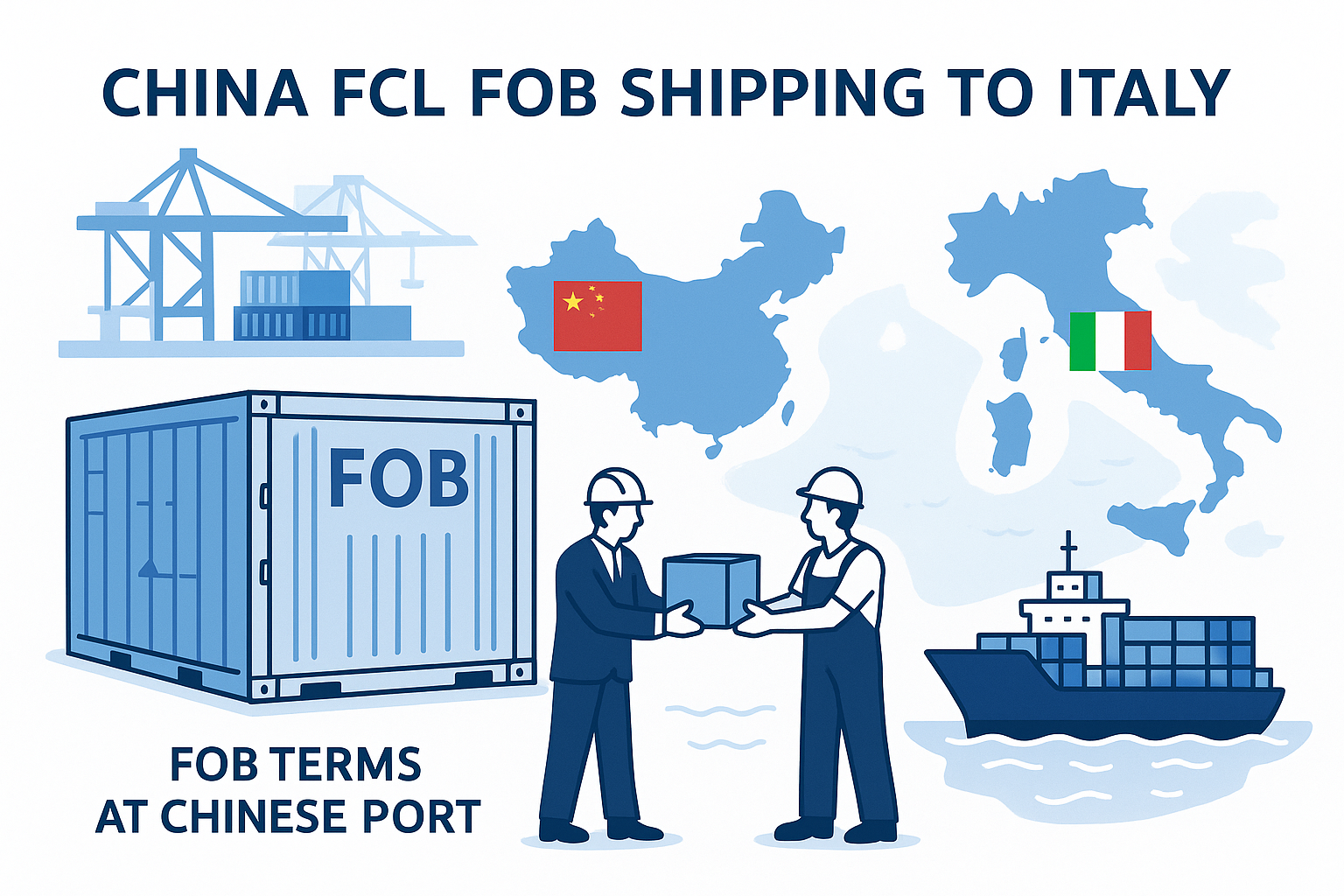
For exporters and importers, China FCL FOB shipping to Italy remains one of the most efficient and reliable ways to move large volumes of goods. Understanding shipping terms, transit time, costs, and customs procedures ensures your supply chain runs smoothly without delays or unexpected expenses.

What Does FOB Mean in FCL Shipping?
FOB (Free on Board) is a common international shipping term that defines responsibility between the buyer and seller. Under the FOB agreement, the seller handles all local export costs until the goods are loaded on board the vessel at a Chinese port.
| Responsibility | Seller (China) | Buyer (Italy) |
|---|---|---|
| Export Customs Clearance | ✔ | ✖ |
| Inland Transportation in China | ✔ | ✖ |
| Sea Freight | ✖ | ✔ |
| Insurance | ✖ | ✔ |
| Import Customs Duties | ✖ | ✔ |
This clear division minimizes disputes and ensures transparent logistics responsibility between Chinese suppliers and Italian importers.
How Does FCL Shipping Work Under FOB Terms?
In FCL (Full Container Load) shipping, an entire container is reserved for one consignee. Under the FOB model, the exporter delivers goods to the port and covers costs up to vessel loading, while the importer manages sea freight and destination charges.
Shipping Flow:
- Buyer books a vessel through a freight forwarder.
- Seller transports goods to port under FOB terms.
- Container is loaded and sealed at origin port.
- Freight forwarder issues a Bill of Lading.
- Cargo sails to Italy, followed by customs clearance and inland delivery.
This method ensures security, efficiency, and full control over the shipment schedule.
What Are the Main Routes and Transit Times from China to Italy?
Transit time varies based on origin port, carrier, and sailing route.
| Port of Origin (China) | Destination Port (Italy) | Transit Time (Days) | Route |
|---|---|---|---|
| Shenzhen | Genoa | 28–32 | Via Suez Canal |
| Ningbo | Venice | 29–33 | Direct |
| Shanghai | Trieste | 31–35 | Via Singapore |
| Qingdao | Naples | 30–34 | Via Colombo |
Tip: Direct sailings are faster but often have limited space; transshipment routes offer better rate stability.
How Much Does FCL FOB Shipping from China to Italy Cost?
Costs depend on container size, cargo weight, and seasonal demand.
| Container Type | Average Cost (USD) | Transit Time (Days) | Cargo Example |
|---|---|---|---|
| 20GP FCL | 2,600–3,200 | 28–32 | Lighting, hardware tools |
| 40GP FCL | 3,800–4,400 | 30–34 | Furniture, auto parts |
| 40HQ FCL | 4,000–4,800 | 30–35 | Electronics, machinery |
Cost-saving Tip: Combine shipments, book in advance, and avoid peak periods (August–October).
Real Case Studies: China–Italy FCL FOB Shipping
Case 1: Ningbo → Venice (Lighting Fixtures)
- Container Type: 20GP FCL
- Cargo Volume: 25 CBM (12 tons)
- Freight Cost: USD 2,850
- Transit Time: 30 days
- Result: Delivered safely; customs cleared within 24 hours.
Case 2: Shenzhen → Genoa (Industrial Machinery)
- Container Type: 40HQ FCL
- Cargo Volume: 60 CBM (15 tons)
- Freight Cost: USD 4,600
- Transit Time: 32 days
- Result: Temperature maintained during transit; insured shipment.
What Documents Are Required for FOB Shipments to Italy?
Proper paperwork prevents customs delays and penalties.
| Document | Purpose |
|---|---|
| Commercial Invoice | Declares value and description of goods |
| Packing List | Specifies contents and weights |
| Bill of Lading | Confirms ownership and shipment details |
| Certificate of Origin | Required for EU imports |
| Insurance Certificate | Optional but recommended |
| Import Declaration | Filed at Italian customs |
Note: Italian authorities require CE certification for specific product categories such as lighting and electronics.
How to Ensure Smooth Customs Clearance in Italy?
Efficient clearance depends on documentation accuracy and broker communication.
Checklist for Italian Imports:
- Submit EORI registration before the first import.
- Verify HS codes and customs tariffs under EU regulations.
- Ensure CE and RoHS compliance for electrical goods.
- Pay import VAT and duties in advance to avoid detention.
Choosing an experienced freight forwarder simplifies this process and minimizes delays at Italian ports.
What Are the Advantages of China FCL FOB Shipping to Italy?
| Advantage | Description |
|---|---|
| Cost Control | Buyers manage main freight and insurance |
| Transparency | Clear division of responsibility |
| Security | Cargo sealed from origin to destination |
| Flexibility | Full container use without sharing space |
| Predictable Timelines | Scheduled departures and consistent sailing times |
In addition, the FOB model allows importers to negotiate competitive rates directly with carriers or forwarders.
Conclusion
Choosing China FCL FOB shipping to Italy provides importers with cost efficiency, control, and predictability. By understanding FOB responsibilities, preparing proper documents, and working with reliable freight partners, your shipments will move safely and on time across international waters.
Request A Free Quote
Get started with TopChinaFreight today! 🚢✨ Simply Request a Free Quote 📝 to receive a customized shipping solution tailored to your needs. Our experts will provide the best rates 💰, fastest routes 🚀, and professional guidance 🌍 for your international logistics.
FAQs
Q1.How long does FCL FOB shipping from China to Italy take?
Transit time typically ranges from 28 to 35 days depending on origin port and vessel schedule.
Q2.What does FOB mean in international shipping?
FOB (Free on Board) means the seller covers all costs until loading, and the buyer handles sea freight and import duties.
Q3.Which ports in China are best for FOB shipments to Italy?
Shenzhen, Ningbo, Shanghai, and Qingdao offer frequent sailings with reliable transit times to Italian ports.
Q4.How much does a 40HQ FCL cost from China to Italy?
The average rate for a 40HQ container is USD 4,000–4,800 depending on season and carrier.
Q5.Do I need insurance for FOB shipping from China to Italy?
Yes, marine insurance protects against loss or damage during transit and is strongly recommended under FOB terms.