
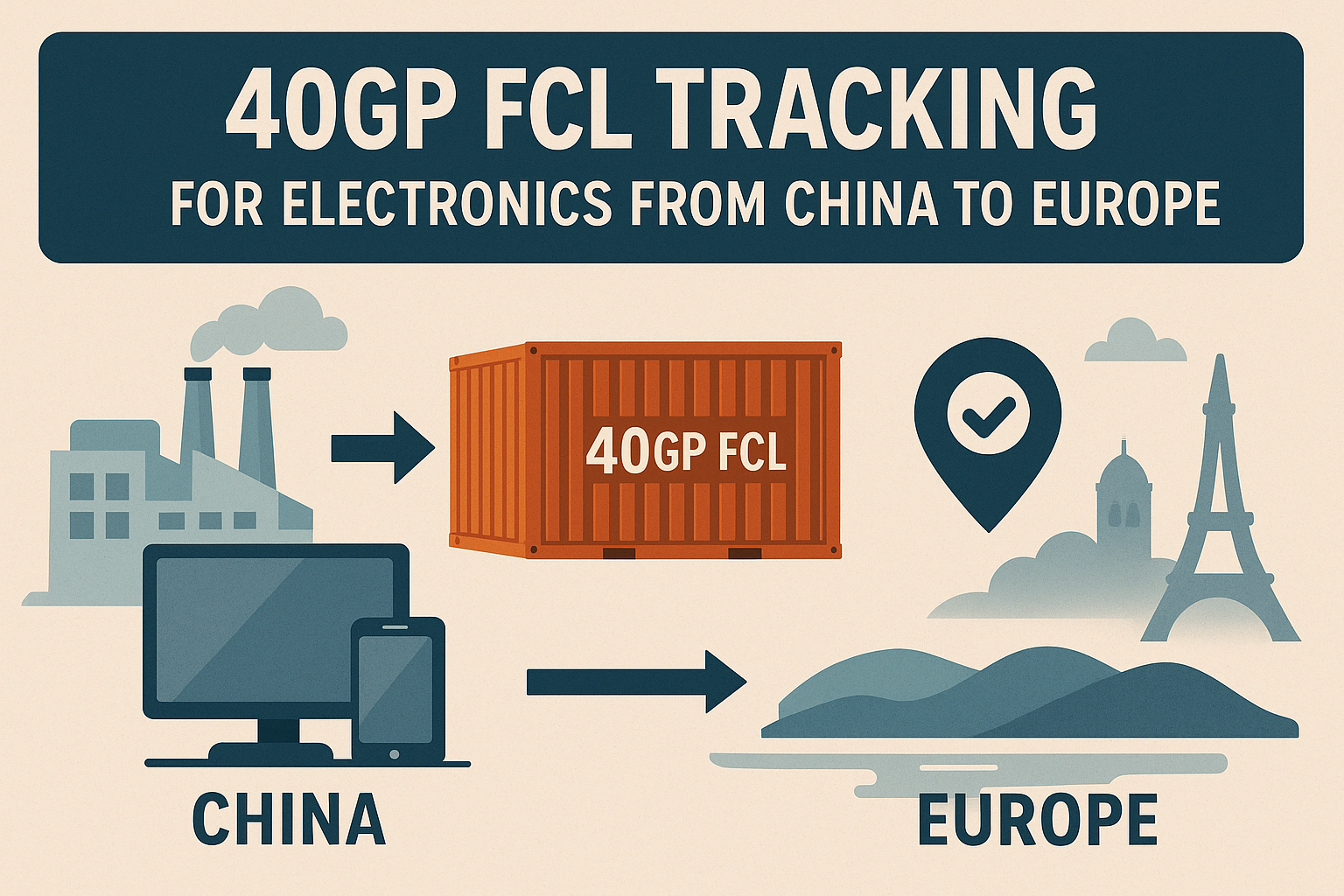
Electronics are among the most valuable and time-sensitive goods shipped internationally. Ensuring their timely and secure delivery requires precise visibility and control. The 40GP FCL tracking for electronics from China to Europe provides manufacturers, freight forwarders, and importers with full transparency across the logistics chain—from factory pickup to European ports and final delivery.
What Is 40GP FCL Shipping and Why Is Tracking Important for Electronics?
A 40GP (40-foot general purpose) container is the most common unit for international sea freight. It holds up to 67 cubic meters and 26 tons, ideal for bulk electronic devices, components, or accessories.
| Container Type | Volume (CBM) | Max Payload (tons) | Best For |
|---|---|---|---|
| 20GP | 33 | 28 | Small electronic parts |
| 40GP | 67 | 26 | Mid-size bulk electronics |
| 40HQ | 76 | 26 | Lightweight high-value goods |
Tracking becomes essential because electronics require temperature control, timely updates, and theft prevention. Moreover, with long transit times across Asia–Europe routes, real-time visibility helps prevent costly delays and losses.
How Does FCL Tracking Work in China–Europe Logistics?
FCL tracking integrates IoT devices, satellite systems, and carrier data feeds to monitor container movement in real time. Most modern forwarders use E-seals, GPS sensors, and cloud-based dashboards.
| Tracking Tool | Function | Frequency | Accuracy |
|---|---|---|---|
| GPS Tracker | Live route monitoring | Every 15 min | ±10m |
| RFID Seal | Security and opening alerts | Event-based | High |
| Online Platform | Consolidated status reports | Real-time | N/A |
| Carrier API | Ocean vessel updates | Hourly | Medium |
Through platforms like CMA CGM eBusiness, Maersk Tradelens, or Top China Freight Tracking, shippers can access location, ETA, and temperature logs anytime.
What Routes Are Common for Electronics Shipping from China to Europe?
Several maritime and intermodal routes connect China to key European markets. Each offers different transit times and reliability.
| Route | Ports Involved | Transit Time (days) | Features |
|---|---|---|---|
| Shenzhen → Rotterdam | Direct | 28–32 | Stable and frequent |
| Ningbo → Hamburg | Via Singapore | 30–35 | Balanced cost |
| Shanghai → Antwerp | Direct | 29–33 | Reliable for electronics |
| Qingdao → Gdynia | Transshipment | 33–38 | Low congestion |
Southern routes through Shenzhen and Ningbo are preferred for electronic exports due to higher carrier frequency and faster customs clearance.
What Are the Benefits of 40GP FCL Tracking for Electronics?
Effective tracking transforms logistics from reactive to proactive management. The main benefits include:
- Real-Time Visibility: Monitor shipment progress and identify port congestion early.
- Improved Security: Alerts for unauthorized access or seal tampering.
- Reduced Delays: Automated ETA updates for better scheduling.
- Customs Transparency: Documentation integration for pre-arrival clearance.
- Customer Confidence: Importers gain trust through predictable delivery updates.
For high-value electronics such as laptops, components, and consumer devices, this visibility ensures compliance with EU import standards and reduces warehousing bottlenecks.
Need a shipping solution? 🚢 Request a Free Quote 📝 from TopChinaFreight and get the best rates and fastest routes today!
Case Studies: 40GP FCL Tracking Success for Electronics
Case 1 – Shenzhen to Rotterdam (Direct FCL)
- Cargo: 40GP of smart home electronics
- Transit: 29 days
- Freight Cost: USD 3,850 all-in
- Tracking System: GPS & E-seal
- Result: Container arrival matched ETA within 2 hours; zero loss reported.
Case 2 – Ningbo to Hamburg (Via Singapore)
- Cargo: 18 tons of industrial sensors
- Transit: 33 days
- Freight Cost: USD 4,200
- Tracking System: Top China Freight real-time platform
- Result: Detected 1-day delay at transshipment; delivery rescheduled seamlessly.
Case 3 – Shanghai to Antwerp (Rail–Sea Combined)
- Cargo: 24 tons of computer parts
- Transit: 26 days
- Freight Cost: USD 5,100 (multimodal)
- Result: Continuous tracking allowed customs pre-clearance; released within 24 hours after arrival.
How Does FCL Tracking Reduce Delays and Damage Risks?
Tracking not only shows location—it prevents costly disruptions by providing predictive alerts and corrective action options.
| Risk Type | Traditional Issue | Tracking Solution |
|---|---|---|
| Port Congestion | Unknown waiting time | Predictive ETA updates |
| Customs Delay | Missing paperwork | E-document synchronization |
| Theft or Tampering | No alerts | Instant RFID notifications |
| Transit Damage | Late response | Temperature & shock sensors |
Moreover, proactive tracking enables shippers to reroute containers if major European ports like Rotterdam or Hamburg experience congestion, thus maintaining delivery commitments.
What Documents Are Required for Electronics FCL Shipping to Europe?
Accurate documentation ensures seamless customs and tracking integration.
| Document | Function | Issued By |
|---|---|---|
| Bill of Lading | Proof of shipment | Carrier |
| Commercial Invoice | Declares value | Exporter |
| Packing List | Item details | Exporter |
| CE Certificate | EU compliance | Manufacturer |
| Certificate of Origin | Trade preference | Chamber of Commerce |
| Insurance Certificate | Coverage proof | Freight forwarder |
Submitting these through EU’s ICS2 (Import Control System) in digital form reduces clearance delays and enables synchronized shipment tracking.
How to Choose the Best Tracking Partner for FCL Electronics Shipments?
Choosing a reliable logistics partner makes tracking more than a dashboard—it becomes a supply chain control tool. Look for:
- End-to-End Visibility: From factory gate to European warehouse.
- Integrated API Access: Real-time updates compatible with ERP systems.
- Dedicated Customer Portal: Provides alert summaries and analytics.
- Expertise in Electronics: Specialized handling of high-value goods.
- Multimodal Options: Sea, rail, and truck for final-mile delivery.
Top China Freight provides unified FCL tracking across routes, customs, and carriers, ensuring 24/7 monitoring and instant response to disruptions.
Conclusion
The 40GP FCL tracking for electronics from China to Europe enables businesses to maintain reliability, security, and transparency across their entire logistics network. With IoT-based systems, predictive analytics, and experienced freight forwarders, electronics exporters can now eliminate uncertainties, streamline customs processes, and ensure on-time deliveries every time.
Request A Quote
Get started with TopChinaFreight today! 🚢✨ Simply Request a Free Quote 📝 to receive a customized shipping solution tailored to your needs. Our experts will provide the best rates 💰, fastest routes 🚀, and professional guidance 🌍 for your international logistics.
FAQs:
How long does 40GP FCL shipping for electronics from China to Europe take?
Typically 28 to 35 days, depending on origin port, carrier route, and customs inspection times across major European terminals.
What tools are used for FCL tracking of electronic shipments?
GPS trackers, RFID seals, and digital platforms integrated with carrier data provide real-time updates from departure to delivery.
Can I monitor container temperature during sea freight?
Yes, smart IoT sensors continuously record temperature and humidity, ensuring sensitive electronics stay within safe limits during transit.
What’s the benefit of using 40GP FCL for electronics?
It offers cost efficiency, better cargo protection, and exclusive container use, reducing the risk of damage or mixing with other goods.
How can tracking help avoid customs delays in Europe?
Digital tracking links shipment data with customs portals, allowing pre-clearance and instant document verification before arrival.