
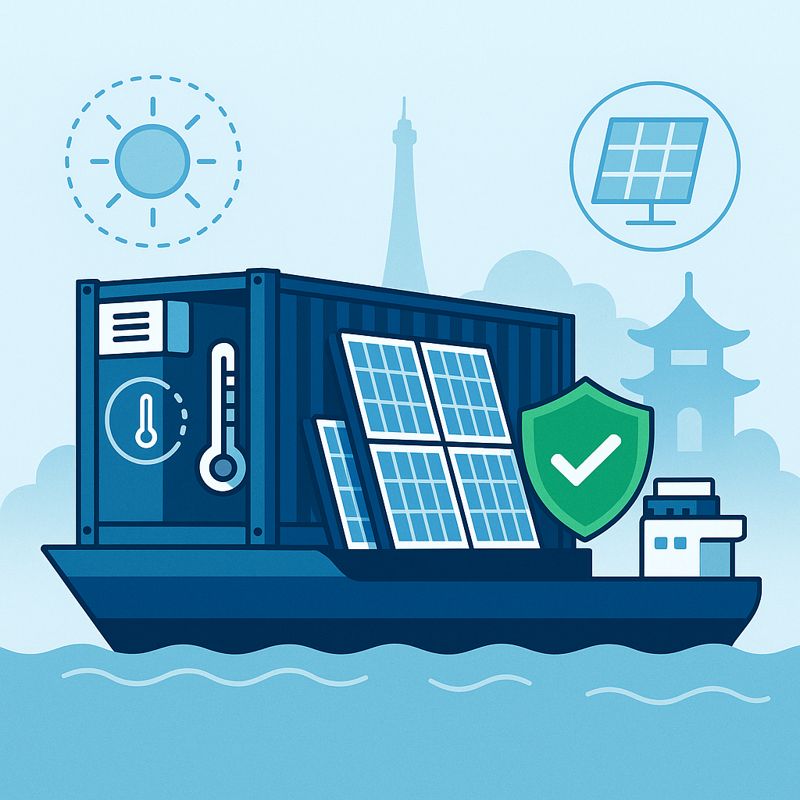
As renewable energy shipments scale up, Reefer FCL insurance for solar panels from China to France has become a decisive safeguard against temperature deviation, handling damage, and port delays. However, complex risk profiles across long sea routes can expose high-value cargo if coverage is misaligned. Therefore, this guide delivers actionable insurance strategies grounded in real movements coordinated by Top China Freight.

What risks do solar panels face in Reefer FCL transport?
Although solar panels are solid-state products, they remain sensitive to environmental and handling factors. Consequently, insurers assess multiple risk vectors.
Temperature deviation and condensation
Reefer containers mitigate heat exposure, yet incorrect setpoints or power interruptions can cause condensation. As a result, micro-cracks or connector corrosion may occur.
Mechanical shock and vibration
Panels are fragile at the glass surface and junction boxes. Therefore, improper bracing during long voyages increases breakage risk.
Port dwell and congestion exposure
Extended terminal stays elevate risk despite refrigeration. Consequently, insurance must consider dwell-time scenarios at origin and destination ports.

Why choose Reefer FCL instead of dry containers for solar panels?
While dry containers dominate general cargo, Reefer FCL offers targeted protection for solar modules on long routes.
Thermal stability across seasons
Reefer units maintain consistent internal conditions. As a result, temperature swings during summer crossings reduce significantly.
Enhanced monitoring and alarms
Most reefers provide data logs. Therefore, deviations can be evidenced during claims.
Cleaner internal environment
Reefers often present lower humidity and contamination risk. Consequently, panel surfaces and connectors remain protected.
Many exporters pair Reefer FCL with specialized coverage through integrated sea freight services to align transport and insurance controls.
How does Reefer FCL insurance differ from standard marine insurance?
Standard marine insurance often undercovers temperature-driven loss. Therefore, Reefer-specific clauses matter.
Temperature deviation endorsements
These clauses extend coverage to losses caused by verified setpoint failures. As a result, claims eligibility improves.
Machinery breakdown extensions
Coverage may include reefer unit malfunction. Consequently, power loss incidents become compensable.
Handling and loading conditions
Insurers require compliant stowage and bracing. Therefore, documented loading plans support claim success.
What coverage scope should solar panel shippers secure?
Coverage scope determines whether losses are reimbursed fully. Therefore, shippers should align policy terms with cargo value and risk.
| Coverage Element | Why It Matters |
|---|---|
| All-risks clause | Broad protection beyond named perils |
| Temperature deviation | Covers heat/cold damage |
| Theft & pilferage | Protects high-value cargo |
| Delay-in-transit | Addresses port congestion exposure |
Selecting the right mix reduces gaps without overpaying premiums.
Case Studies
Solar modules from Ningbo to Marseille
Shipment profile:
• Origin: Ningbo, China
• Destination: Marseille, France
• Cargo: Crated photovoltaic panels
• Container: 1 × Reefer FCL
Execution:
The shipper set conservative temperature limits and secured deviation coverage. As a result, minor port delays did not affect cargo integrity.
Outcome:
• Transit time: 33 days
• Temperature deviations: None
• Insurance claim: Not required
Utility-scale panels from Shanghai to Le Havre
Shipment profile:
• Origin: Shanghai, China
• Destination: Le Havre, France
• Cargo: Utility-scale solar panels
• Container: 1 × Reefer FCL
Execution:
A brief power interruption occurred during transshipment. Consequently, data logs supported a partial claim under the deviation endorsement.
Outcome:
• Transit time: 41 days
• Claim outcome: Approved
• Loss recovery: Timely
How does insurance integrate with the Reefer FCL shipping process?
Although insurance is often treated as a paperwork item, it should be integrated into the shipping workflow. Therefore, alignment between transport execution and policy terms matters.
Pre-shipment risk assessment
Before loading, insurers evaluate routing, seasonality, and port conditions. As a result, risk scoring influences premiums and deductibles.
Booking-stage declarations
Temperature setpoints, cargo sensitivity, and container type must match policy declarations. Otherwise, coverage disputes may arise later.
In-transit monitoring
Reefer data logs provide continuous evidence. Consequently, insurers rely on these records when assessing claims.
What role does door-to-door planning play in insurance protection?
Insurance risk extends beyond the ocean leg. Therefore, door-to-door planning closes exposure gaps.
Inland leg inclusion
Policies should cover inland transport within France. Otherwise, damage during final delivery may fall outside scope.
Single responsibility chain
Using one logistics provider reduces disputes over liability handoffs.
Predictable delivery schedules
Shorter dwell time reduces environmental exposure. As a result, loss probability declines.
Many exporters integrate insurance planning with structured door-to-door transport to stabilize outcomes.
What hidden gaps should solar exporters avoid?
Even comprehensive policies may contain gaps. Therefore, careful review is essential.
| Potential Gap | Risk Exposure | Mitigation |
|---|---|---|
| Excluded temperature deviation | Unpaid damage | Add deviation endorsement |
| Limited inland coverage | Final-mile loss | Extend policy scope |
| High deductibles | Reduced recovery | Balance premium vs risk |
Closing these gaps protects margins on high-value solar shipments.
Conclusion
In conclusion, Reefer FCL insurance for solar panels from China to France plays a central role in safeguarding high-value renewable energy cargo against temperature deviation, handling damage, and delay-related loss. Rather than treating insurance as an afterthought, proactive integration with transport planning delivers stronger protection and predictable recovery. With the right coverage structure and experienced logistics support, solar exporters can ship with confidence.
Request A Free Quote
Start shipping smarter with TopChinaForwarder today! 🚢✨ Request a Free Quote 📝 and get a tailored logistics plan built around your cargo and timeline.
FAQ:
Is Reefer FCL insurance mandatory for solar panels?
Insurance is not mandatory, but it is strongly recommended due to the high value and fragility of solar panels.
Does standard marine insurance cover temperature deviation?
Usually no; temperature deviation requires a specific endorsement for Reefer containers.
Can insurance cover damage caused by port congestion?
Coverage applies only if physical damage results from congestion-related conditions.
How are insurance premiums calculated for solar panels?
Premiums depend on cargo value, routing, seasonality, and risk controls.
What documents are required for a Reefer insurance claim?
Temperature logs, invoices, packing lists, photos, and survey reports are typically required.