
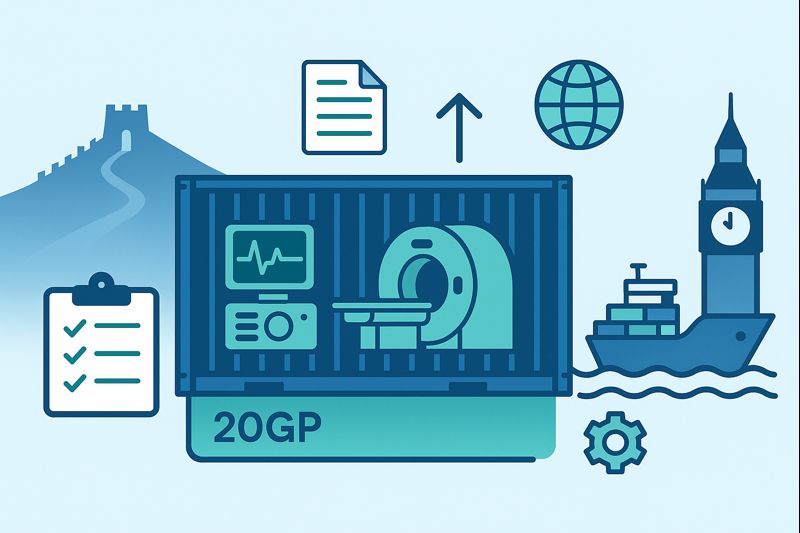
As healthcare supply chains globalize, the 20GP FCL booking process for medical equipment from China to Europe has become a mission-critical task for importers who demand accuracy and compliance. However, booking mistakes, incomplete documents, or misaligned timelines can quickly disrupt hospital deliveries. Therefore, this guide outlines a practical, step-by-step booking framework, informed by real shipments coordinated through Top China Freight.
What does the 20GP FCL booking process involve for medical equipment?
Although FCL booking may appear straightforward, medical equipment adds regulatory and handling layers. Consequently, each stage must be coordinated precisely.
Booking request submission
Shippers submit cargo details, including dimensions, weight, HS codes, and temperature sensitivity. As a result, carriers can assess space and equipment suitability early.
Vessel space confirmation
Once carriers confirm space, the booking moves to provisional status. Therefore, production schedules should align with the vessel cutoff.
Equipment allocation
A 20GP container is assigned based on cargo density and packaging style. This step ensures optimal load safety and compliance.
Why is 20GP FCL preferred for medical equipment shipments?
Medical equipment often requires controlled handling and predictable timelines. Therefore, FCL offers several advantages.
Enhanced cargo integrity
FCL shipments avoid consolidation with unrelated cargo. Consequently, contamination and handling risks decrease significantly.
Clear booking accountability
With one shipper per container, responsibility for packing and sealing remains clear. As a result, inspections proceed more smoothly.
Stable transit planning
FCL bookings usually experience fewer schedule disruptions compared with LCL medical cargo.
Many exporters rely on professional FCL and LCL services to determine the optimal container strategy.
What documents are required during the booking stage?
Even before export clearance, documentation supports booking approval. Consequently, early preparation avoids vessel rollovers.
| Document | Purpose at Booking Stage |
|---|---|
| Commercial Invoice (Draft) | Cargo value & description |
| Packing List | Volume and load planning |
| Product Datasheet | Handling & safety review |
| Export License (if required) | Regulatory validation |
When documentation aligns early, the booking process remains uninterrupted.

How should shippers prepare medical equipment data before booking?
Preparation determines booking success. Therefore, accurate data collection must happen before any carrier request.
Product classification
Medical devices require correct HS codes and EU classification. Misclassification can delay both booking and clearance.
Packaging specifications
Shock protection, moisture control, and palletization details help carriers evaluate container suitability.
Temperature and handling notes
Some diagnostic devices or reagents require temperature stability. Thus, special instructions should be flagged at booking.
Case Studies
Diagnostic devices from Shanghai to Germany
Shipment profile:
• Origin: Shanghai, China
• Destination: Frankfurt, Germany
• Cargo: Diagnostic imaging components
• Container: 1 × 20GP FCL
Execution:
The exporter submitted complete product data and compliance documents at booking. As a result, space was confirmed on the first request.
Outcome:
• Booking lead time: 9 days
• Transit reliability: High
• Clearance issues: None
Hospital equipment from Shenzhen to Netherlands
Shipment profile:
• Origin: Shenzhen, China
• Destination: Rotterdam, Netherlands
• Cargo: Hospital monitoring equipment
• Container: 1 × 20GP FCL
Execution:
Because of temperature sensitivity, special handling notes were added during booking. Consequently, the container allocation met all requirements.
Outcome:
• Booking approval: Smooth
• Schedule adherence: On time
• Cargo condition: Fully intact
How long does the booking timeline usually take?
Although timelines vary by season, the booking window follows a predictable pattern.
| Booking Milestone | Typical Timeframe |
|---|---|
| Initial booking request | 10–14 days before ETD |
| Space confirmation | 7–10 days before ETD |
| Container pickup | 5–7 days before ETD |
| Port cutoff | 2–3 days before ETD |
Therefore, aligning production and paperwork with this timeline protects delivery schedules.
What role does door-to-door delivery play after booking?
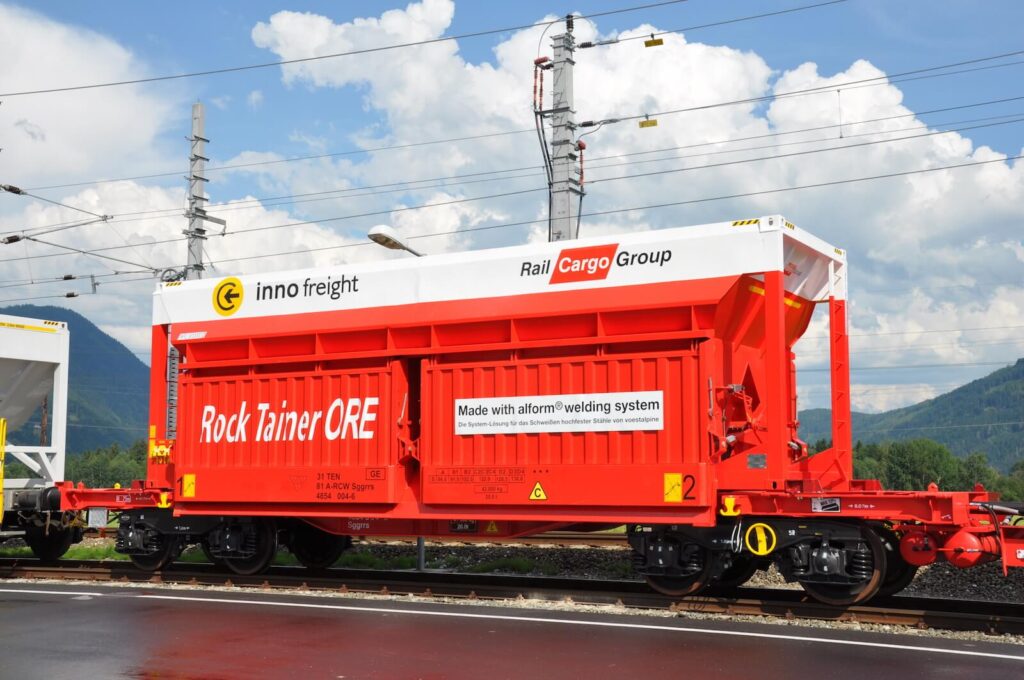
While the booking process focuses on ocean transport, delivery does not end at the port. Therefore, door-to-door planning adds stability.
Inland delivery scheduling
Pre-booked trucking or rail avoids delays after arrival. Consequently, hospitals and distributors receive equipment on time.
Single-point responsibility
One logistics provider manages multiple legs. As a result, accountability remains clear.
Reduced administrative burden
Shippers avoid coordinating multiple vendors, which lowers operational risk.
Many medical importers choose structured door-to-door transport to support time-sensitive deliveries.
What indirect costs depend on a smooth booking process?
Although booking itself does not incur all costs, poor execution increases expenses downstream.
| Cost Area | Booking Impact | Control Method |
|---|---|---|
| Demurrage | Late gate-in | Early container pickup |
| Storage | Clearance delay | Document accuracy |
| Inventory cost | Extended transit | Reliable scheduling |
Thus, a well-managed booking process protects both timelines and budgets.
Conclusion
Top China Freight supports medical equipment shippers by aligning booking workflows, compliance checks, and inland coordination into a single process. By combining regulatory awareness with operational control, clients benefit from predictable timelines and reduced booking-related risks across Europe-bound routes.
Request A Free Quote
Start shipping smarter with TopChinaForwarder today! 🚢✨ Request a Free Quote 📝 and get a tailored logistics plan built around your cargo and timeline.
FAQ:
How early should I book a 20GP FCL for medical equipment?
Booking 10–14 days before departure is recommended, especially during peak healthcare demand periods.
Do medical devices require special booking declarations?
Yes, some devices need additional compliance notes or export approvals declared at booking.
Can I change cargo details after booking confirmation?
Minor changes may be accepted, but major revisions can risk space cancellation.
What happens if I miss the port cutoff?
The container usually rolls to the next sailing, which can delay delivery by a week or more.
How can I reduce booking-related risks?
Early preparation, accurate documentation, and experienced forwarder support reduce most risks.