
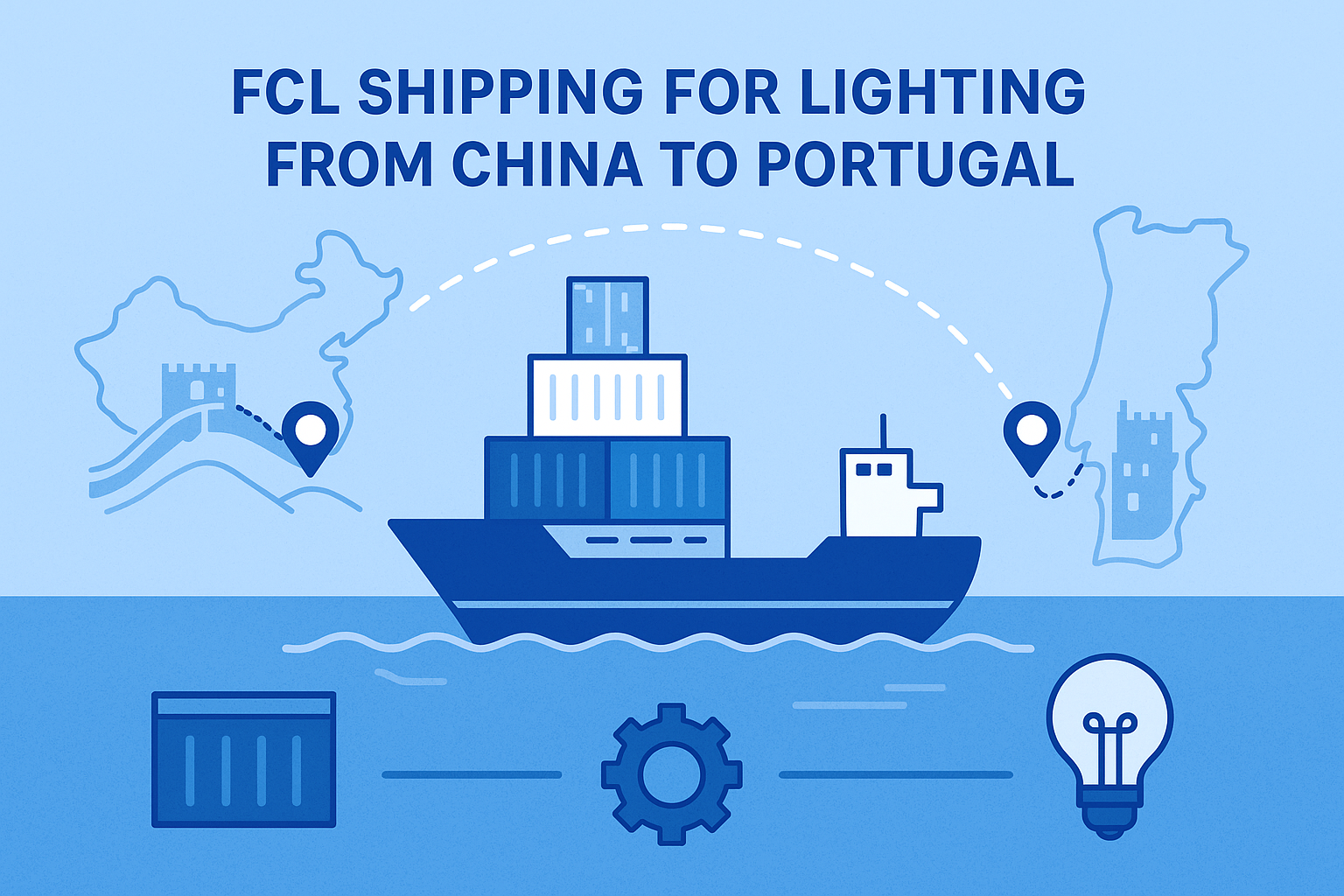
Although many importers view full-container transport as a straightforward process, FCL shipping for lighting from China to Portugal requires precise planning across packing, customs, vessel schedules, and inland delivery. Therefore, this guide breaks down each step and offers practical strategies to help lighting brands, wholesalers, and contractors reduce risk and control freight costs—especially when working with experienced partners like Top China Freight. Moreover, you will learn how to protect fragile lighting items, stabilize timelines, and navigate European customs without unnecessary delays.


What Makes FCL Shipping Ideal for Lighting from China to Portugal?
Lighting products—LED fixtures, chandeliers, panels, and architectural lighting—often require stable handling, dedicated space, and consistent vibration control. Because FCL offers full use of a single container, importers avoid the consolidation risks of LCL shipments.
Advantages of FCL for Lighting
- Better protection for fragile fixtures
- Fewer touchpoints, reducing breakage
- More predictable delivery schedules
- Improved control of pallet layout and packaging
- Lower cost per unit for bulk shipments
Additionally, lighting suppliers benefit from dedicated container sealing, ensuring no exposure to other cargo categories during transit.
How Should Lighting Cargo Be Packed for Safe FCL Transport?
Because lighting items range from delicate glass components to heavy industrial fixtures, packing is a decisive factor. Moreover, correct packaging reduces insurance claims and improves efficiency during loading.
Recommended Packing Guidelines
- Use multilayer corrugated boxes with foam or EPE inserts
- Strengthen corners with protective angles
- Apply shock indicators for premium lighting pieces
- Palletize uniformly to avoid leaning or toppling
- Keep moisture-sensitive LED drivers sealed with desiccant
While exporters often handle basic packaging, importers should still verify compliance with European handling standards before booking.
How Much Does FCL Shipping for Lighting from China to Portugal Typically Cost?
Although rates fluctuate weekly, lighting importers can rely on general cost patterns based on container size, routing, and handling requirements. Because fragile goods may require additional loading supervision, budgeting must include both freight and operational surcharges.
Reference Cost Table (Non-binding Estimates)
| Container Type | Typical Freight Cost (USD) | Notes |
|---|---|---|
| 20GP | 1,250–2,050 | Suitable for dense LED items |
| 40GP | 1,850–2,950 | Popular for mixed lighting shipments |
| 40HQ | 1,950–3,200 | Ideal for larger decorative lighting |
Since peak demand seasons—such as Q2 project cycles and Q4 retail orders—increase freight volatility, importers should request updated quotes regularly.
What Transit Time Should Importers Expect for China–Portugal FCL Routes?
Transit time depends on the port of loading, carrier routing, and transshipment hubs. Nevertheless, predictable patterns allow lighting buyers to plan inventory cycles more effectively.
Estimated Door-to-Port Transit Time
| Origin Port | Destination (Portugal) | Transit Time | Notes |
|---|---|---|---|
| Shanghai | Lisbon | 28–35 days | Fastest East-West routes |
| Ningbo | Porto | 30–38 days | Stable capacity year-round |
| Shenzhen | Lisbon | 27–34 days | Strong for lighting exporters |
| Qingdao | Porto | 32–42 days | Longer inland transport |
Although transit windows shift occasionally, importers can reduce delays by ensuring clean documentation and early booking.
Case Studies
LED Panel Shipment from Shenzhen to Lisbon
Cargo: 40HQ with 850 cartons of LED panels
Transit Time: 31 days
Challenge: High moisture sensitivity during winter sailings
Solution: Desiccant-enhanced packaging, reinforced pallets, early customs document preparation
Outcome: Cargo arrived in perfect condition; warehouse processing time reduced by 18%
Decorative Lighting Shipment from Ningbo to Porto
Cargo: 20GP containing chandeliers, glass pendants, and mixed accessories
Transit Time: 34 days
Challenge: Fragile glass components with vibration risk
Solution: Double-layer foam packaging, shock sensors, and supervised container loading
Outcome: Zero breakage reported; installation schedule for Portuguese retailer remained uninterrupted
Should Importers Use Door-to-Door Service for Lighting Cargo?
Although many shippers choose port-to-port arrangements, door-to-door solutions simplify operations significantly for lighting businesses. Because fragile cargo requires fewer handovers, a single-provider model reduces breakage risk.
Benefits of Door-to-Door Delivery
- Clearer accountability throughout the route
- Reduced manual coordination for final-mile trucking
- Faster response to timeline changes
- Simplified customs and unloading arrangements
- More predictable total logistics cost
Therefore, importers handling large volumes or premium decorative lighting often prefer door-to-door service for its stability and convenience.
What Are the Main Risks When Shipping Lighting Products from China—and How to Mitigate Them?
Lighting items are notoriously sensitive to impact, moisture, and pressure. Although FCL provides superior protection, supply-chain disruptions still pose challenges.
Common Risks
- Packaging failures during rough seas
- Delays caused by incomplete customs documentation
- Weather-driven schedule changes
- Production fluctuations at Chinese factories
- Handling errors during last-mile delivery
Mitigation Strategies
- Strengthen packaging and use shock sensors
- Validate CE compliance and HS classification early
- Build buffer time into project schedules
- Book carriers with stable on-time performance
- Track containers proactively through each milestone
Additionally, leveraging experienced FCL specialists such as Top China Freight enhances control across every operational step.
How Can Lighting Importers Maintain Cost Stability Amid Market Fluctuations?
Because freight rates shift weekly based on capacity, fuel prices, and port conditions, maintaining stable budgets requires structured planning.
Cost-Control Measures
- Request quotes from multiple carriers before booking
- Avoid peak holiday shipping weeks from China
- Coordinate container stuffing to maximize volume efficiency
- Balance SKU diversity to reduce carton variations
- Use long-term procurement agreements for predictable flows
When applied consistently, these methods help businesses reduce volatility and prevent cost overruns.
Conclusion
The process of FCL shipping for lighting from China to Portugal involves far more than container booking. It requires planned packaging, accurate customs documentation, efficient loading, stable carrier selection, and structured receiving processes in Portugal. Moreover, lighting cargo benefits significantly from FCL’s dedicated space, reduced handling movements, and predictable transit windows. Therefore, importers aiming to optimize reliability, minimize damage, and enhance supply-chain efficiency should adopt a well-integrated FCL strategy supported by experienced logistics partners.
Request A Free Quote
Start shipping smarter with TopChinaForwarder today! 🚢✨ Request a Free Quote 📝 and get a tailored logistics plan built around your cargo and timeline.
FAQ:
What is the best FCL container type for lighting cargo?
A 40HQ is typically preferred because it accommodates taller cartons and maximizes space for lighting fixtures.
How can fragile lighting components be protected during shipping?
Double-layer foam, reinforced corners, and pallet uniformity significantly reduce breakage risk.
Does FCL shipping reduce transit risk compared to LCL?
Yes. FCL limits handling exposure and prevents mixing with unrelated cargo, which improves safety.
Is door-to-door delivery recommended for lighting shipments?
It is often recommended because it simplifies coordination and reduces the chance of damage.
How early should importers book FCL during peak seasons?
Booking 3–4 weeks in advance helps secure space and prevent rate surges.