
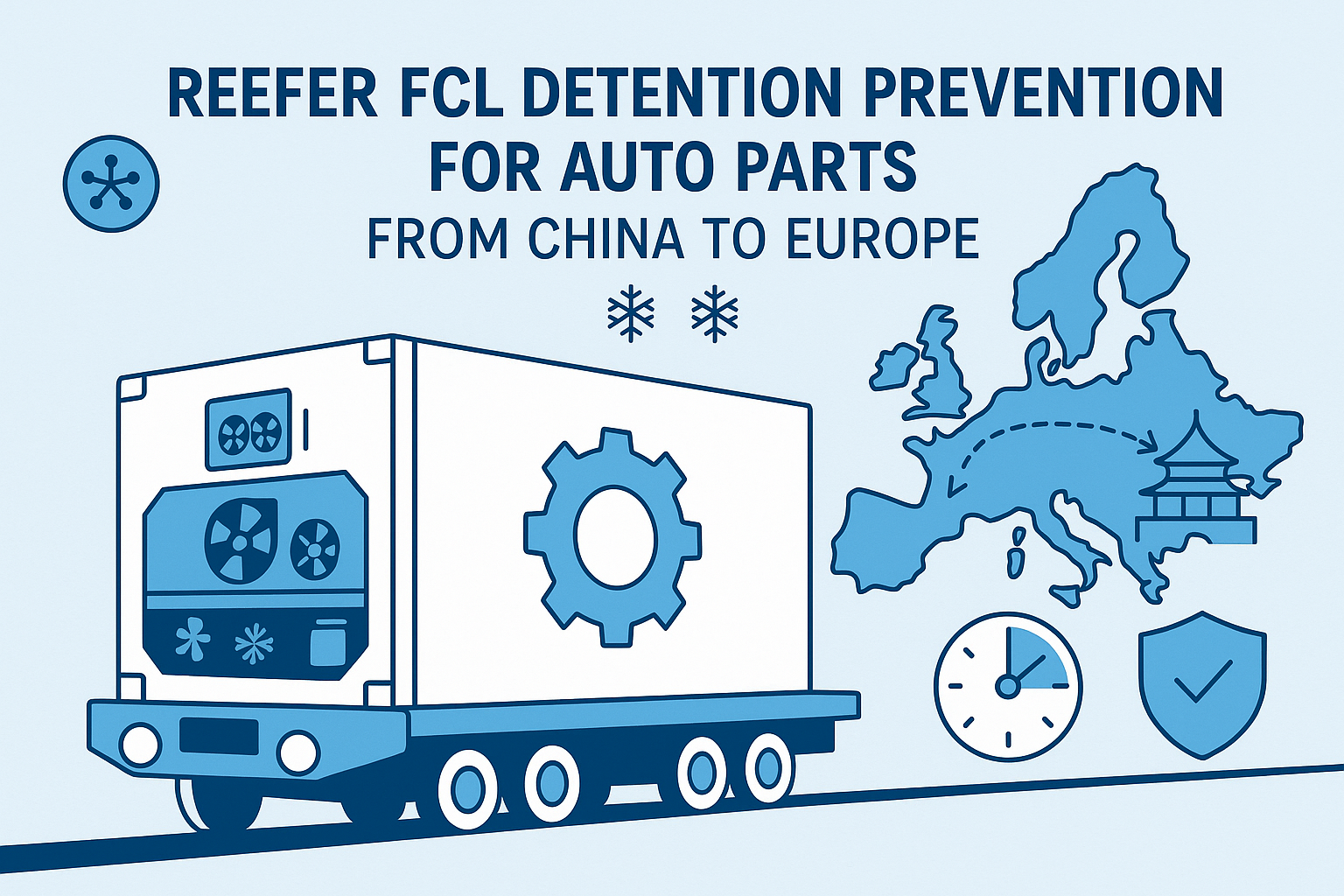
Although Reefer FCL detention prevention for auto parts from China to Europe sounds like a matter of timing, the real challenge lies in coordinating temperature-controlled equipment, inland trucking, free-time planning and Europe-side unloading readiness. Moreover, auto parts often require stable temperatures and tight delivery schedules, which makes detention especially costly if operations fall out of sync. Therefore, this guide offers a practical, step-by-step prevention framework—supported by insights from Top China Freight and resources on our homepage—to help shippers secure predictable reefer container movement across the China–Europe supply chain.
What Makes Reefer FCL Detention Prevention for Auto Parts from China to Europe So Important?
Although reefer equipment is usually associated with food or pharmaceuticals, Europe-bound auto parts often require stable temperatures and precise handling, especially for electronics, rubber components and lubricant-sensitive units. Moreover, detention fees escalate quickly when timing between factories, ports, carriers and European warehouses becomes misaligned. Because reefer containers operate on pre-trip inspection (PTI), active cooling and stricter yard rules, detention becomes far more expensive than standard FCL.
Therefore, preventing detention is not only about avoiding additional fees—it is a strategy that protects supply chain stability and reduces operational downtime for European automotive buyers. Additionally, temperature deviations caused by prolonged yard time may compromise product quality, making timing even more critical.
How Do Cargo Characteristics Affect Reefer FCL Detention Risk for Auto Parts?
Auto parts vary greatly in sensitivity, and although many components tolerate ambient conditions, certain items require controlled temperatures to prevent corrosion, degradation or electronic malfunction.
High-risk auto parts include:
- ECU modules and microchips
- EV battery components
- Rubber bushings and seals
- High-precision engine parts
- Lubricant-infused mechanical components
Moreover, carriers apply stricter rules to reefer containers holding industrial cargo because temperature loss during detention increases their liability exposure. Therefore, planning predictable yard time becomes essential.
Why Does Scheduling Matter More for Reefer Containers Than Standard FCL?
Reefer equipment consumes energy, requires monitoring and operates under cooling cycles. Although these factors are manageable during transit, they become risky when the container sits idle at origin or destination ports.
Why reefer detention escalates faster:
- Power supply at the terminal may be limited
- Monitoring staff prioritize perishable cargo over industrial shipments
- Temperature fluctuations occur when containers wait in non-powered areas
- EU ports often impose higher daily storage rates for reefer units
Because of these constraints, early coordination between factories, truckers, and port terminals dramatically reduces detention risk.
To simplify scheduling, many exporters rely on Top China Freight and its synchronized sea freight planning for China–Europe trade.
What Documentation Errors Commonly Trigger Reefer FCL Detention for Auto Parts?
Although auto parts seem straightforward to classify, mixed-material goods frequently cause documentation inconsistencies. Moreover, automotive electronics require precise HS Codes, and errors often trigger customs exams at EU ports, delaying unloading and raising detention risk.
Critical documentation checklist
| Document | Why It Matters | Common Issue |
|---|---|---|
| Commercial Invoice | Identifies part categories | Missing technical specs |
| Packing List | Confirms carton & pallet data | Wrong weight segmentation |
| HS Codes | Determines EU risk level | Mislabeling electronics |
| Temperature Requirement Sheet | Ensures reefer programming | Missing temperature range |
| Bill of Lading Draft | Must match cargo type | Incorrect cargo description |
Therefore, preparing clear documents 48 hours before CY cut-off helps prevent customs-triggered detention upon arrival.
How Should You Manage Reefer Container Free Time to Avoid Detention in Europe?
Carriers provide far fewer free days for reefer cargo—often 2–3 days compared to 5–7 for DRY FCL. Moreover, Europe’s automotive warehouses frequently operate on pre-booked unloading windows, which means minor schedule shifts immediately impact detention exposure.
Best practices for free-time protection
- Request extended free time during rate negotiation
- Align unloading with warehouse shift patterns
- Pre-clear auto parts in advance to shorten EU hold time
- Track ETA changes daily during the final transit week
Because reefer units incur higher operational cost, detention fees can double in peak season. Therefore, negotiating free time before booking is far more effective than disputing charges later.
Case Studies
Shanghai → Rotterdam — High-Value ECU Components
- Cargo: Engine control units and onboard computer chips
- Reefer Setting: 20°C constant temperature
- Issue: PTI delay caused by depot congestion
- Solution: Temperature pre-programming + early trucking booking
- Result: Zero detention, smooth unloading in Rotterdam
- Savings: approx. €280–€350
Although ECU components can withstand mild fluctuations, early coordination ensured stable temperature and timely gate-in.
Shenzhen → Valencia — Rubber Bushings & Suspension Parts
- Cargo: Rubber-intensive automotive components
- Reefer Setting: 14°C humidity-control mode
- Issue: Warehouse unloading window misalignment
- Solution: Dynamic ETA monitoring + rescheduled trucking
- Result: Avoided 2-day reefer detention during port congestion
- Savings: approx. €300–€420
Moreover, improved timeline visibility helped the consignee allocate labor efficiently.

What Operational Steps Reduce Reefer Detention at China Ports?
Reefer FCL timing relies on precise upstream coordination. Although factories control loading, carriers and depots determine reefer availability and PTI scheduling.
Origin-side prevention checklist
- Confirm reefer container availability 3–5 days before loading
- Request PTI results immediately after allocation
- Program temperature settings before dispatching the truck
- Prepare final packing list at least 24 hours before loading
- Ensure factory’s forklift capacity matches pallet weight
Additionally, exporters using EXW terms often synchronize pickup through Top China Freight’s door-to-door solution to maintain timing discipline.
What Does a Reefer FCL Detention Prevention Cost Structure Look Like?
Although detention charges vary by carrier and season, the following ranges help with early planning.
Detention Cost Overview
| Cost Category | Typical Range | Notes |
|---|---|---|
| Reefer Detention Fee | €90–€180/day | Higher than DRY containers |
| Terminal Power Charge | €30–€60/day | Energy allocation fee |
| Reefer Monitoring Fee | €15–€40 | Depends on daily cycles |
| Truck Standby Fee | €50–€120/hour | EU congestion increases risk |
| Customs Exam Fee | €20–€60 | Triggered by HS Code checks |
Therefore, reducing dwell time delivers immediate operational savings across multiple categories.
Conclusion
In summary, Reefer FCL detention prevention for auto parts from China to Europe depends on synchronized scheduling, precise documentation, real-time monitoring and proactive coordination between suppliers, carriers and European warehouses. Moreover, importers who establish structured reefer handling processes significantly reduce detention fees while protecting the integrity of temperature-sensitive auto parts. Companies seeking predictable performance should request a coordinated solution that integrates timeline planning, compliance support and reefer equipment management.
Request A Free Quote
Need a reliable logistics partner? Share your shipment details and we’ll provide a tailored quotation quickly and accurately.
FAQ:
What causes most reefer detention for auto parts?
Delays from customs checks, warehouse scheduling or trucking misalignment often increase reefer detention.
How early should I request reefer equipment?
Requesting availability 3–5 days before loading ensures PTI and power checks are completed on time.
Can auto electronics ship in reefer containers?
Yes. Many electronics benefit from stable temperatures and low humidity during long ocean transit.
How does Europe port congestion impact reefer units?
Congestion limits powered slots, increasing the risk of detention during peak periods.
What helps avoid warehouse unloading delays?
Sharing ETA updates and pre-booking unloading windows reduces downtime.