
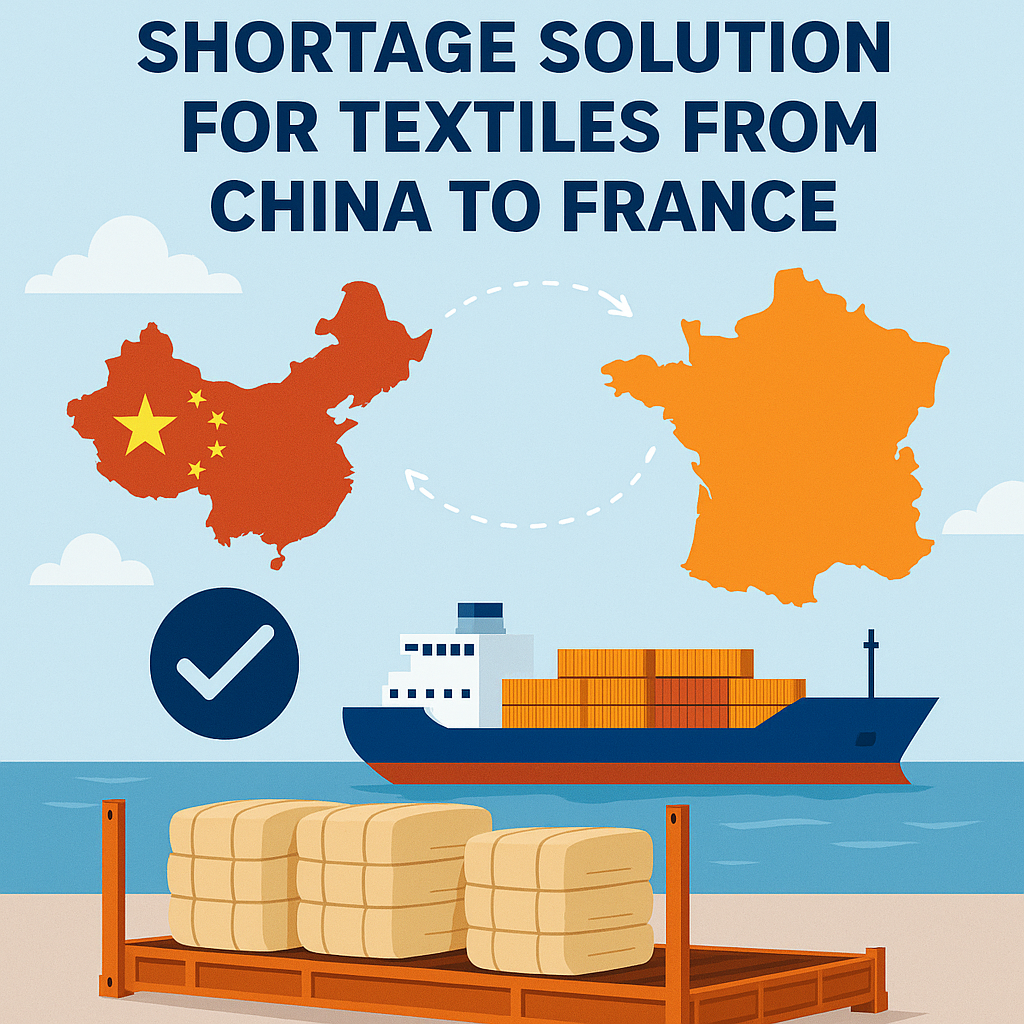
In today’s volatile shipping market, textile exporters face ongoing container shortages that disrupt delivery schedules and increase costs. Finding the right Flat Rack FCL container shortage solution for textiles from China to France ensures timely, cost-efficient, and secure transport for bulky or irregular cargo.

What Is a Flat Rack FCL Container and Why Is It Used for Textiles?
A Flat Rack FCL container features open sides and removable walls, ideal for oversized or non-standard textile cargo such as rolls, bales, or wrapped fabrics. It allows easy loading of irregular dimensions and helps maximize cargo space when traditional containers are unavailable.
| Container Type | Structure | Volume (CBM) | Best For |
|---|---|---|---|
| 20’ Flat Rack | Open sides & ends | ~32 | Heavy textile machinery |
| 40’ Flat Rack | Larger deck & flexible height | ~60 | Rolled fabrics, wide loads |
| 40HQ Standard | Closed type | 76.4 | Packaged textile goods |
When 40HQ containers become scarce, Flat Racks provide an efficient alternative, especially for factories exporting textile machinery or bulk fabric rolls.
Why Is There a Container Shortage for Textile Exports?
The shortage of containers, including Flat Racks, stems from multiple global logistics disruptions.
- Trade imbalance — more containers remain in Europe and North America than return to Asia.
- Port congestion — delays in Marseille and Le Havre reduce container turnover.
- Seasonal demand — textile exports peak before European fashion seasons.
- Pandemic and geopolitical shifts — unpredictable shipping capacity allocation.
- Poor equipment repositioning — empty Flat Racks not returned to China efficiently.
As a result, exporters face higher freight rates, limited availability, and longer lead times when shipping from China to France.
What Are the Main Routes for Flat Rack FCL Shipping to France?
Flat Rack FCL cargo from China typically sails to Marseille, Le Havre, or Dunkirk, the primary entry points for textile imports to France.
| Origin Port | Destination | Transit Time (Days) | Common Carriers |
|---|---|---|---|
| Shanghai | Marseille | 30–34 | COSCO, CMA CGM, ONE |
| Ningbo | Le Havre | 32–36 | Evergreen, Hapag-Lloyd |
| Shenzhen | Dunkirk | 28–33 | MSC, Maersk |
Inland destinations like Lyon or Paris are served via trucking or rail from these French ports, offering flexibility for door-to-door textile delivery.
What Are the Costs and Options During Container Shortage?
Freight costs for Flat Rack FCL shipments from China to France can fluctuate widely depending on container availability and route.
| Option | Estimated Cost (USD) | Pros | Cons |
|---|---|---|---|
| Flat Rack FCL | $4,800–$6,200 | Ideal for oversized textile cargo | Limited container supply |
| Standard 40HQ | $3,800–$5,000 | Cheaper if available | Not suitable for large loads |
| LCL (Consolidation) | $100–$150/CBM | Flexible for small exports | Higher handling risk |
| Air Freight | $6–$9/kg | Fast delivery | Expensive for textiles |
Therefore, exporters often adopt mixed solutions—combining FCL and LCL shipments—to optimize space and maintain delivery schedules.

Real Case Studies: Textile Shipments Overcoming Container Shortage
🟦 Case 1: Fabric Rolls from Ningbo to Marseille
- Container Type: 40’ Flat Rack FCL
- Cargo: 61 CBM, 22 tons of cotton rolls
- Cost: USD 5,200
- Transit Time: 32 days
- Result: Booked via TopChinaFreight’s container pool; avoided two-week delay.
🟩 Case 2: Textile Machinery from Shanghai to Le Havre
- Container Type: 40’ Flat Rack
- Cargo: 25 tons of weaving equipment
- Cost: USD 6,000
- Transit Time: 34 days
- Result: Used alternate port (Le Havre) and early booking to secure space.
How to Handle Customs Clearance for Textiles in France
Textile imports are subject to EU regulations, so accurate documentation is critical.
| Document | Purpose | Notes |
|---|---|---|
| Commercial Invoice | Declares cargo value | Must match HS code (e.g., 5208 for fabrics) |
| Packing List | Lists package details | Ensure weight and CBM consistency |
| Bill of Lading | Proof of shipment | Required for cargo release |
| Certificate of Origin | Identifies country of production | Can reduce import duty |
| Textile Compliance Certificate | Ensures fabric safety standards | Required by EU customs |
| Importer Security Filing (ISF) | Pre-notification | Avoids penalties or clearance delays |
Submitting correct paperwork speeds up customs inspection and prevents demurrage at French ports.
What Are Effective Strategies to Solve Flat Rack Shortage?
To tackle the Flat Rack FCL container shortage, exporters should use proactive supply chain management.
- Book Early: Reserve space at least 3–4 weeks before production completion.
- Flexible Routing: Use alternative ports such as Xiamen or Qingdao for better availability.
- Leverage Container Pools: Work with forwarders offering shared equipment solutions.
- Consider Alternative Equipment: Use Open Top or Standard 40HQ if cargo fits.
- Consolidate Shipments: Group multiple textile orders into one full container.
- Negotiate Long-Term Contracts: Fix rates and guarantee container allocation.
These approaches help maintain consistent delivery schedules and avoid last-minute cancellations.
Why Choose TopChinaFreight for Textile Logistics to France?
TopChinaFreight offers specialized Flat Rack FCL shipping solutions for textile exporters. Their extensive carrier network ensures container access even during global shortages.
| Service | Description |
|---|---|
| Container Allocation | Priority Flat Rack and alternative equipment availability |
| Route Optimization | Flexible port and carrier combinations |
| Door-to-Door Delivery | Factory pickup and inland trucking to French destinations |
| Customs Assistance | Full documentation and clearance support |
| Cost Management | Competitive rates through bulk contracts |
| Cargo Protection | Comprehensive insurance and handling supervision |
By leveraging their expertise, textile suppliers can overcome space constraints and streamline export operations.
Conclusion
In summary, addressing the Flat Rack FCL container shortage solution for textiles from China to France requires proactive booking, flexible routing, and the right logistics partner. With average transit times of 30–35 days and costs ranging from USD 4,800–6,200, exporters can still achieve reliability and efficiency. Partnering with TopChinaFreight ensures consistent equipment access, timely customs clearance, and optimized freight costs for every shipment.
Request A Free Quote
Get started with TopChinaFreight today! 🚢✨ Simply Request a Free Quote 📝 to receive a customized shipping solution tailored to your needs. Our experts will provide the best rates 💰, fastest routes 🚀, and professional guidance 🌍 for your international logistics.
FAQs
Q1.How long does Flat Rack FCL shipping from China to France take?
Transit time is usually 30–35 days, depending on port congestion and carrier schedules between China and France.
Q2.What causes Flat Rack container shortages in textile shipping?
Shortages result from trade imbalances, seasonal peaks, and delayed equipment repositioning after European imports.
Q3.Which ports in France are best for Flat Rack textile shipments?
Marseille, Le Havre, and Dunkirk are major French ports offering reliable access for textile imports.
Q4.How can I secure a Flat Rack FCL container during shortage?
Book early, consider alternate ports, and work with forwarders offering container pooling or flexible routing.
Q5.Are Flat Racks suitable for shipping textile machinery?
Yes, Flat Racks are perfect for oversized or heavy machinery that cannot fit inside standard containers.