
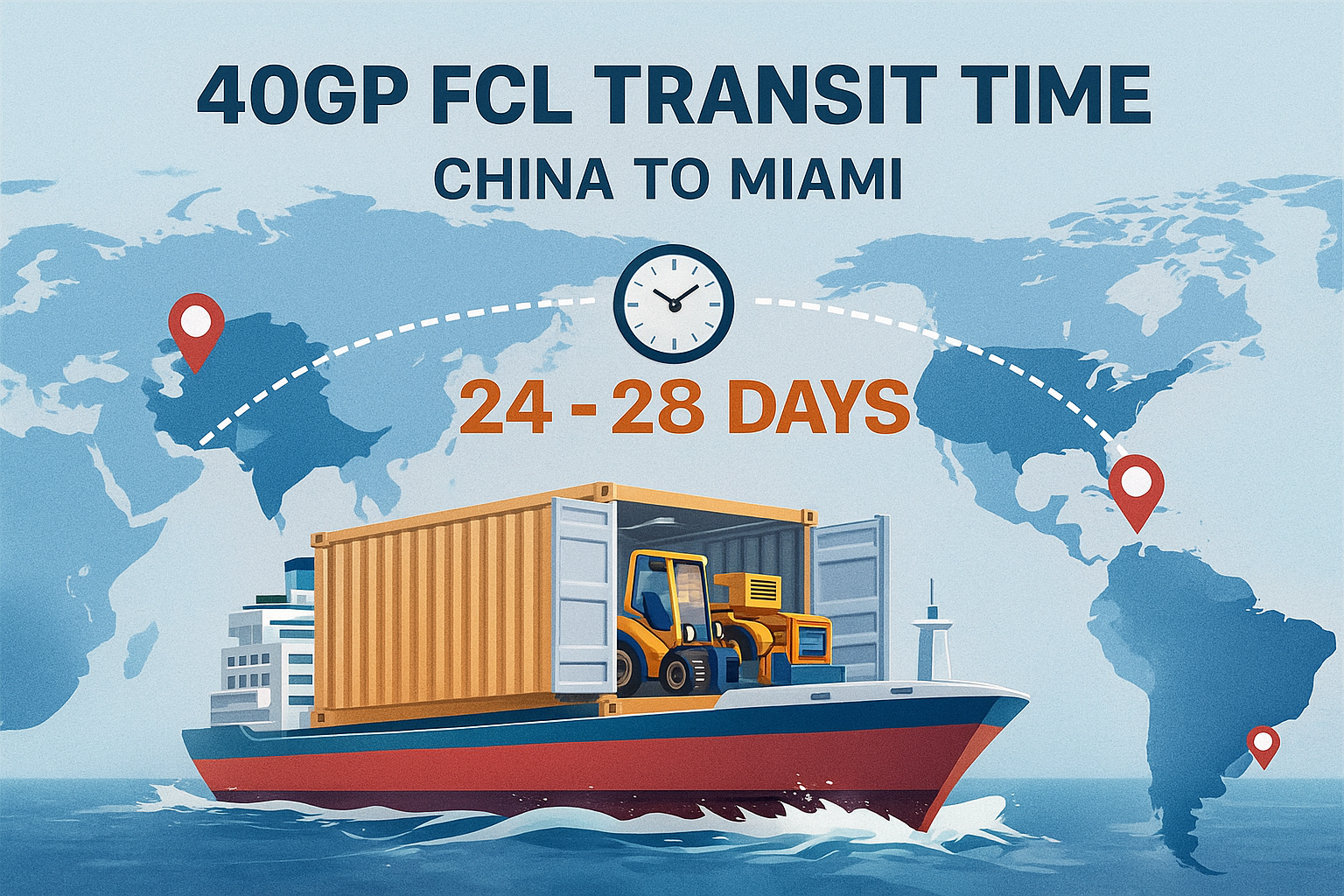
Understanding the 40GP FCL transit time for machinery from China to Miami is crucial for exporters managing production deadlines and delivery schedules. Since machinery shipments are often heavy, time-sensitive, and high-value, accurate transit planning ensures smooth supply chain operations, reduces demurrage, and maintains client satisfaction.

What Determines 40GP FCL Transit Time from China to Miami?
Several factors influence shipping time between China and the U.S. East Coast. These include the port of origin, route selection, customs processes, and carrier schedules.
| Factor | Description | Impact on Transit Time |
|---|---|---|
| Port of Loading | Shanghai, Ningbo, or Shenzhen | Varies by sailing frequency |
| Transshipment Port | Usually via Panama Canal | Adds 3–5 days depending on congestion |
| Customs Clearance | Export and import inspections | Delays if documents are incomplete |
| Seasonal Demand | Peak manufacturing season | May extend lead time by 7–10 days |
In general, transit time ranges from 33 to 38 days, depending on shipping line and route configuration.
How Long Does It Take to Ship Machinery from China to Miami?
Below is a breakdown of average sailing durations from key Chinese ports.
| Port of Origin | Estimated Transit Time (Days) | Typical Route |
|---|---|---|
| Shanghai | 34–36 | Shanghai → Panama Canal → Miami |
| Ningbo | 33–37 | Ningbo → Colon → Miami |
| Shenzhen | 32–35 | Shenzhen → Pacific Ocean → Miami |
| Qingdao | 36–40 | Qingdao → Singapore → Panama → Miami |
Most routes involve transshipment through Central America. Therefore, selecting a direct or express service helps minimize delays.
Why Choose 40GP FCL for Machinery Shipments?
The 40GP (General Purpose) container is ideal for transporting machinery due to its versatile capacity and cost efficiency.
Advantages include:
- Optimal for large and heavy machinery loads.
- Provides better space utilization for irregular equipment.
- Supports secure lashing and bracing to prevent cargo damage.
- Offers cost-per-unit savings over multiple LCL shipments.
Thus, using 40GP FCL ensures balance between freight cost, safety, and time efficiency.
What Are the Main Shipping Routes to Miami?
Machinery exports from China to Miami follow multiple maritime routes through key international transshipment points.
| Route | Transit Time | Main Stops |
|---|---|---|
| East Asia – Panama Canal – Miami | 34–36 days | Shanghai / Ningbo / Shenzhen → Colon → Miami |
| South China – Pacific – Panama – Miami | 33–35 days | Shenzhen → Long Beach → Miami |
| North China – Singapore – Panama – Miami | 36–39 days | Qingdao → Singapore → Panama → Miami |
Choosing a Panama Canal route provides consistent transit reliability and direct access to Florida’s logistics hub.
Case Studies: 40GP FCL Machinery Shipping from China to Miami
Case 1: Industrial Pumps
Origin: Ningbo, China
Destination: Miami, USA
Cargo: 18 tons of industrial pumps
Shipping Method: 40GP FCL, sea freight
Transit Time: 35 days
Cost: USD 5,480
Result: Early booking reduced delay risk and secured lower peak-season rates.
Case 2: Construction Machinery
Origin: Shanghai, China
Destination: Miami, USA
Cargo: 24 tons of construction machinery parts
Transit Time: 36 days
Cost: USD 5,700
Result: Real-time tracking and flexible routing avoided Panama Canal congestion.
Need a reliable logistics partner? Share your shipment details and we’ll provide a tailored quotation quickly and accurately.
What Documents Are Required for Machinery Export to the U.S.?
Accurate documentation is critical for avoiding clearance delays and penalties.
| Document | Purpose | Issued By |
|---|---|---|
| Commercial Invoice | Declares value and description | Exporter |
| Packing List | Confirms dimensions and packaging details | Supplier |
| Bill of Lading | Proof of carriage | Carrier |
| Certificate of Origin | Confirms manufacturing source | Chamber of Commerce |
| Importer Security Filing (ISF) | U.S. customs requirement | Importer or agent |
| Cargo Insurance Policy | Protects against loss or damage | Insurer |
In addition, ensure compliance with U.S. machinery import standards (ANSI/OSHA/UL).
How to Shorten 40GP FCL Transit Time to Miami
Reducing shipping duration depends on smart coordination and proactive planning.
| Strategy | Implementation | Benefit |
|---|---|---|
| Book Early | Secure container at least 3 weeks before ETD | Avoids congestion delays |
| Choose Direct Routes | Use ports with express sailings | Reduces transit by 3–5 days |
| Combine Sea + Rail | Use intermodal logistics via Los Angeles | Improves flexibility |
| Partner with TopChinaFreight | Get access to multiple carrier schedules | Ensures optimized lead time |
Furthermore, using real-time tracking tools and digital booking systems ensures greater shipment transparency.
What Are the Cost Components of 40GP Machinery Shipping?
| Cost Element | Description | Approximate Range (USD) |
|---|---|---|
| Ocean Freight | Port-to-port base charge | 5,200–5,700 |
| Bunker Adjustment Factor | Fuel surcharge | 200–300 |
| Documentation Fee | Bill of lading & processing | 60–120 |
| Port Handling | Terminal loading/unloading | 150–250 |
| Customs & ISF Filing | U.S. import compliance | 50–100 |
Average total cost: USD 5,600–6,200 per container (subject to season and carrier rate changes).
Conclusion
Efficient planning for the 40GP FCL transit time for machinery from China to Miami allows exporters to maintain production schedules and reduce overall logistics costs. By understanding route options, documentation requirements, and real-world case studies, shippers can optimize both timing and reliability.
Collaborating with TopChinaFreight ensures faster transit, flexible booking, and expert handling of heavy machinery logistics—delivering your cargo on time, safely, and cost-effectively.
Request a Quote
Need a tailored solution for your shipping from China?Let TJ China Freight Forwarder assist you with reliable, cost-effective service.
FAQ:
Q1.How long does 40GP FCL transit take from China to Miami?
The 40GP FCL transit time from China to Miami usually ranges between 33 and 38 days, depending on port location and route choice.
Q2.What factors affect 40GP FCL shipping time for machinery?
Weather conditions, port congestion, customs delays, and vessel scheduling can directly impact the total 40GP FCL transit duration for machinery shipments.
Q3.How can I reduce machinery shipping time to Miami?
Book your FCL space early, select faster carriers, and coordinate real-time route adjustments with your freight forwarder for reduced delays.
Q4.What is the estimated 40GP FCL shipping cost to Miami?
Average rates range from USD 5,200 to 6,000, depending on the port of departure, carrier selection, and container availability.
Q5.Is insurance necessary for 40GP FCL machinery shipments?
Yes, machinery insurance is essential to protect against potential loss, damage, or unforeseen delays during long-distance sea freight.