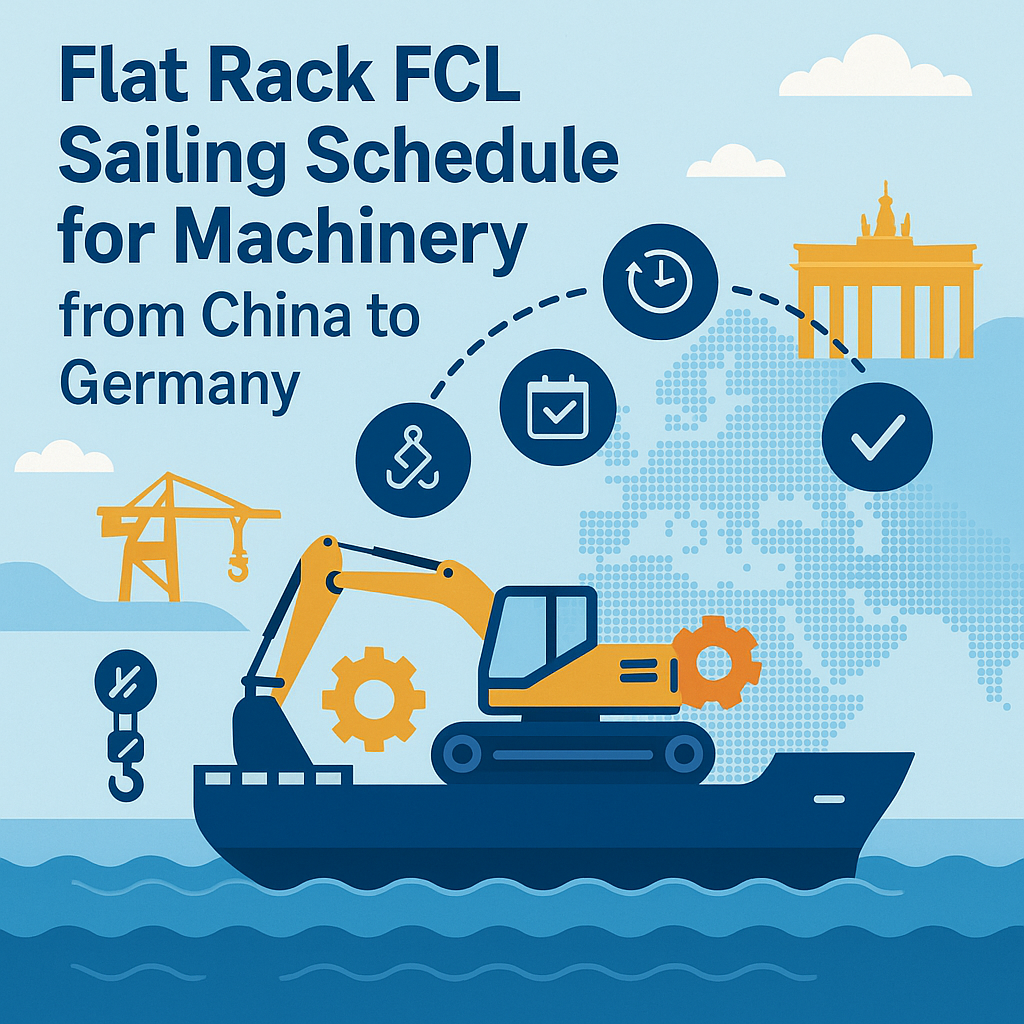
Although the Flat Rack FCL sailing schedule for machinery from China to Germany is crucial for oversized cargo planning, many shippers still face uncertainty due to routing variations, port congestion, and vessel capacity. Therefore, this guide explains how sailing schedules work, what impacts OOG machinery timelines, and how to plan reliable China–Germany exports with support from the experienced team at Top China Freight.
What defines the Flat Rack FCL sailing schedule for machinery from China to Germany?
The sailing schedule for machinery cargo depends on vessel frequency, flat rack equipment availability, and the loading sequence for out-of-gauge cargo. Moreover, oversized machinery—such as CNC systems, mining equipment, injection molding units, and heavy presses—requires special loading windows that differ from standard FCL shipments. Because schedules shift weekly, accurate updates become essential for supply chain planning.
How do vessel departures vary across major China ports?
Machinery exporters mainly use Shanghai, Tianjin, Qingdao, and Ningbo for flat rack bookings. Additionally, each port has its own weekly vessel pattern, affecting transit time and pre-loading requirements.
Weekly China → Germany Flat Rack Sailing Frequency
Origin Port
Weekly Sailings
Notes
Shanghai
2–3
Best for oversized machinery loads
Ningbo
2
Strong OOG equipment availability
Qingdao
1–2
Suitable for northern factories
Tianjin
1
Longer inland trucking but stable
These patterns directly influence China to Hamburg machinery transport time and China to Bremerhaven flat rack vessel schedule.
Why does flat rack cargo require special loading coordination?
Unlike standard containers, flat rack units require crane slot booking, oversized loading supervision, and correct lashing arrangements. Moreover, weather conditions, wind speed, and yard availability significantly affect loading time. Because heavy machinery can exceed width or height limits, cargo may require custom bracing before CY cutoff.
How long is the typical transit time from China to Germany?
Transit varies by port pair, carrier, and intermediate stops. However, most China–Germany flat rack shipments follow similar time ranges.
Estimated China → Germany Transit Times
Route
Transit Time
Route Style
Shanghai → Hamburg
32–38 days
Direct/semi-direct
Ningbo → Hamburg
34–40 days
Transshipment via Singapore
Qingdao → Bremerhaven
36–42 days
Northern route
Tianjin → Hamburg
38–45 days
Indirect
These times support supply chain planning for machinery exporters who must coordinate factory packing, trucking, vessel loading, and EU inland delivery.
Customs requirements for machinery imports into Germany
Moreover, transshipment impact on machinery sailing schedule becomes a critical factor since flat rack cargo may wait for connecting vessels.
Case Studies
Shanghai → Hamburg (Industrial Press Machine)
Cargo: 1 oversized press (OOG width) Volume: Flat rack OOG load Transit: 36 days Cost: USD 4,850 Result: Because the shipper booked early and used a direct sailing, the cargo loaded without delays. Additionally, lashing and structural reinforcement were completed within the port’s crane schedule, ensuring smooth departure.
Ningbo → Bremerhaven (CNC Machinery Set)
Cargo: CNC machining centers + accessories Volume: Two flat rack units Transit: 41 days Cost: USD 5,230 Result: Although the routing included a transshipment, the importer saved 9% on freight. Consequently, equipment arrived on time for factory commissioning in Germany.
How can Top China Freight optimize flat rack machinery schedules?
Top China Freight provides schedule forecasting, route recommendations, and OOG handling support. Furthermore, our sea freight solutions include equipment reservation, lashing supervision, and real-time schedule monitoring. Because flat rack machinery shipping requires precision planning, professional support ensures stable, on-time results.
What are the best routes for heavy machinery shipped by flat rack?
Carriers commonly offer:
Direct Routes
Direct services shorten transit time and reduce OOG cargo handling risks. Advantages:
Minimal transshipment
Lower chance of damage
More predictable ETD/ETA
Indirect Routes
Indirect routes sometimes offer lower cost and better flat rack availability. Advantages:
Flexible equipment allocation
Lower freight rates
Suitable during peak season
Thus, best routes for heavy machinery FCL shipments depend on project deadlines, cargo dimensions, and budget.
Conclusion
The Flat Rack FCL sailing schedule for machinery from China to Germany depends on weekly vessel frequency, equipment availability, port congestion, and customs preparation. Moreover, choosing the right route and coordinating OOG loading ensures stable and predictable shipping performance. Therefore, importers should partner with experienced logistics teams to secure both schedule reliability and safe machinery handling.
Request A Free Quote
Need a reliable logistics partner? Share your shipment details and we’ll provide a tailored quotation quickly and accurately.