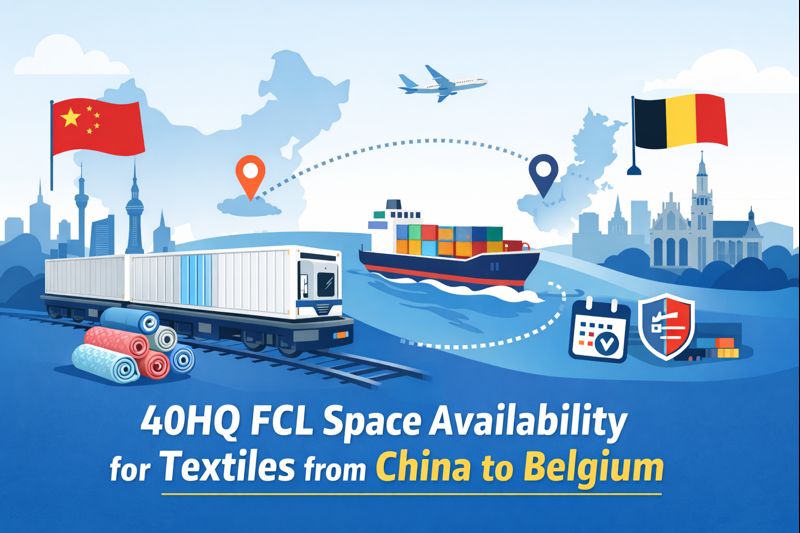
40HQ FCL space availability for textiles from China to Belgium has become a critical issue as European demand rebounds and container supply remains uneven. Therefore, exporters must secure space early while balancing shipping time, freight rates, and delivery reliability to avoid costly delays. In this guide, we break down practical strategies and real-world insights, starting with proven planning methods supported by experienced partners such as Top China Freight.
Why is 40HQ FCL space availability critical for textile shipments?
Textile cargo is highly volume-driven, which makes 40HQ containers the preferred choice for exporters shipping garments, fabrics, and home textiles. As a result, limited 40HQ FCL space availability for textiles from China to Belgium often creates bottlenecks during peak export cycles.
Moreover, Belgium—especially Antwerp—serves as a major distribution hub for Western Europe. Consequently, delays in container allocation can disrupt downstream supply chains across France, Germany, and the Netherlands.
How does seasonality affect 40HQ FCL space availability?
Seasonality plays a decisive role in determining container space availability. Typically, Q2 and Q3 experience intense pressure due to fashion launches and retail replenishment cycles.
During peak periods:
Carriers prioritize high-yield routes
40HQ containers are reallocated to Asia–US trades
Booking windows shorten dramatically
Therefore, exporters who wait for spot availability often face rollovers or forced schedule changes.
Can early booking really secure 40HQ FCL space?
Early booking remains one of the most effective strategies, especially for textile exporters with predictable production schedules. By locking space 2–3 weeks in advance, shippers gain access to a broader carrier pool.
Additionally, working with structured FCL and LCL shipping solutions improves allocation priority when carriers ration equipment. Consequently, exporters reduce last-minute disruptions and maintain delivery commitments.
Reference transit time and space pressure overview
The table below illustrates typical transit times alongside relative space pressure levels for key routes. These figures are indicative and vary by carrier and season.
Origin Port
Destination
Transit Time
Space Pressure
Shanghai
Antwerp
30–34 days
High
Ningbo
Antwerp
32–36 days
Medium–High
Shenzhen
Zeebrugge
34–38 days
Medium
Because Antwerp attracts significant cargo volume, alternative Belgian gateways may offer better space availability during congestion periods.
FCL vs LCL during space shortages: what works better?
When 40HQ FCL space availability for textiles from China to Belgium tightens, some exporters consider LCL as a fallback. However, this option has trade-offs.
Factor
40HQ FCL
LCL
Space Control
High
Limited
Transit Stability
Strong
Variable
Cost per Unit
Lower for volume
Higher
Risk of Delay
Lower
Higher
While LCL offers flexibility for smaller volumes, FCL remains the preferred solution for bulk textile exports whenever space is secured.
What role does customs readiness play in space allocation?
Customs readiness indirectly affects space availability because incomplete documentation can lead carriers to deprioritize bookings. Therefore, shippers with prepared export paperwork often receive smoother confirmations.
Using reliable customs brokerage support helps prevent last-minute issues that could jeopardize confirmed space.
How can exporters improve 40HQ FCL space availability outcomes?
Although space constraints are common, exporters are not powerless. In fact, several operational adjustments can significantly improve 40HQ FCL space availability for textiles from China to Belgium.
Effective actions include:
Sharing rolling forecasts with forwarders 4–6 weeks ahead
Remaining flexible on sailing dates within a defined window
Diversifying carrier options instead of relying on a single line
As a result, exporters often secure space more consistently, even during volatile periods.
Conclusion
40HQ FCL space availability for textiles from China to Belgium is shaped by seasonality, routing choices, and operational readiness. By booking early, staying flexible, and aligning documentation with carrier expectations, exporters can significantly reduce disruption risks. Ultimately, consistent access to container space supports stable supply chains and predictable delivery performance.
Request A Free Quote
Start shipping smarter with TopChinaForwarder today! 🚢✨ Request a Free Quote 📝 and get a tailored logistics plan built around your cargo and timeline.