
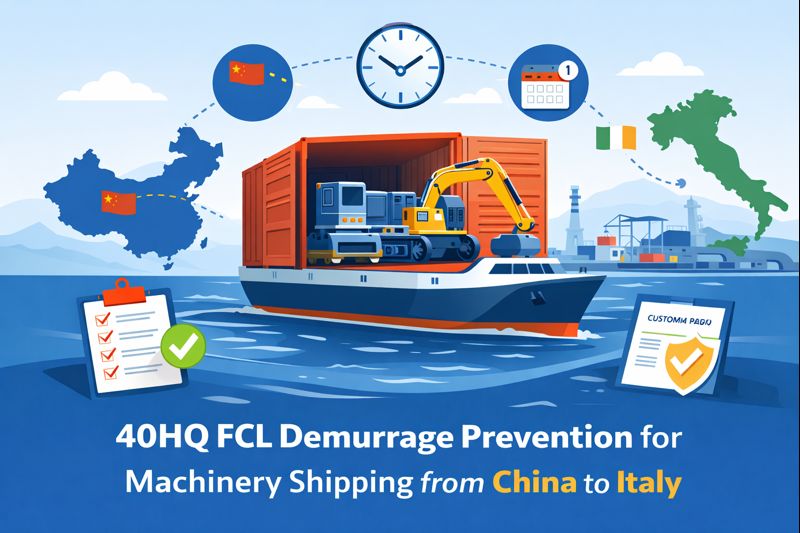
As heavy machinery exports to Europe continue to grow, 40HQ FCL demurrage prevention for machinery from China to Italy has become a key cost-control challenge for importers managing tight delivery schedules. However, demurrage charges often result from preventable coordination gaps rather than unavoidable delays.
Therefore, this guide outlines practical, field-tested strategies used by experienced partners such as Top China Freight to help machinery importers protect free time and avoid unnecessary port penalties.

Why Is Demurrage Risk Higher for 40HQ Machinery Shipments?
Although 40HQ containers provide essential space for industrial equipment, machinery cargo introduces unique operational risks that increase demurrage exposure.
Key Demurrage Drivers for Machinery Cargo
First, machinery often requires specialized unloading equipment, which limits truck appointment flexibility. Second, customs inspections occur more frequently due to technical classifications. Finally, oversized or heavy cargo reduces terminal handling speed.
As a result, 40HQ FCL demurrage prevention for machinery from China to Italy requires tighter coordination than standard consumer-goods shipments.
How Free Time Misunderstanding Leads to Demurrage Costs
Free time appears simple on paper, yet it frequently causes disputes and unexpected charges.
Common Free Time Miscalculations
- Free time may begin upon vessel discharge, not customs release
- Weekends and port holidays may count as chargeable days
- Early vessel arrival can reduce effective planning windows
Consequently, machinery importers must align free time assumptions with actual terminal rules to protect margins.

Machinery shipments face higher documentation scrutiny than general cargo. Therefore, paperwork accuracy plays a decisive role in demurrage prevention.
High-Risk Documentation Errors
- Inconsistent HS codes for machinery components
- Missing technical descriptions or serial numbers
- Incorrect consignee or importer of record details
Because customs holds often arise without warning, proactive document checks are essential. Many importers integrate demurrage prevention planning with professional customs brokerage services to minimize clearance delays.
How Italian Port Congestion Affects Demurrage Exposure
Italian ports experience periodic congestion driven by labor schedules, vessel bunching, and inland bottlenecks. When congestion peaks, terminal dwell time increases rapidly.
Demurrage Risk by Major Italian Ports
| Port | Typical Free Time (Days) | Congestion Sensitivity | Demurrage Risk |
|---|---|---|---|
| Genoa | 4–5 | High | High |
| La Spezia | 5–6 | Moderate | Medium |
| Trieste | 6–7 | Lower | Medium |
Therefore, port selection and discharge timing directly influence 40HQ FCL demurrage prevention for machinery from China to Italy.
Case Studies
CNC Machinery Shipment to Genoa
Route: Shanghai → Genoa
Cargo: CNC machining equipment, 40HQ FCL
Declared Value: EUR 180,000
Challenge:
High inspection probability and limited trucking capacity.
Solution:
The importer pre-validated documents, booked heavy-duty trucking in advance, and aligned warehouse receiving schedules before vessel arrival.
Outcome:
- Demurrage cost: EUR 0
- Terminal dwell time: 4 days
- Delivery completed on schedule
Industrial Press Shipment to La Spezia
Route: Ningbo → La Spezia
Cargo: Industrial hydraulic press, 40HQ FCL
Declared Value: EUR 240,000
Challenge:
Congestion and limited unloading equipment at destination terminal.
Solution:
The importer scheduled heavy-lift trucking in advance, aligned warehouse cranes, and monitored berth changes through real-time tracking.
Outcome:
- Demurrage avoided: EUR 1,600
- Dwell time reduced to 5 days
- On-time production installation achieved
How End-to-End Coordination Controls Hidden Demurrage Costs
Demurrage rarely appears alone. Instead, it often triggers detention, storage, and rescheduling expenses. Therefore, coordinated execution minimizes total landed cost rather than addressing isolated fees.
Coordinated vs Fragmented Execution
| Cost Area | Fragmented Planning | End-to-End Coordination |
|---|---|---|
| Demurrage | Frequent | Rare |
| Detention | High risk | Controlled |
| Schedule disruptions | Common | Minimal |
Importers who align ocean freight, customs, inland transport, and delivery consistently achieve stronger cost predictability.
How Inland Trucking Delays Trigger Machinery Demurrage
Even after customs release, inland transport can become the final failure point.
Common Inland Delay Scenarios
- Shortage of heavy-duty chassis or low-bed trucks
- Limited driver availability for oversized cargo
- Warehouse appointment congestion
To reduce these risks, advanced importers plan inland delivery in parallel with ocean bookings, often coordinating through integrated FCL and LCL solutions rather than treating trucking as an afterthought.
Should Machinery Importers Bundle Demurrage Prevention with Freight Planning?
Separating demurrage management from freight execution often creates gaps. Therefore, experienced importers integrate both under a single operational framework.
By aligning documentation, tracking, and inland planning with ocean execution, providers such as Top China Freight help machinery importers reduce friction and respond faster when conditions change, particularly on complex Europe-bound routes.
Conclusion
40HQ FCL demurrage prevention for machinery from China to Italy depends on preparation, coordination, and visibility rather than luck. When free time planning, customs clearance, inland transport, and warehouse readiness align, most penalties become avoidable.
Ultimately, structured demurrage control strengthens delivery reliability, protects margins, and stabilizes machinery supply chains.
Request A Free Quote
Start shipping smarter with TopChinaForwarder today! 🚢✨ Request a Free Quote 📝 and get a tailored logistics plan built around your cargo and timeline.
FAQ:
What usually causes demurrage on machinery shipments?
Delays often come from customs inspections, trucking shortages, or warehouse unavailability rather than ocean transit itself.
How much free time do Italian ports typically allow?
Most ports offer 4–7 free days, depending on terminal rules and congestion levels.
Does oversized machinery increase demurrage risk?
Yes. Heavy or oversized cargo limits handling flexibility and often requires specialized equipment.
Can tracking tools actually prevent demurrage?
They help by enabling faster decisions, but coordination across customs and trucking remains essential.
Should importers choose ports based on demurrage risk?
Yes. Port selection influences dwell time, congestion exposure, and inland efficiency.