
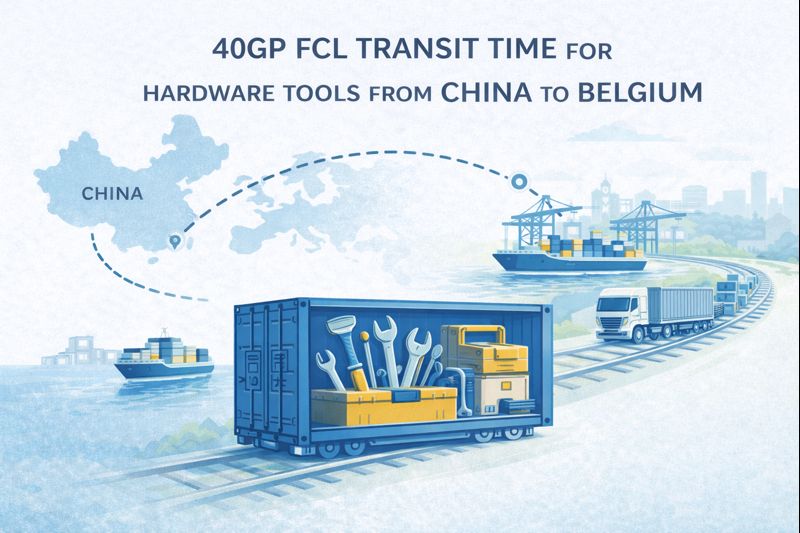
As European demand for construction and industrial supplies grows, the 40GP FCL transit time for hardware tools from China to Belgium has become a key benchmark for inventory planning and supplier coordination. However, transit time varies widely depending on routing, port congestion, and inland connections within Europe. Therefore, this guide explains realistic sailing timelines, delay factors, and optimization strategies—starting with end-to-end shipment planning supported by Top China Freight.

Why does transit time matter for hardware tool shipments?
Hardware tools such as hand tools, fasteners, power-tool components, and industrial kits often support downstream manufacturing and retail schedules. Consequently, even small transit delays can disrupt project timelines or seasonal sales windows.
Moreover, hardware tools typically ship in heavy cartons or pallets, which limits flexibility once containers are loaded. As a result, accurate transit time forecasting helps importers balance stock levels, warehouse space, and cash flow more effectively.

What affects the 40GP FCL transit time from China to Belgium?
Transit time is influenced by a combination of ocean, port, and inland variables. Therefore, importers should assess the full route rather than focusing only on sailing days.
Origin port selection in China
Major ports such as Shanghai, Ningbo, and Shenzhen offer different sailing frequencies. Ports with higher weekly sailings usually provide more stable schedules.
Carrier routing and vessel rotation
Some services sail directly to Northern Europe, while others include transshipment stops. Direct services often reduce variability, although they may not always be available.
European port congestion
Congestion at key hubs can extend dwell time before containers move inland. Consequently, transit reliability depends on both arrival timing and terminal performance.
Can transit time remain stable during peak seasons?
Peak seasons often challenge transit reliability due to vessel overbooking and port congestion. However, stability improves when shippers adopt proactive measures.
Common mitigation steps include:
- Booking space earlier than standard lead times
- Selecting carriers with consistent Northern Europe services
- Coordinating with experienced sea freight services to manage schedule changes
By planning ahead, importers often maintain predictable arrival windows even during busy periods.
What is the total door-to-port and door-to-door transit time?
The table below outlines typical transit time ranges for planning purposes. These figures represent common scenarios rather than guaranteed schedules.
| Route Example | Container Type | Ocean Transit | Total Lead Time |
|---|---|---|---|
| Shanghai → Antwerp | 40GP FCL | 30–33 days | 35–40 days |
| Ningbo → Zeebrugge | 40GP FCL | 28–32 days | 34–38 days |
Total lead time includes port handling and basic inland movement. Therefore, delays may occur if customs inspections or trucking bottlenecks arise.
Case Studies
Hardware Tool Shipment to Antwerp
Origin: Ningbo, China
Destination: Antwerp, Belgium
Cargo: Hand tools and fastening kits
Container Type: 40GP FCL
Transit Time: 36 days
By choosing a direct Northern Europe service and pre-booking inland trucking, the importer avoided transshipment delays and achieved a stable delivery schedule despite moderate port congestion.
Industrial Tool Shipment to Brussels Region
Origin: Shanghai, China
Destination: Antwerp, Belgium
Final Delivery: Brussels area warehouse
Cargo: Industrial hardware tool sets
Container Type: 40GP FCL
Total Transit Time: 38 days
By shifting shipment timing outside the busiest peak window and coordinating inland trucking in advance, the importer reduced dwell time and achieved consistent arrivals across multiple shipments.
How do customs procedures influence transit time in Belgium?
Although customs clearance does not change ocean sailing days, it can significantly affect the final 40GP FCL transit time for hardware tools from China to Belgium. Therefore, importers who prepare documents late often experience avoidable delays after vessel arrival.
Hardware tools usually require standard EU import documentation, including commercial invoices, packing lists, and accurate HS codes. When these documents are complete and pre-filed, clearance often finishes within one to two working days. Conversely, discrepancies or missing details can trigger inspections that extend dwell time at the terminal.
Should hardware tools move port-to-port or door-to-door?
Choosing between port-to-port and door-to-door shipping directly affects transit predictability. While port-to-port options appear faster on paper, they leave inland coordination to the importer.
Door-to-door solutions, by contrast, integrate ocean freight, inland transport, and scheduling under one framework. Consequently, many hardware importers favor structured door-to-door transportation when delivery deadlines matter, as it reduces handoff delays and improves timeline control.
40GP FCL vs alternative transport options for hardware tools
While 40GP FCL remains the standard choice for hardware tools, alternative modes sometimes support urgent needs.
| Transport Mode | Cost Level | Transit Time | Best Use Case |
|---|---|---|---|
| 40GP FCL Sea Freight | Medium | 35–40 days | Regular hardware tool supply |
| LCL Consolidation | Low–Medium | 40–50 days | Small or irregular volumes |
| Air Freight | High | 5–7 days | Emergency or critical tools |
In practice, most importers rely on FCL for predictable supply while reserving air freight services for exceptional cases.
Conclusion
The 40GP FCL transit time for hardware tools from China to Belgium depends on more than ocean sailing days alone. By considering port selection, customs readiness, inland transport, and seasonal risks, importers gain a clearer and more reliable timeline. Ultimately, disciplined planning turns transit time from an uncertainty into a manageable supply chain metric.
Request A Free Quote
Start shipping smarter with TopChinaForwarder today! 🚢✨ Request a Free Quote 📝 and get a tailored logistics plan built around your cargo and timeline.
FAQ:
How long does a 40GP FCL shipment from China to Belgium usually take?
Transit time typically ranges from 35 to 40 days, depending on origin port, routing, and inland delivery.
Which Belgian port offers the fastest clearance for hardware tools?
Antwerp is commonly preferred due to frequent services and efficient inland connections.
Can customs inspections delay hardware tool shipments?
Yes, inspections can extend terminal dwell time, especially if documentation is incomplete.
Do peak seasons affect transit time reliability?
Peak seasons increase the risk of rollovers and congestion, which may extend transit time.
How can importers improve transit time predictability?
Early booking, accurate documentation, and integrated logistics planning consistently improve reliability., pulvinar dapibus leo.