
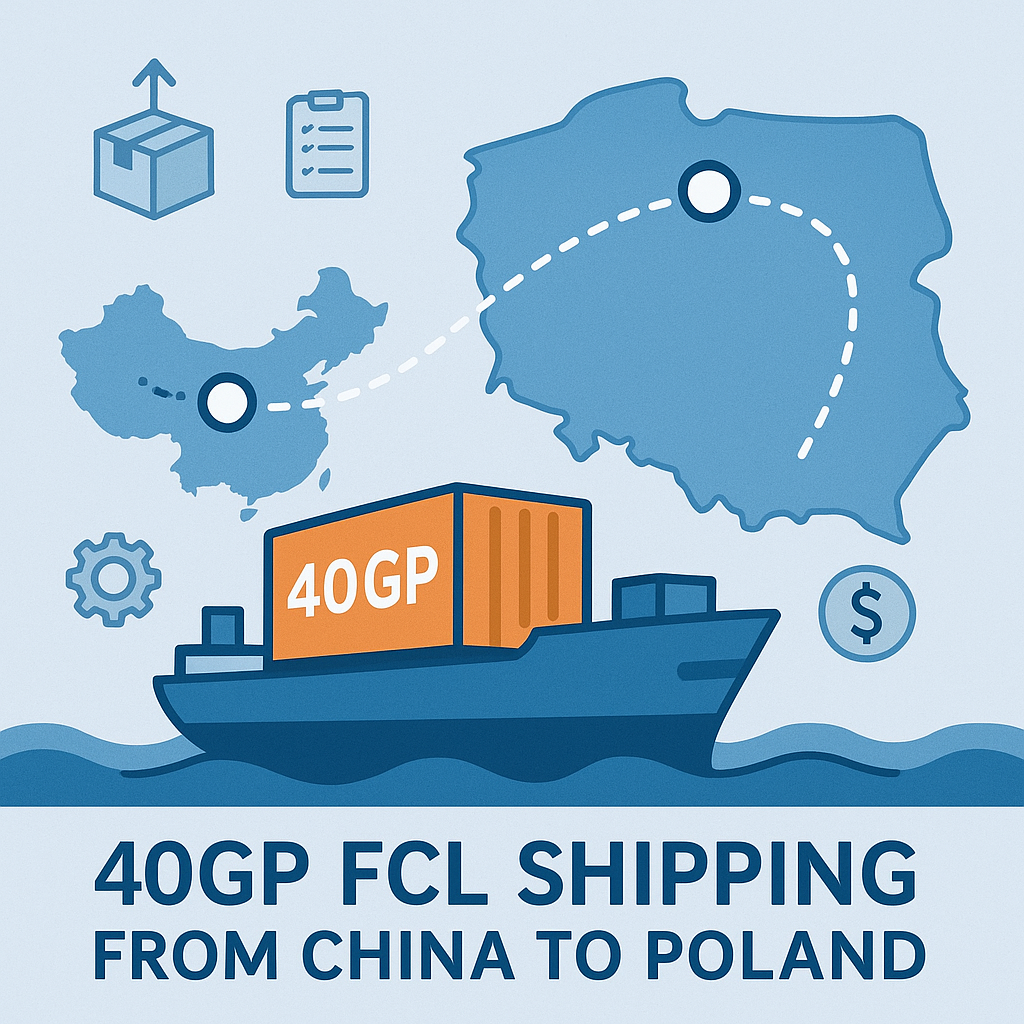
Because Europe’s fast-growing import market demands stability, many buyers now choose 40GP FCL shipping from China to Poland to secure predictable transit times and better freight control; however, rising freight rates, documentation rules, and equipment allocation require careful planning. Moreover, shippers who rely on steady routes often partner with experienced logistics providers such as Top China Freight to streamline processes and reduce risk across long-haul European lanes.

Why Do Polish Importers Prefer 40GP FCL Shipping for China–Europe Trade?
Although multiple shipping methods exist, 40GP FCL shipping remains the most reliable for bulk commercial goods. Moreover, Polish importers benefit from lower per-unit costs, reduced handling, and stronger cargo protection. Because Poland is a vital entry point for Central and Eastern Europe, stable freight scheduling supports regional distribution hubs in Warsaw, Gdańsk, Poznań, and Wrocław.
Additionally, importers gain better control over sailing schedules, supply chain planning, and customs preparation when shipments move as full-container loads.
What Cargo Types Commonly Move in 40GP FCL Containers to Poland?
Because 40GP containers offer high cubic capacity, they support a wide variety of industries. Furthermore, manufacturers shipping from China often select 40GP for balanced cost and volume efficiency.
Typical Cargo Categories
- Machinery, bearings, and industrial components
- Electronics, appliances, and consumer goods
- Furniture, lighting, and home improvement items
- Textiles, packaged goods, and mixed retail cargo
- Automotive accessories and mechanical assemblies
Because Poland serves as a strategic European distribution point, these items often move onward to Germany, Czechia, Slovakia, and the Baltics after clearance.
How Should Importers Plan Container Loading for 40GP FCL Shipments?
Although 40GP offers sufficient capacity, optimized loading ensures safety and cost control. Moreover, structured loading boosts efficiency and reduces damage risk during long-haul China–Europe voyages.
Best Practices for Container Loading
- Place heavy goods at the bottom to balance weight
- Use dunnage bags to reduce lateral movement
- Apply moisture-control materials for electronics
- Reinforce pallets with corner protection
- Label fragile cargo clearly for safe handling
Additionally, importers using 40GP container loading for Europe-bound shipments often reduce claims and maintain tighter delivery schedules.
What Routes Support 40GP FCL Shipping From China to Poland?
Shipping routes influence transit time, cost, and inland distribution. Moreover, Poland benefits from both direct European port links and inland connections to major logistics hubs.
Common Routes for China–Poland 40GP Shipments
| Route | Transit Time | Cost Level | Key Advantages |
|---|---|---|---|
| China → Gdańsk | 32–40 days | Medium | Strong EU access and customs efficiency |
| China → Hamburg → Poland | 30–38 days | Medium-Low | Fast rail links to Polish inland hubs |
| China → Rotterdam → Poland | 32–42 days | Medium | High reliability and sailing frequency |
| China → Koper → Poland | 28–36 days | Medium | Shorter inland routes for southern Poland |
Because Europe’s ports operate with high predictability, importers gain stable sailing schedules for China to Europe routes.
Real Case Studies
Case: Electronics shipment from Shenzhen to Gdańsk
- Cargo: Home appliance components
- Container: 1 × 40GP FCL
- Transit Time: 35 days
- Solution: Moisture-control packaging + reinforced pallets
- Outcome: Zero damage; faster inland trucking to Warsaw distribution center.
Case: Furniture shipment from Ningbo to Hamburg → Poland
- Cargo: Mixed home furniture SKUs
- Container: 1 × 40GP FCL
- Transit Time: 37 days
- Solution: Consolidation through warehouse hub + balanced loading
- Outcome: Smooth customs clearing; reduced inland delivery cost to Poznań.
What Costs Should Importers Expect for 40GP FCL Shipping?
Although freight rates shift with global logistics trends, core cost components remain consistent. Moreover, understanding these elements helps importers budget accurately.
Cost Breakdown for China–Poland 40GP FCL Cargo
| Cost Component | Description |
|---|---|
| Ocean Freight | Base cost depending on season and carrier |
| Origin Charges | Trucking, warehouse loading, documentation |
| Terminal Handling | Charged at China port & EU port |
| Inland Delivery | Rail/truck transport to Polish hubs |
| Insurance | Recommended for high-value goods |
Additionally, freight rate management for China–Poland FCL cargo helps reduce seasonal cost volatility.
How Does Mode Diversification Improve Supply Chain Stability?
Even though 40GP FCL shipping remains the most economical method, diversification helps importers handle urgent or seasonal fluctuations. Moreover, businesses facing unexpected demand often combine modes to maintain inventory levels.
Diversification Options
- Use air freight for urgent goods
- Shift oversize or high-value items to express routing when necessary
- Blend FCL with LCL for partial replenishment
- Explore rail freight options for time-sensitive Europe shipments
Additionally, mode diversification supports stable delivery schedules for Poland-bound businesses during volatile market periods.

When Should Importers Consolidate Cargo Before Booking FCL Shipments?
Although 40GP containers offer significant space, consolidation ensures better use of cost and volume. Moreover, warehouses in Ningbo, Shanghai, Shenzhen, and Qingdao support efficient pre-loading processes.
Consolidation Benefits
- Reduce shipping cost per cubic meter
- Combine multi-supplier cargo into one container
- Improve loading structure for mixed SKUs
- Align production timelines with vessel schedules
Furthermore, importers using warehouse consolidation for Poland-bound shipments frequently achieve higher logistics efficiency.
Conclusion
In conclusion, 40GP FCL shipping from China to Poland provides one of the most stable and efficient logistics methods for bulk commercial goods, industrial components, and consumer products. Moreover, strategic route selection, optimized loading, and proper customs documentation significantly improve on-time delivery performance. Therefore, importers aiming for predictable supply chains should adopt structured planning, strengthen risk-prevention methods, and work with experienced logistics partners for seamless China–Europe operations. To support long-term growth, businesses may request tailored freight solutions designed for both cost efficiency and schedule reliability.
Request A Free Quote
Need a reliable logistics partner? Share your shipment details and we’ll provide a tailored quotation quickly and accurately.
FAQ:
How early should I book a 40GP container for Poland shipments?
Booking 1–2 weeks before production completion ensures better sailing options and stable equipment availability.
Are electronics suitable for 40GP FCL transport?
Yes. Strong moisture control, proper palletizing, and reinforced packaging make 40GP ideal for large-volume electronics.
Do all cargo types require CE compliance when importing to Poland?
Not all, but electronics, appliances, and certain machinery must meet EU CE standards for customs approval.
What influences total FCL shipping cost to Poland?
Costs depend on freight rates, inland delivery distance, seasonal market cycles, and service-level selection.
How do I avoid moisture damage during winter sailings?
Use desiccants, anti-rust wrapping, and raised pallet positioning to prevent condensation issues.