
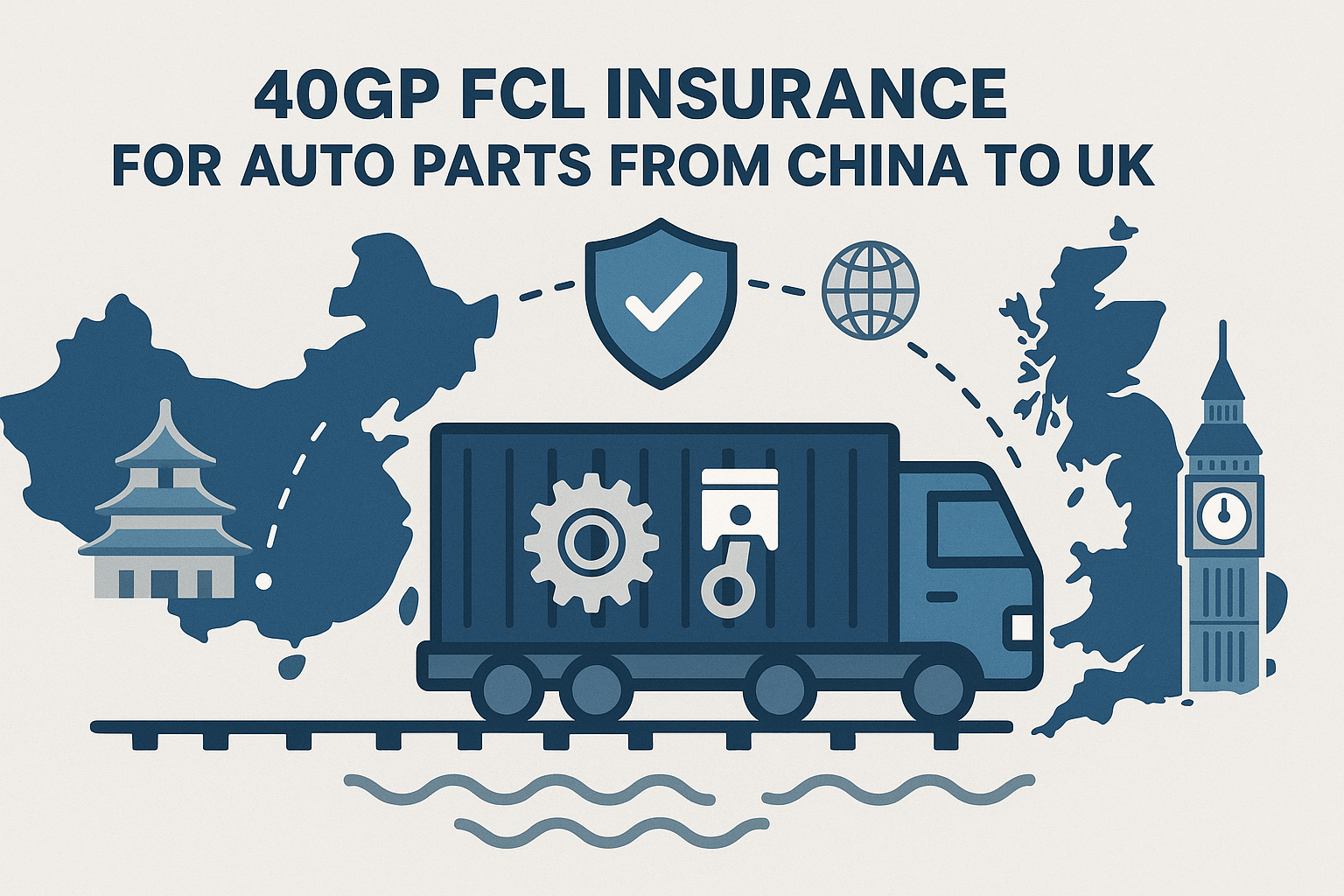
Although many importers rely on 40GP FCL insurance for auto parts from China to UK, they still face challenges balancing cargo risks, policy requirements, and rising supply-chain volatility. However, with clear planning and reliable guidance from providers such as Top China Freight, companies can protect high-value automotive components while maintaining stable shipping timelines. Therefore, this guide explains how insurance works, what it covers, and how importers can secure cost-effective, comprehensive protection.

What Makes 40GP FCL Insurance Essential for Auto Parts Shipping From China to the UK?
Auto parts—especially engines, transmissions, bearings, electronics, and structural components—carry high damage value and strict supply chain timing requirements. Moreover, these items face risks such as corrosion, deformation, theft, and handling damage. Therefore, 40GP FCL insurance becomes a necessary layer of protection rather than an optional add-on.
Additionally, because the UK automotive manufacturing sector depends heavily on just-in-time delivery, even minor damage can halt production. Thus, comprehensive coverage minimizes operational losses, avoids disputes, and secures consistent, predictable import schedules.
Furthermore, insurance strengthens financial risk management by covering partial loss, total loss, and general average—critical when shipping high-value FCL loads across long maritime routes.
How Does FCL Insurance Protect High-Value Automotive Components?
Although many importers assume standard carrier liability is enough, it rarely covers the full value of auto parts. Therefore, dedicated FCL insurance offers broader and more accurate protection aligned with automotive supply chain requirements.
Key coverage features include:
- All-risk coverage for breakage, rust, moisture, and collision
- General Average contribution protection
- Theft and pilferage coverage
- Water damage and humidity control protection
- Mechanical and electronic component protection
Moreover, because auto parts often include metal components prone to corrosion and electronic modules sensitive to moisture, insurance becomes even more important during long-haul voyages.
Additionally, insurers evaluate cargo type, packaging quality, and shipping conditions, so importers who optimize their FCL loading process benefit from reduced premiums and stronger overall protection.
Why Does the 40GP Container Play a Unique Role in Auto Parts Insurance?
A 40GP container offers more loading flexibility and weight tolerance compared to a 20GP container. Therefore, many automotive manufacturers and distributors prefer 40GP containers for shipping mixed SKUs, oversized assemblies, or dense metal parts.
The container’s characteristics influence insurance in several ways:
- Higher cargo value → higher insurable amount
- Larger loading volume → more exposure to shifting risks
- Heavier weight → increased risk of handling accidents
- Mixed auto parts → varied sensitivity to moisture and impact
Moreover, insurers often require clear weight distribution, palletization, and proper blocking and bracing. When these criteria are met, auto parts move safely through the UK supply chain, reducing claim frequency.
How Does UK Customs Compliance Influence Insurance Validity?
UK customs plays a significant role in whether your insurance remains valid throughout the transport cycle. Importers must ensure documents match the actual cargo and shipping details. Otherwise, coverage may become limited.
Critical customs documents for auto parts include:
- HS code declarations for automotive goods
- Detailed component descriptions
- Commercial invoice accuracy
- Packing list verification
- Import permits for sensitive components (if applicable)
Moreover, inaccurate documentation may cause inspections, delays, or penalties—each increasing the likelihood of cargo exposure to damage. Therefore, preparing compliant documents reduces risk and protects insurance validity throughout the UK import process.
For simplified customs coordination, many importers work with
customs clearance specialists
to ensure paperwork accuracy and avoid disruptions.
Case Studies
Mixed Auto Parts Shipped in 40GP FCL to UK
- Origin: Ningbo
- Cargo: Engine components, bearings, electrical sensors (21 tons)
- Mode: 40GP FCL
- Insurance Type: All-risk coverage
- Outcome: Minor corrosion detected due to condensation; insurer compensated the importer within seven days because packing evidence and documentation were complete.
- Result: Claim value covered 92% of loss, preventing supply chain disruption.
High-Value Auto Electronics to Southampton
- Origin: Shanghai
- Cargo: ECU modules, lighting control units, PCB-based automotive systems
- Mode: 40GP FCL
- Insurance Type: All-risk + theft protection
- Incident: External dent discovered during UK drayage
- Outcome: Insurer confirmed cargo impairment and provided settlement quickly due to pre-shipment valuation and strong packing documentation.

What Are the Main Steps for Securing 40GP FCL Insurance From China to the UK?
Although every insurer has its own process, most follow a predictable sequence that ensures shipment safety and compliance.
Typical FCL Insurance Workflow
| Step | Description |
|---|---|
| 1. Cargo Valuation | Declare realistic cargo value based on invoice and true market value |
| 2. Policy Selection | Choose between All-Risk, Named Risk, or Free of Particular Average |
| 3. Document Review | Provide invoice, packing list, and container loading plan |
| 4. Premium Confirmation | Insurer calculates premium based on cargo and risk level |
| 5. Certificate Issuance | Insurance certificate issued before vessel departure |
| 6. Claim Procedure | Follow agreed steps if loss or damage occurs |
Moreover, early policy issuance is critical because insurance cannot retroactively cover events before activation. Therefore, importers should finalize insurance before loading begins.
Can Importers Reduce 40GP FCL Insurance Costs Through Better Route Planning?
Yes—route optimization significantly influences risk exposure and insurance pricing. Although importers commonly ship through major Chinese ports such as Shanghai, Ningbo, and Qingdao, each route has unique risk factors.
Cost-saving route strategies include:
- Choosing carriers with lower historical claim rates
- Selecting UK arrival ports with smoother customs clearance
- Avoiding peak-season sailings when weather risks increase
- Using transshipment-free routes to reduce handling exposure
Additionally, insurance providers often review carrier performance data. Therefore, importers who collaborate with forwarders like Top China Freight can access route intelligence that stabilizes both shipping time and premium cost.
How Can Supply Chain Coordination Reduce Insurance Claims and Costs?
Well-planned supply chain coordination reduces risks and strengthens insurance validity. Although insurance protects financial exposure, operational consistency ensures cargo arrives intact and on schedule.
Recommended coordination steps:
- Align Chinese factory production schedules with vessel cut-off times
- Share container load plans with insurers and forwarders
- Monitor milestone updates through digital tracking
- Coordinate UK drayage early to avoid demurrage costs
- Prepare customs documents days before arrival
Moreover, integrating shipment visibility helps automotive companies prevent unexpected damage, maintain stable workflows, and avoid emergency inventory purchases.
Conclusion
In summary, 40GP FCL insurance for auto parts from China to UK protects importers against financial loss, operational delays, and supply chain risks. Moreover, proper packing, customs compliance, and route optimization significantly strengthen insurance effectiveness. Therefore, automotive businesses should combine strong insurance coverage with expert logistics support to maintain safe, predictable, and cost-efficient cross-border shipments.
Request A Free Quote
Start shipping smarter with TopChinaForwarder today! 🚢✨ Request a Free Quote 📝 and get a tailored logistics plan built around your cargo and timeline.
FAQ:
What does 40GP FCL insurance cover for auto parts?
It typically covers physical damage, loss, theft, water damage, corrosion, and General Average obligations.
How can I reduce my insurance premium?
Improve packing quality, maintain accurate documents, and choose stable carrier routes.
What happens if my container is damaged en route?
You submit a claim with photos, packing evidence, and survey reports for compensation.
What is General Average and why does it matter?
GA requires cargo owners to share loss during emergencies; insurance covers this cost.
Can forwarders help manage insurance requirements?
Yes, forwarders assist with documents, packing advice, and operational coordination.