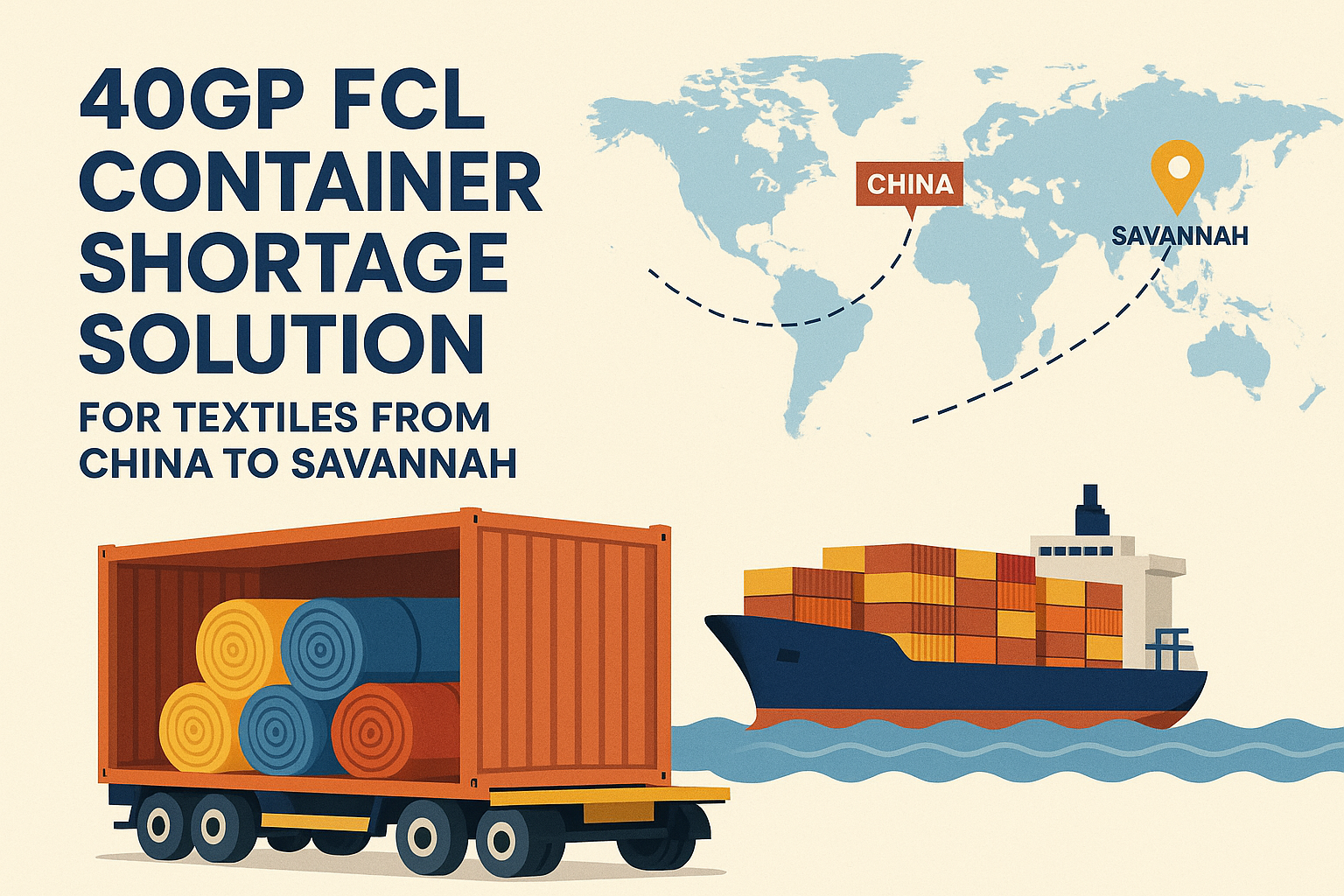
Global trade imbalances have made it difficult for textile exporters to secure 40GP containers on time. The 40GP FCL container shortage solution for textiles from China to Savannah helps stabilize shipments, optimize supply chains, and reduce logistics costs, ensuring smooth textile delivery to U.S. buyers.

What Causes 40GP Container Shortages in the Textile Supply Chain?
Shortages occur when global demand outpaces container repositioning capabilities. After the pandemic, cargo flows became uneven—containers often remained stuck in import-heavy ports like Savannah or Los Angeles instead of returning quickly to Asia.
| Primary Cause | Description | Impact on Textile Exporters |
|---|---|---|
| Port Congestion | Backlogs at major terminals | Longer lead times |
| Imbalanced Trade | More imports than exports | Empty container scarcity |
| Rising Freight Rates | Demand-driven price surges | Increased cost per shipment |
| Carrier Scheduling | Limited sailing frequency | Reduced cargo space availability |
Thus, understanding these root causes allows textile manufacturers to plan ahead with targeted mitigation strategies.
How Can Chinese Exporters Secure 40GP FCL Space Effectively?
To overcome container shortages, Chinese textile exporters can adopt multi-layered strategies:
- Early Booking: Reserve slots 3–4 weeks in advance to ensure allocation.
- Flexible Ports: Choose nearby ports like Ningbo or Xiamen instead of solely relying on Shanghai.
- Partnership with NVOCCs: Non-Vessel Operating Common Carriers often have dedicated space contracts.
- Consolidation Programs: Combine partial loads with other exporters’ goods.
Additionally, integrating digital booking tools helps track container availability in real time and prevents last-minute cancellations.
Why Is Savannah a Strategic Destination for Textile Imports?
Savannah Port, known for its efficient rail and trucking connectivity, serves as the main gateway to the southeastern U.S. textile market. Its infrastructure supports high-volume FCL operations for fashion retailers, apparel brands, and distributors.
| Advantage | Description |
|---|---|
| Deepwater Terminal | Accommodates large vessels with 40GP containers |
| On-Dock Rail Access | Connects to Atlanta, Charlotte, and Memphis |
| Shorter Dwell Time | Reduces port storage and demurrage |
| Customs Efficiency | Fast clearance under CTPAT standards |
Therefore, exporters using Savannah can benefit from faster turnaround times and reduced inland logistics costs.
What Are the Most Reliable Shipping Routes from China to Savannah?
Several sea routes connect Chinese textile hubs to Savannah through the Panama Canal.
| Route | Transit Time | Estimated Cost (40GP FCL) | Remarks |
|---|---|---|---|
| Shanghai → Savannah | 34–37 days | USD 4,200–4,800 | Balanced option |
| Ningbo → Savannah | 35–39 days | USD 4,400–5,000 | Good for high-volume cargo |
| Shenzhen → Savannah | 33–36 days | USD 4,000–4,600 | Fastest route via Panama Canal |
Some exporters also leverage transshipment via Los Angeles to balance costs and manage shortage issues during peak seasons.
Case Studies: Solving Container Shortages for Textile Shipments
Case 1 – Apparel Fabrics Export
- Origin: Guangzhou, China
- Destination: Savannah, USA
- Container Type: 40GP FCL
- Volume: 24 tons / 67 CBM
- Freight Cost: USD 4,350
- Duration: 35 days
- Solution: Early space booking with flexible departure from Yantian terminal.
Case 2 – Home Textile Rolls
- Origin: Ningbo, China
- Destination: Savannah, USA
- Container Type: 40GP
- Cargo Type: Cotton and polyester blends
- Transit Time: 37 days
- Strategy: Space guaranteed via NVOCC’s long-term contract.
What Are the Best Practices for Managing FCL Shortages?
Companies must rethink their logistics operations. The following practices have proven effective:
| Strategy | Description | Result |
|---|---|---|
| Long-Term Contracts | Secure rate agreements with carriers | Stable freight rates |
| Shared Container Programs | Join co-loading initiatives | Optimize space usage |
| Demand Forecasting | Align production with vessel schedules | Prevent urgent bookings |
| Intermodal Flexibility | Combine sea + rail + truck | Balanced lead time |
Moreover, supply chain visibility platforms allow textile exporters to identify delays early and adjust production or shipping schedules accordingly.
How Can Technology Improve 40GP FCL Tracking and Allocation?
Digital platforms provide a powerful way to manage space and monitor shipping flows. Through integrated AI-driven logistics systems, exporters gain predictive insights into vessel congestion, container turnaround, and schedule reliability.
Technological Benefits Include:
- Real-time visibility of 40GP container availability.
- Automatic notifications for free space openings.
- Seamless connection with carriers and customs systems.
- Data analytics for optimizing shipment planning.
These tools empower textile exporters to make proactive decisions and reduce logistics downtime.
How Do Forwarders Help Solve the 40GP FCL Shortage for Textiles?
Freight forwarders play a vital role by leveraging global contracts and space allocations from carriers. Furthermore, they consolidate smaller shipments, provide inland trucking, and negotiate competitive rates for exporters struggling with space scarcity.
Key Freight Forwarder Services
- Guaranteed space for critical textile shipments.
- End-to-end tracking and temperature monitoring.
- Customs clearance assistance at both origin and destination.
- Risk management through cargo insurance and documentation support.
Ultimately, choosing an experienced forwarder ensures continuity even when global shipping conditions are unstable.
Conclusion
In conclusion, the 40GP FCL container shortage solution for textiles from China to Savannah lies in early booking, digital monitoring, and logistics collaboration. These strategies help exporters maintain steady production, minimize shipping delays, and preserve their competitive edge in the U.S. textile market. Therefore, by planning ahead and partnering with reliable freight forwarders, textile companies can overcome supply chain disruptions efficiently.
Request A Free Quote
Get started with TopChinaFreight today! 🚢✨ Simply Request a Free Quote 📝 to receive a customized shipping solution tailored to your needs. Our experts will provide the best rates 💰, fastest routes 🚀, and professional guidance 🌍 for your international logistics.
FAQs
Q1.What causes 40GP FCL container shortages from China?
Global demand surges, port congestion, and uneven trade flows lead to limited container availability.
Q2.How can textile exporters reserve 40GP containers early?
They can pre-book space 3–4 weeks before departure and use digital freight platforms for visibility.
Q3.Which port in the U.S. is best for textile imports?
Savannah is ideal because of its strong inland rail links, fast clearance, and lower terminal congestion.
Q4.Are there cost differences between direct and transshipment routes?
Yes, direct routes cost slightly more but reduce delays, while transshipment routes are cheaper but slower.
Q5.How can freight forwarders help during container shortages?
They provide guaranteed slots, optimize carrier selection, and handle documentation to reduce delay risks.