Table of Contents
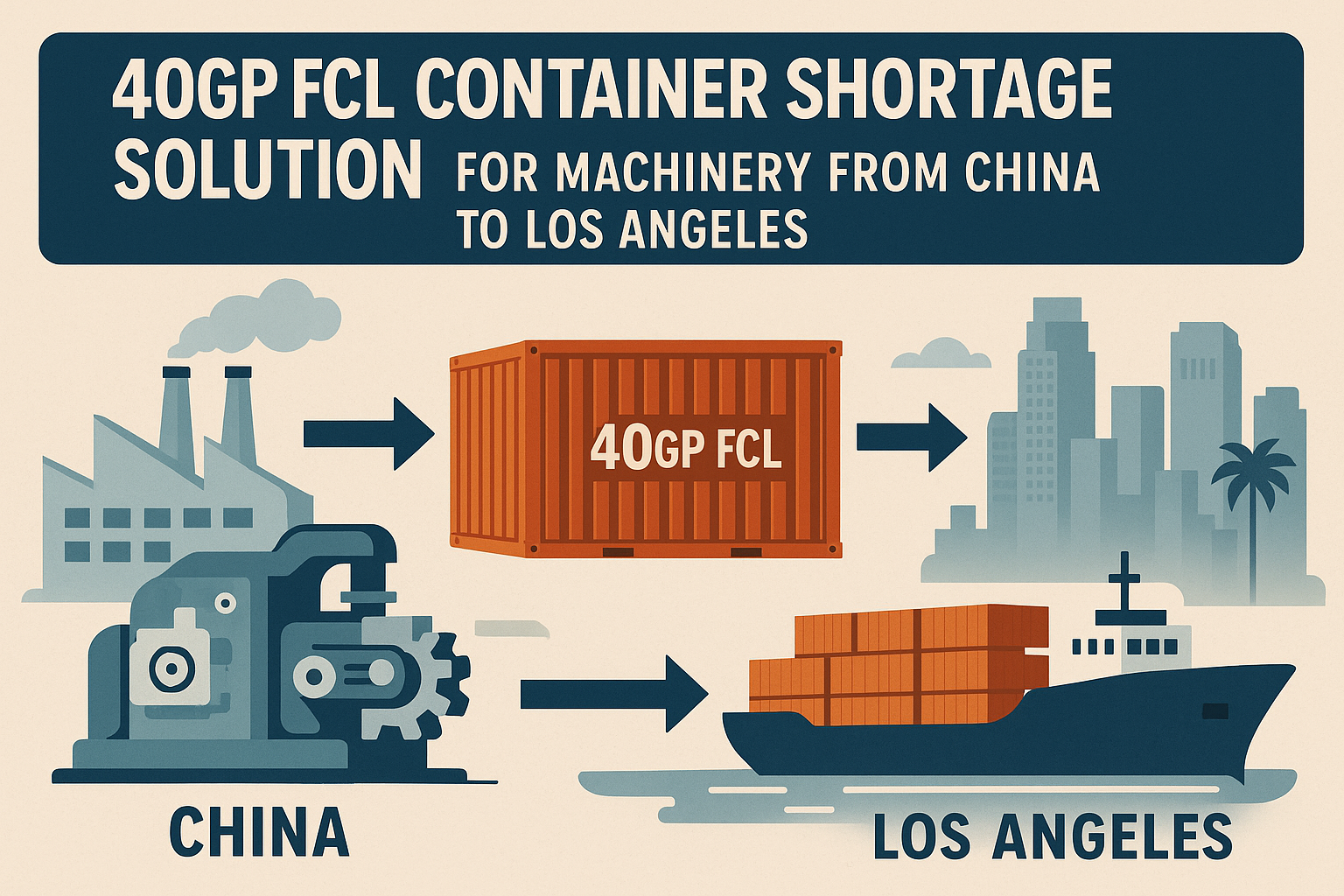
The global container crisis has heavily impacted exporters of heavy industrial goods. For companies moving equipment and machinery, securing space on vessels is often harder than expected. The 40GP FCL container shortage solution for machinery from China to Los Angeles involves careful planning, supplier coordination, and capacity booking strategies that guarantee timely delivery and cost control.

What Causes the 40GP FCL Container Shortage Problem?
The demand for 40-foot containers surged as global trade recovered post-pandemic. Meanwhile, containers remained stranded in Europe and the U.S., creating severe imbalance.
| Root Cause | Explanation | Effect on China–US Route |
|---|---|---|
| Port Congestion | Delays in unloading increase turnaround time | Slower container rotation |
| Trade Imbalance | More exports than imports from Asia | Equipment shortage |
| Longer Transit Loops | Empty repositioning takes weeks | Fewer available 40GPs |
| Seasonal Peaks | August–December rush | High freight and scarcity |
Machinery shippers suffer most because 40GP units are essential for large, heavy, or palletized cargo requiring sturdy loading floors.
How Does the Container Shortage Affect Machinery Exporters?
The impact extends beyond shipping rates. When FCL containers are unavailable, exporters face:
- Longer booking lead times (2–4 weeks in peak months)
- Rising spot freight rates up to 300% higher
- Extended production storage waiting for available equipment
- Missed delivery deadlines due to postponed vessel sailings
For example, exporters from Guangzhou reported up to USD 4,500 per 40GP during 2024’s logistics crunch, nearly triple pre-crisis levels.
What Are Effective Solutions for the 40GP FCL Container Shortage?
Shippers must diversify both booking channels and equipment types. The most reliable solutions include:
- Early Slot Booking – Reserve FCL space 3–4 weeks before shipping.
- Alternative Equipment Use – Replace 40GP with 40HQ or Open Top containers when cargo height allows.
- Consolidated Shipments – Split machinery into multiple 20GP containers.
- Use NVOCC Forwarders – Non-vessel operators often access private container pools.
- Backhaul Repositioning – Utilize empty-return programs from U.S. West Coast carriers.
| Solution | Average Cost Saving | Risk Level | Implementation Difficulty |
|---|---|---|---|
| Early booking | 10–15% | Low | Easy |
| Alternative size use | 5–10% | Medium | Moderate |
| Shared leasing | 20% | Low | Easy |
| Rail + Sea hybrid | 15% | Medium | Complex |
These steps minimize risk and guarantee shipment continuity despite equipment shortages.
Which Routes Work Best for 40GP FCL Machinery Shipping to Los Angeles?
Selecting the right route directly affects container availability and total transit time.
| Origin Port | Route Type | Transit (days) | Reliability | Notes |
|---|---|---|---|---|
| Shanghai → Los Angeles | Direct | 16–19 | High | Most stable capacity |
| Shenzhen (Yantian) → Long Beach | Direct | 15–18 | High | Fastest schedule |
| Ningbo → Los Angeles | Transshipment | 18–22 | Moderate | Risk of delay |
| Qingdao → Los Angeles | Direct | 19–23 | High | Stable for heavy cargo |
Southern China ports like Shenzhen and Guangzhou offer more frequent sailings and equipment pools, which reduce booking pressure for 40GP machinery shipments.
Real Case Studies: Solving 40GP FCL Shortages
Case 1 – Guangzhou to Los Angeles (40GP FCL)
- Cargo: CNC machine tools (26 tons)
- Freight: USD 4,200
- Transit: 18 days (direct service)
- Action: Switched from 40HQ to 40GP through forwarder pool
- Result: Secured equipment within 5 days, no delay.
Case 2 – Shanghai to Long Beach (Two 20GP FCLs)
- Cargo: Industrial engines (32 CBM each)
- Freight: USD 2,600 × 2
- Action: Split load using dual 20GPs due to 40GP unavailability
- Result: Delivered on schedule, cost 5% higher but avoided delay.
Need a shipping solution? 🚢 Request a Free Quote 📝 from TopChinaFreight and get the best rates and fastest routes today!
What Are the Typical Freight Costs and Transit Times?
| Container Type | Base Freight (USD) | Transit Time | Peak Season Surcharge | Suitability for Machinery |
|---|---|---|---|---|
| 20GP | 2,100 – 2,600 | 18–23 days | +15% | Smaller equipment |
| 40GP | 3,800 – 4,500 | 15–19 days | +25% | Heavy cargo |
| 40HQ | 4,000 – 4,700 | 15–20 days | +20% | Tall machinery |
| Open Top | 4,500 – 5,000 | 20–24 days | +25% | Oversized crates |
Tip: Working with experienced forwarders like Top China Freight ensures fair market pricing and priority equipment access through direct carrier partnerships.
How Do Customs and Documentation Affect Container Turnaround?
Delays in documentation often extend container use time and worsen shortages. Machinery shipments require multiple certifications and declarations.
| Document | Purpose | Issued By |
|---|---|---|
| Commercial Invoice | Declares product value | Exporter |
| Packing List | Details machinery layout | Exporter |
| Bill of Lading | Proof of transport | Carrier |
| Certificate of Origin | Trade compliance | Chamber of Commerce |
| HS Code Declaration | Customs verification | Freight forwarder |
| Insurance Certificate | Cargo coverage | Insurer |
Submitting all documents electronically through the U.S. Customs ACE portal can cut clearance time by 1–2 days, improving container turnaround and reducing demurrage.
How Can Exporters Secure Reliable FCL Supply During Shortages?
To ensure continuous shipment flow, exporters should integrate logistics and procurement planning.
- Forecast Export Volume: Predict monthly demand and book capacity early.
- Join Equipment-Sharing Networks: Access containers through global leasing firms.
- Diversify Ports: Split export load across multiple Chinese terminals.
- Use Flexible Incoterms (FOB/CIF): Negotiate responsibility for container procurement.
- Track Market Updates: Monitor freight index data weekly for pricing trends.
Ultimately, combining forecasting + flexibility allows machinery exporters to maintain consistent supply chains even in tight container markets.
Conclusion
The 40GP FCL container shortage solution for machinery from China to Los Angeles depends on early booking, flexible routing, and reliable partnerships. Exporters who diversify ports, substitute container sizes, and leverage NVOCC or leasing options consistently maintain stable logistics operations. With expert management from Top China Freight, you can secure guaranteed space, competitive pricing, and smooth customs clearance for every machinery shipment.
Request A Free Quote
Get started with TopChinaFreight today! 🚢✨ Simply Request a Free Quote 📝 to receive a customized shipping solution tailored to your needs. Our experts will provide the best rates 💰, fastest routes 🚀, and professional guidance 🌍 for your international logistics.
FAQs
Q1.Why is there a 40GP FCL shortage from China to Los Angeles?
Container imbalance, port congestion, and trade flow disruption reduce available 40GP equipment in China’s main export terminals.
Q2.How can machinery exporters secure FCL containers faster?
Reserve space weeks ahead, use multiple ports, and collaborate with NVOCCs or leasing companies for guaranteed container access.
Q3.What’s the difference between 40GP and 40HQ containers?
Both have similar lengths, but 40HQ offers extra height—ideal for taller machinery—though costs slightly more per shipment.
Q4.Are there alternative routes to Los Angeles for machinery?
Yes. Some shipments use Shanghai–Oakland or Ningbo–Seattle routes before trucking to Los Angeles to avoid port congestion.
Q5.How long does a 40GP FCL take from China to Los Angeles?
Transit averages 15 to 19 days depending on port origin, vessel type, and current West Coast shipping congestion levels.