
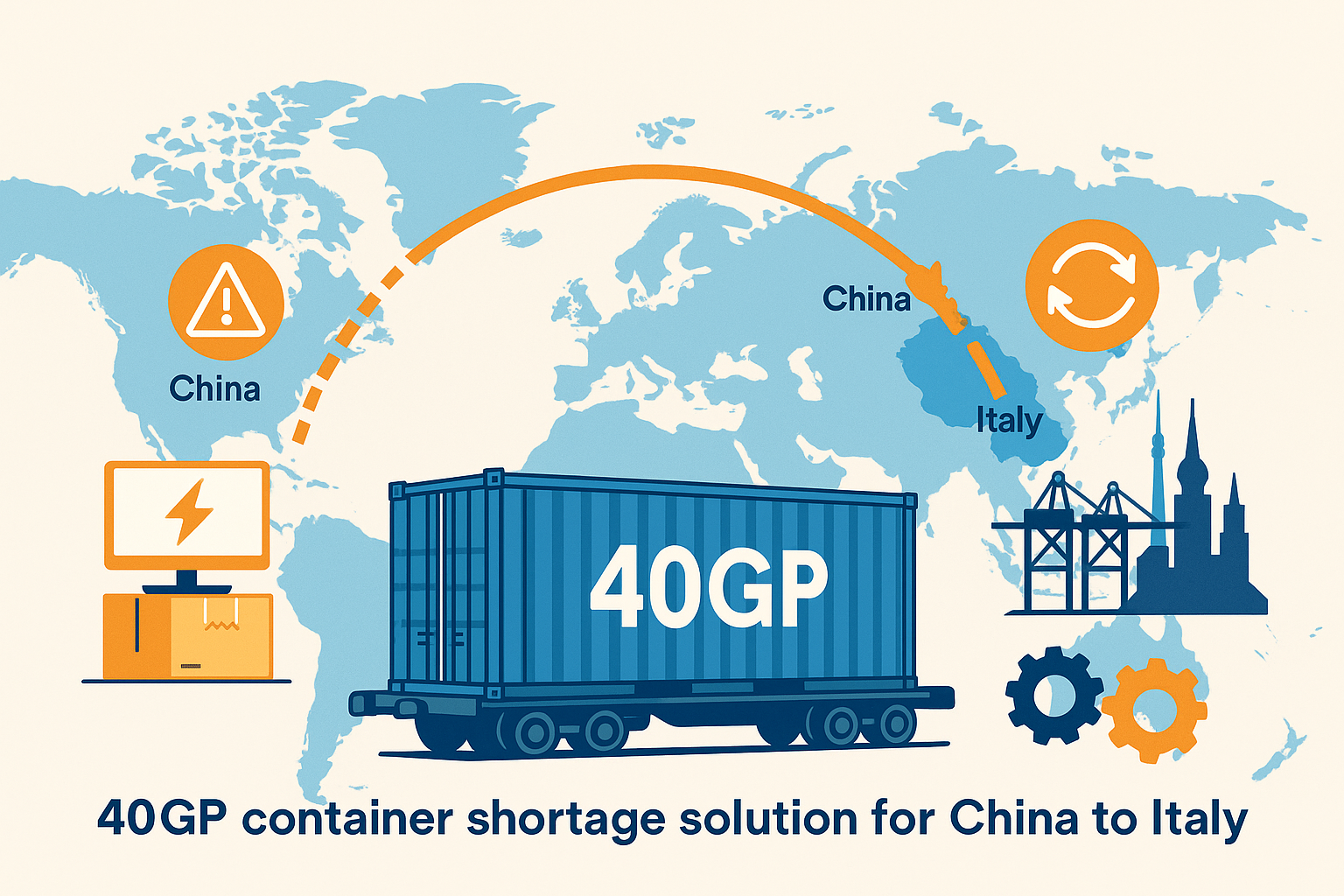
Although 40GP FCL container shortage solution for electronics from China to Italy has become a major concern for importers, there are still structured ways to secure stable container access. Therefore, this article outlines practical strategies that help avoid delays, control freight rates, and keep your supply chain predictable. For companies seeking reliable support, Top China Freight provides end-to-end solutions through our homepage at Top China Freight.

What Causes 40GP FCL Container Shortage for Electronics from China to Italy?
Because global equipment distribution remains uneven, 40GP shortages continue to affect exporters shipping electronics to Italy. Although demand usually spikes during promotional seasons, the core issue often comes from limited container repositioning, unstable vessel schedules, and congestion at key European ports. Consequently, importers face extended booking lead times, rising freight rates, and unpredictable loading windows.
Moreover, electronics manufacturers frequently require larger 40GP units due to packaging dimensions and stackability. Nevertheless, the same container type is popular in multiple industries, causing even more pressure on China–Europe lanes. When demand surges, shippers must rely on proactive measures rather than reactive troubleshooting.
To give importers more control, later sections explain how container allocation strategies, multimodal alternatives, consolidation methods, and early planning reduce risk even during the tightest capacity cycles.
How Does Early Booking Improve Your Container Allocation Success?
Although many shippers treat container reservations as a final step before loading, the truth is that early booking has become essential for securing 40GP units. When electronics exporters extend their booking window by 10–14 days, carriers gain enough visibility to forecast demand and allocate equipment more accurately.
Furthermore, freight forwarders with strong space contracts often submit rolling forecasts, and this strengthens your probability of receiving priority equipment. Because electronics are time-sensitive and seasonal, booking earlier also ensures you avoid peak-week bidding where freight rates fluctuate rapidly.
To streamline this stage, importers can request consolidation schedules through the FCL & LCL service page at Top China Freight. This provides planning data that reduces operational uncertainty.

What Routing Adjustments Help Bypass Peak-Season Congestion?
Because most carriers prioritize full service loops, importers may reduce shortage exposure by selecting alternative transshipment hubs. Ports such as Piraeus, Valencia, or Barcelona occasionally offer more stable equipment access for cargo eventually moving to Italy, especially through feeder networks.
Moreover, flexible routing helps shippers avoid bottlenecks created by labor disruptions, draft restrictions, or sudden vessel omittance in northern Italy. Although electronics still arrive within competitive transit windows, this routing reduces the likelihood of rollovers.
Routing Comparison Table
| Routing Option | Transit Time Range | Container Availability | Notes |
|---|---|---|---|
| Direct China → Italy | 28–35 days | Low–Medium | Highest shortage risk during peak season |
| China → Piraeus → Italy | 30–38 days | Medium–High | Strong feeder reliability |
| China → Valencia → Italy | 32–40 days | Medium–High | Good for Western importers |
| China → Barcelona → Italy | 33–42 days | Medium | Flexible customs procedures |
This table illustrates that although routing adjustments add 2–5 days, they significantly improve equipment reliability—an essential factor during shortage cycles.
How Can Consolidation and Warehouse Optimization Increase Your Equipment Success Rate?
Although many importers depend on factory-direct loading, consolidation provides greater control over container allocation. When multiple suppliers deliver to the same warehouse, freight forwarders can pre-position empty units, allowing better synchronization between arrival times and container readiness.
Benefits of consolidation
- Predictable loading windows
- Reduced risk of missed cut-offs
- Cost-efficient handling for multi-supplier orders
- Buffer storage for unexpected supplier delays
Furthermore, consolidation facilities often maintain 40GP stock for high-volume customers, giving electronics importers preferential loading access. For importers who need flexible warehousing support, the sea freight section at Top China Freight outlines additional optimization methods.
Case Studies
Electronics Shipment via Alternative Routing
Origin: Ningbo, China
Destination: Milan, Italy
Cargo: 40GP, 28 CBM electronics
Issue: No container availability at Ningbo for 5 days
Solution: Shifted routing to China → Piraeus → Italy
Total Transit Time: 36 days
Outcome: Equipment allocated within 48 hours; avoided potential 10-day delay
Cost Difference: +USD 240 vs. direct route
Although the route extension added 4–5 days, the customer avoided expensive downtime at the warehouse and kept inventory stable.
Consolidation Warehouse Strategy
Origin: Shenzhen suppliers (3 factories)
Destination: Rome, Italy
Cargo: 40GP, full load of mixed electronics
Issue: No synchronized availability across three suppliers
Solution: Used consolidation warehouse with pre-positioned 40GP
Transit Time: 31 days
Outcome: Shipment loaded on first available vessel; no rollovers
Savings: USD 320 in trucking + avoided 7-day delay
Because consolidation optimized timing, the importer achieved stronger predictability and improved cost control.
Why Capacity Forecasting Is Essential for Electronics Importers?
Since electronics shipping volumes rise aggressively around seasonal events, forecasting demand helps stabilize your equipment availability. When importers provide 8–12-week forecasts, freight forwarders can submit batches of space requests to carriers, allowing them to earmark equipment at optimal times.
Moreover, forecasting aligns with rate-stabilization strategies, enabling companies to secure predictable freight costs rather than bidding during chaotic peak weeks.
Forecasting also helps:
- Reduce dependency on high-risk departure weeks
- Improve supplier production planning
- Maintain sufficient inventory buffers in Europe
- Strengthen negotiation leverage with carriers
Because forecasting influences nearly every shortage-prevention tactic, it remains one of the most effective long-term strategies.
How Do Freight Rate Trends Influence Container Availability?
Because shipping lines allocate equipment to the most profitable lanes, rate movements significantly affect container distribution. When China–Europe freight rates surge, carriers redirect more equipment to match the demand surge. Conversely, when the market softens, equipment becomes more accessible.
Understanding rate cycles allows importers to time bookings strategically, especially when shortage pressure intensifies.
Typical rate pattern during shortage cycles
- Pre-peak: Rates rise slightly; equipment becomes tight
- Peak week: Rates spike; high shortage risk
- Post-peak: Rates stabilize; more availability returns
The interplay between rate movements and equipment allocation makes market monitoring essential for electronics importers.
Why Do Alternative China Ports Help Solve 40GP Shortages for Italy?
Since container shortages typically start at high-demand southern ports such as Shenzhen and Ningbo, shifting your shipment to alternative gateways may significantly improve your loading probability. Although this adjustment adds minor trucking costs, the speed advantage often outweighs the difference.
Key advantages of alternative ports
- They maintain more balanced equipment pools.
- Their congestion levels are usually lower.
- Vessel cut-off times tend to be more flexible.
- Electronics factories in Guangdong or Zhejiang can still reach them efficiently.
Additionally, some importers secure containers directly from inland depots connected to China’s rail freight networks. Although the cargo proceeds via ocean, these inland depots provide better allocation, especially during peak seasons.
Conclusion
In summary, implementing a structured 40GP FCL container shortage solution for electronics from China to Italy enables importers to maintain predictable operations even in volatile markets. Through early booking, consolidation, routing flexibility, demand forecasting, and strong documentation control, supply chain disruptions can be significantly reduced. When importers prioritize stability, they gain better control over freight costs, transit times, and inventory strategies.
For companies seeking professional support, Top China Freight offers tailored space-optimization and shortage-prevention solutions designed for long-term reliability across China–Europe lanes.
Request A Free Quote
Start shipping smarter with TopChinaForwarder today! 🚢✨ Request a Free Quote 📝 and get a tailored logistics plan built around your cargo and timeline.
FAQ:
How are FCL shortage-related charges calculated?
Charges depend on carrier rate cycles, booking lead time, and equipment imbalance surcharges. Moreover, early planning usually lowers cost exposure.
Do electronics require special documentation for Italy?
Yes. Italian customs often request conformity details, HS validation, and product standards. Accurate paperwork reduces the risk of rollovers.
Is cargo insurance recommended during shortage periods?
Definitely. Insurance protects high-value electronics against delay-related risks, handling damage, and routing shifts.
How can I track cargo during route adjustments?
Most forwarders provide digital visibility dashboards, offering real-time vessel movement and predictive ETA updates.
What is the best long-term way to avoid shortages?
Consistent forecasting, stable carrier partnerships, and flexible routing form the strongest long-term mitigation strategy.