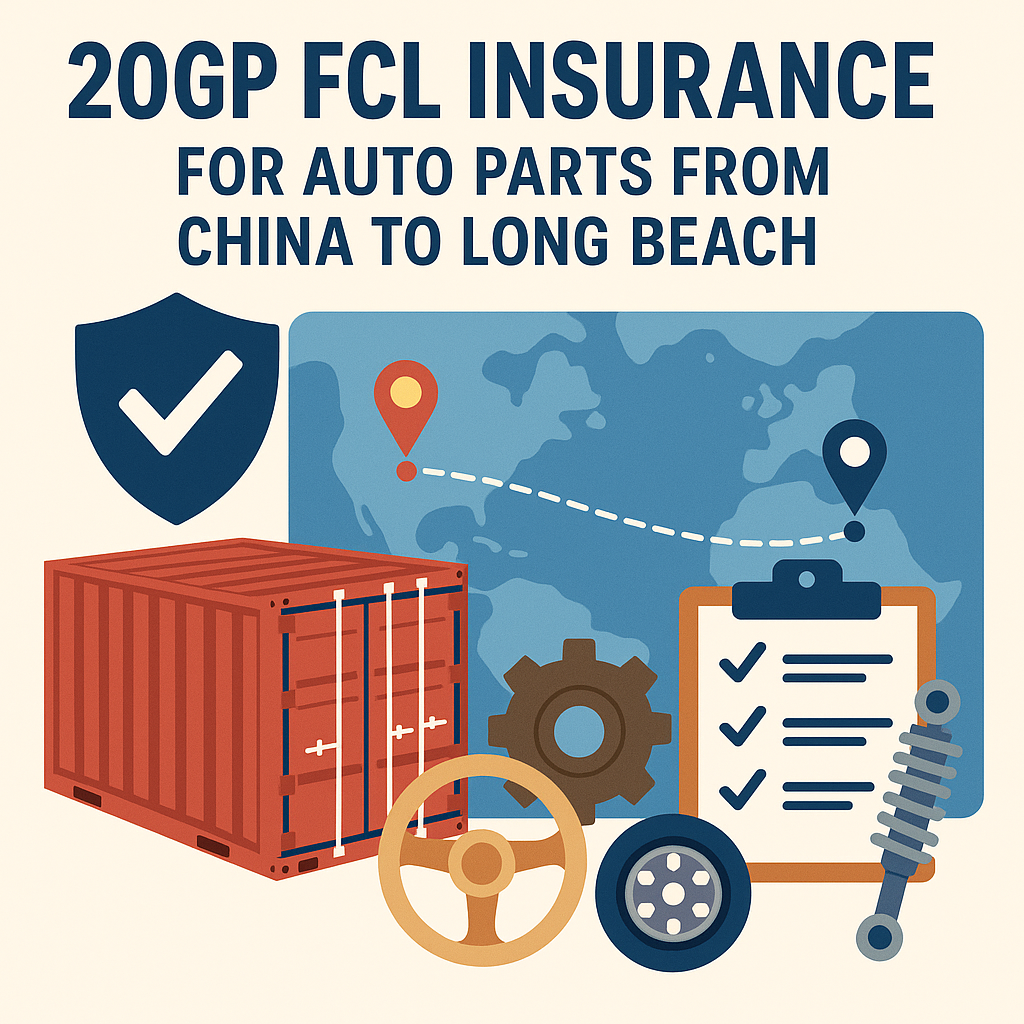
Transporting auto parts across the Pacific involves multiple risks—from cargo damage to unforeseen port delays. The 20GP FCL insurance for auto parts from China to Long Beach offers peace of mind by protecting your shipment throughout its journey. This guide explores insurance types, costs, documentation, and case studies to help importers safeguard their high-value automotive goods during sea transport.

What Is 20GP FCL Insurance and Why Is It Important for Auto Parts?
A 20GP (20-foot General Purpose) container is widely used for small- to medium-volume shipments of heavy goods such as automotive components. FCL (Full Container Load) ensures exclusive use of the container, minimizing handling and damage risk.
However, accidents like rough seas, mishandling, or port congestion can still cause losses. That’s where marine cargo insurance plays a vital role—covering your auto parts against damage, theft, or loss from port to port.
| Insurance Coverage Type | Description | Recommended For |
|---|---|---|
| All Risk (A Clause) | Covers physical loss/damage except exclusions | High-value or delicate auto parts |
| With Average (WA Clause) | Covers partial loss due to perils of the sea | General hardware or engines |
| Free of Particular Average (FPA Clause) | Covers total loss only | Low-value bulk parts |
How Much Does 20GP FCL Insurance Cost from China to Long Beach?
Insurance premiums depend on cargo value, coverage type, and route conditions. For FCL shipments, rates usually range from 0.3% to 0.6% of the declared cargo value.
| Cargo Value (USD) | Coverage Type | Estimated Premium (USD) |
|---|---|---|
| 30,000 | All Risk | 120–180 |
| 50,000 | WA Clause | 150–200 |
| 80,000 | All Risk + War Risk | 240–300 |
Example: For auto parts worth $50,000, the estimated insurance cost is around $160 for full All-Risk coverage, offering complete protection throughout transit.
What Are the Benefits of Insuring FCL Shipments?
Opting for FCL insurance for auto parts ensures several critical advantages:
- Financial Security: Compensation in case of loss or damage.
- Customs Compliance: Insurance documentation helps smooth customs clearance in both China and the U.S.
- Supply Chain Continuity: Protects your logistics from disruption due to unforeseen events.
- Reduced Risk Exposure: Covers common incidents like storms, theft, or mechanical handling errors.
- Peace of Mind: Confidence that valuable vehicle parts—such as engines, bumpers, or transmissions—are fully protected.
Additionally, insured containers are prioritized in claims processes, enabling faster recovery or reimbursement.
What Is the Typical Transit Time from China to Long Beach?
The sea journey from major Chinese ports to Long Beach averages 15–22 days, depending on carrier route and seasonal conditions.
| Origin Port | Destination | Transit Time | Carrier Example |
|---|---|---|---|
| Shanghai | Long Beach | 16–18 days | COSCO |
| Shenzhen | Long Beach | 18–20 days | MSC |
| Ningbo | Long Beach | 19–22 days | Hapag-Lloyd |
Including port clearance and inland delivery, the total door-to-door transit time can reach 25–30 days.
Case Studies: Real 20GP Auto Parts Shipments to Long Beach
Case 1: Shanghai → Long Beach (Auto Engine Components)
Cargo: 12 tons of engine parts
Container: 20GP FCL
Freight Cost: USD 2,950
Insurance: USD 150 (All Risk)
Transit Time: 17 days
✅ Result: Cargo delivered intact, insured under “All Risk” policy, ensuring full compensation readiness for any loss.
Case 2: Shenzhen → Long Beach (Brake System Kits)
Cargo: 10 tons of brake systems
Container: 20GP FCL
Freight Cost: USD 2,850
Insurance: USD 120 (WA Clause)
Transit Time: 19 days
✅ Result: Shipment faced port delay, but insurance covered storage costs due to marine delay clause.
Need a reliable logistics partner? Share your shipment details and we’ll provide a tailored quotation quickly and accurately.
What Documents Are Required for FCL Insurance and Customs Clearance?
Accurate paperwork ensures quick claims and compliance with international trade standards.
| Document | Purpose | Issued By |
|---|---|---|
| Commercial Invoice | Declares shipment value | Supplier |
| Packing List | Lists item details | Exporter |
| Bill of Lading | Confirms shipment | Shipping Line |
| Insurance Certificate | Proof of coverage | Insurer |
| Certificate of Origin | Verifies product origin | Chamber of Commerce |
| Arrival Notice | Required for U.S. Customs | Freight Forwarder |
Ensure that the insurance certificate matches the Bill of Lading number, or customs officers may question the cargo’s authenticity.
How to File an Insurance Claim for FCL Shipments?
If cargo damage occurs, follow this standard claim process:
| Step | Action | Timeline |
|---|---|---|
| 1 | Notify insurer within 3 days of delivery | 72 hours |
| 2 | Gather evidence (photos, survey report, documents) | Immediately |
| 3 | Submit claim with insurer’s form | Within 7 days |
| 4 | Await surveyor inspection | 3–5 days |
| 5 | Compensation approval and payout | 10–15 days |
Tip: Partnering with logistics companies like TopChinaFreight helps streamline claim submissions and coordinate with underwriters efficiently.
Comparing Insured vs. Uninsured FCL Shipments
| Criteria | Insured Shipment | Uninsured Shipment |
|---|---|---|
| Risk Coverage | Protected against damage, loss, delay | Fully exposed |
| Customs Clearance | Faster with verified documents | May face delays |
| Financial Liability | Reduced due to compensation | 100% borne by importer |
| Client Confidence | High reliability | Potential distrust |
In international trade, insurance is not just a safety net—it’s a competitive edge that protects both financial and operational stability.
Conclusion
The 20GP FCL insurance for auto parts from China to Long Beach ensures cargo safety, operational reliability, and financial protection. With transit times of about 20 days and insurance premiums starting at 0.3% of cargo value, this approach balances affordability and security.
Choosing a trusted logistics partner such as TopChinaFreight guarantees professional insurance support, transparent documentation, and seamless customs coordination from China to your U.S. warehouse.
Request a Quote
Need a tailored solution for your shipping from China?Let TJ China Freight Forwarder assist you with reliable, cost-effective service.
FAQ:
Q1.Why is FCL insurance important for auto parts shipments?
It protects cargo against damage, theft, or loss during sea transport, ensuring financial recovery for high-value vehicle components.
Q2.What is the average insurance cost for 20GP FCL to Long Beach?
Premiums typically range from 0.3% to 0.6% of declared cargo value, depending on coverage level and risk conditions.
Q3.Which insurance type is best for auto parts shipments?
“All Risk” coverage offers the broadest protection, ideal for expensive or fragile automotive products shipped by sea.
Q4.How can I reduce shipping risks for auto parts?
Use professional packing, weather-resistant containers, and secure marine insurance through experienced forwarders.
Q5.What documents are needed for FCL insurance claims?
You’ll need the Bill of Lading, insurance certificate, commercial invoice, packing list, and survey report as evidence.