
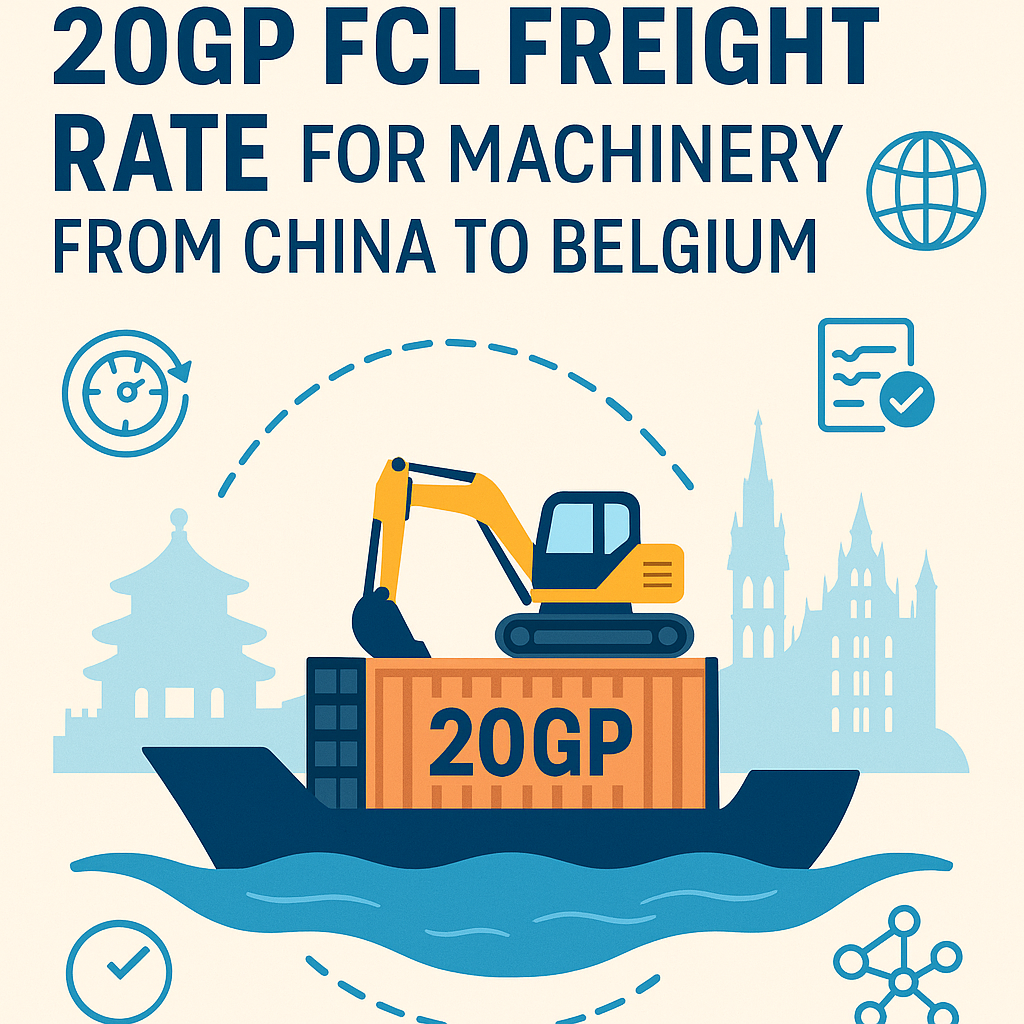
Although machinery buyers aim to secure a predictable 20GP FCL freight rate for machinery from China to Belgium, costs still fluctuate due to routing, seasonal demand, and port conditions. Therefore, this guide provides a clear and actionable structure to help procurement teams control expenses and avoid unexpected fees while shipping through a reliable partner like Top China Freight. As a result, you’ll learn how rates work, how to optimize loading, and how to prepare customs-ready documentation.

What Defines the 20GP FCL Freight Rate for Machinery from China to Belgium?
Understanding the composition of a 20GP FCL freight rate for machinery from China to Belgium is essential, especially because machinery tends to be heavy and sometimes oversized. Moreover, rates reflect carrier capacity, bunker prices, port congestion, and China–Europe supply chain dynamics. Although these factors evolve monthly, machinery shippers benefit from stable pricing windows when planning early.
Key Freight Cost Components
- Base ocean freight driven by carrier supply and demand.
- Bunker adjustment factor (BAF) linked to fuel cost movements.
- Equipment surcharges when 20GP stock is tight.
- Peak season surcharges applied during Q3–Q4.
- Port handling fees at both POL and POD.
Because machinery is often dense, weight-based surcharges may apply. Nevertheless, early booking helps avoid these additional fees.

How Much Does a 20GP FCL Cost from China to Belgium?
Although exact rates vary weekly, machinery importers typically see similar pricing patterns. Additionally, port selection—Antwerp, Zeebrugge, or Rotterdam for onward trucking to Belgium—influences final landed cost.
Reference Cost Ranges
| Route | Estimated Ocean Freight (USD) | Transit Time | Notes |
|---|---|---|---|
| Shanghai → Antwerp | 850–1,250 | 28–33 days | Most stable carrier schedules |
| Ningbo → Antwerp | 900–1,350 | 29–35 days | Strong space availability |
| Shenzhen → Antwerp | 1,000–1,450 | 30–38 days | Popular for machinery consolidation |
Because machinery often moves in single-SKU shipments, consistent loading efficiency reduces drayage and warehouse delays.
Why Does Machinery Impact FCL Freight Rate Differently?
Machinery freight behaves differently from textiles, electronics, or consumer goods. Furthermore, machinery often requires reinforced packing, heavier forklift handling, and additional port labor. Consequently, these factors influence the 20GP FCL freight rate for machinery from China to Belgium more than standard cargo.
Machinery-Specific Cost Drivers
- Higher gross weight increases terminal handling fees.
- Special lashing for industrial equipment.
- Additional risk-related surcharges.
- Longer loading time at origin warehouse.
Since many machinery units require wooden crates or steel base frames, packaging compliance also affects customs clearance efficiency.
How Do Transit Times Affect 20GP FCL Freight Rates for Machinery?
Transit time plays a crucial role in budgeting because carriers offering faster schedules typically charge a premium. Nevertheless, machinery buyers often value predictability more than pure speed.
Common Transit Patterns
- Direct routes: fewer transshipments, more stable ETAs.
- Transshipment routes: cost-saving but slightly longer.
- Slow-steaming schedules: cheaper but extended by 4–7 days.
Moreover, transit reliability directly impacts production planning for Belgian manufacturers awaiting spare parts or industrial assemblies.
What Documents Are Required to Avoid Delays in Belgium?
Because Belgian customs enforce strict documentation compliance for machinery, importers must prepare documents early. Additionally, machinery must match HS-code-level requirements to prevent clearance delays.
Documentation Checklist
| Document | Purpose | Required For |
|---|---|---|
| Commercial Invoice | Duty calculation | All machinery shipments |
| Packing List | Volume & weight verification | All FCL containers |
| HS Code Declaration | Customs classification | Machinery-specific |
| CE/Conformity Certificate | Compliance | Industrial equipment |
| Bill of Lading | Ownership & transport record | Port release |
Proper preparation ensures machinery is cleared without penalties or reinspection fees.
Case Studies
achinery Shipment from Ningbo to Antwerp
Cargo: CNC industrial machinery, 7,200 kg
Container: 20GP FCL
Route: Ningbo → Antwerp
Transit Time: 32 days
Total Freight Cost Components:
- Base ocean freight: USD 1,100
- BAF: USD 95
- Terminal handling: USD 210
- Destination port charges: USD 185
Because the shipment required reinforced lashing and certified wooden crates, early coordination saved two days of terminal storage.
Hydraulic Equipment Shipment from Shenzhen to Rotterdam
Cargo: Hydraulic cylinders, 5,800 kg
Container: 20GP FCL
Route: Shenzhen → Rotterdam → Trucking to Belgium
Transit Time: 34 days + 2 days inland
Cost Efficiency Gains:
- Saved 14% via transshipment routing
- Reduced warehouse waiting time through pre-booked drayage
- Achieved smoother clearance with early HS code validation
Both cases demonstrate how planning directly shapes freight rate stability.
Why Early Booking Helps Reduce 20GP FCL Freight Rates
Machinery exporters benefit significantly from securing earlier bookings. Moreover, carriers frequently reward early space commitments with better base freight levels.
Early Booking Advantages
- Avoids peak season surcharges.
- Ensures availability of 20GP containers suitable for heavy cargo.
- Improves inland drayage scheduling.
- Reduces risk of last-minute storage or rollover fees.
Additionally, early documentation validation—handled by providers such as Top China Freight’s customs brokerage team—prevents costly customs delays in Belgium.
Can Machinery Shippers Use LCL Instead of 20GP FCL?
While full container load is preferred, certain machinery categories work with LCL—although weight and cubic density become major constraints. Nevertheless, comparing both options helps importers control budget variations.
FCL vs LCL Comparison for Machinery
| Factor | 20GP FCL | LCL |
|---|---|---|
| Suitable For | Heavy machinery, full-unit shipments | Small equipment, spare parts |
| Cost Efficiency | Lower per-unit cost | Higher per CBM cost |
| Transit Predictability | High | Medium |
| Cargo Risk | Lower | Higher due to consolidation |
Although LCL works for small components, full machinery units nearly always require 20GP FCL due to weight, safety, and cost efficiency.
Conclusion
In summary, securing the most predictable 20GP FCL freight rate for machinery from China to Belgium requires a combination of early booking, documentation accuracy, port selection, and strong supply chain alignment. Furthermore, machinery shippers benefit greatly from working with a provider capable of balancing cost stability with operational precision. For tailored rate guidance, importers should review their route, weight profile, and crate specifications to ensure optimal cost performance.
Request A Free Quote
Need a reliable logistics partner? Share your shipment details and we’ll provide a tailored quotation quickly and accurately.
FAQ:
What affects the 20GP FCL freight rate for machinery the most?
Fuel costs, carrier capacity, weight-based surcharges, and seasonal demand influence machinery freight rates the most.
Can customs delays increase overall logistics cost?
Yes, delays may cause demurrage or additional inspection fees if documentation is incomplete or mismatched.
Are transit times stable for China–Belgium shipping?
Usually stable, but routing changes, congestion, or weather events may adjust ETD/ETA by several days.
Should machinery be shipped via FCL instead of LCL?
Generally yes, because machinery weight and size make FCL safer, cheaper per unit, and more predictable.
How can I reduce destination charges in Belgium?
Prepare documentation early, coordinate truck arrival, and select ports with lower congestion.